Epigraph:
“The enemies of African freedom will not admit defeat. They will disguise their imperialism in the garments of assistance, but we will know them by their acts.”
— Ahmed Sékou Touré
The Empire Strikes Back
When Guinea voted “No” in 1958, it didn’t just leave the French colonial empire—it detonated a bomb under it. Ahmed Sékou Touré’s decision to reject de Gaulle’s proposal for a “French Community” was not simply a call for sovereignty. It was a declaration of total rupture with neocolonialism, a refusal to inherit a colonial state apparatus wrapped in new flags. Guinea didn’t ask for half-freedom—it demanded everything. And for that, France responded with war.
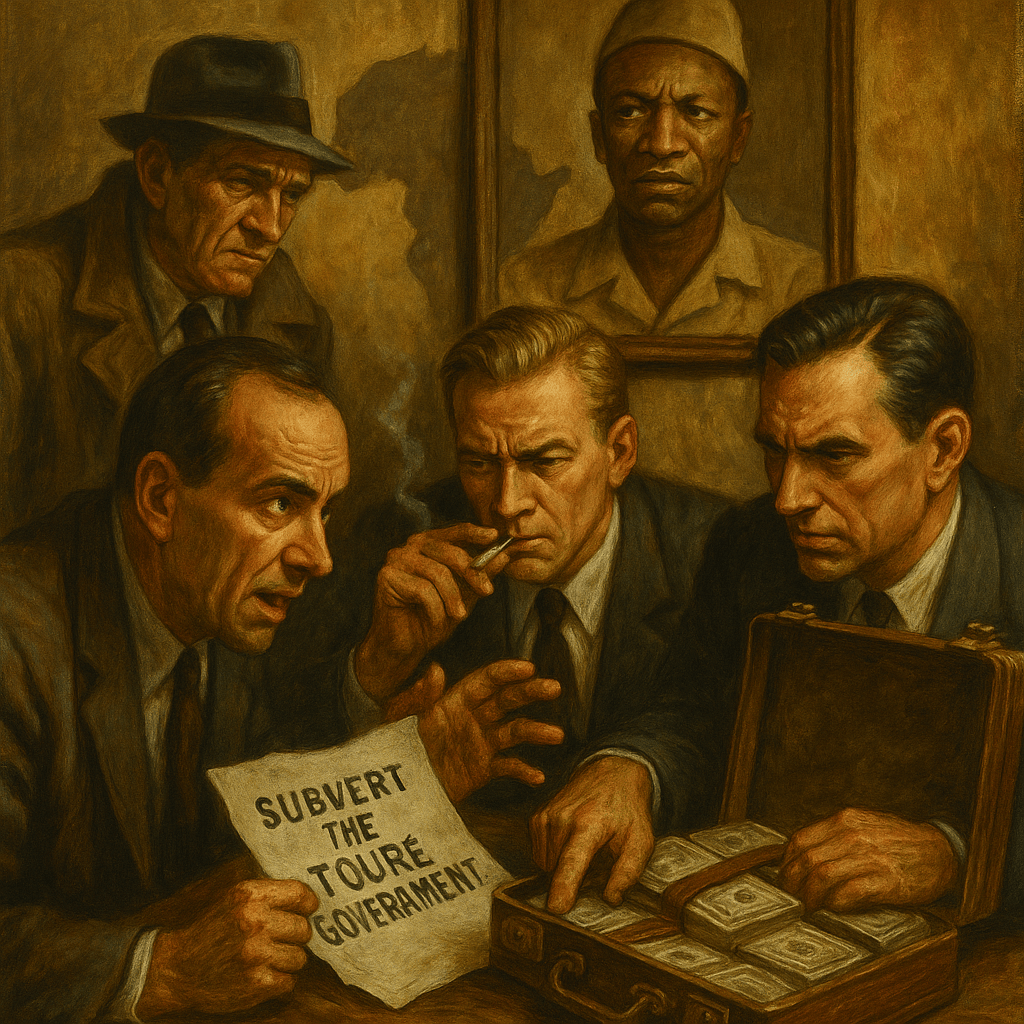
Operation Persil was that war. Launched in 1960 by French intelligence operatives under the SDECE, it wasn’t a war of open confrontation, but a covert war of economic sabotage and political destabilization. France knew it couldn’t openly re-colonize Guinea—but it could strangle it, humiliate it, and turn it into a cautionary tale for the rest of Africa. The goal was clear: punish Guinea so thoroughly that no other colony would dare follow its path.
This essay documents that war—not as a historical footnote, but as a vital case study in the operations of hyper-imperialism, economic warfare, and neocolonial counterinsurgency. It is a story that must be told not in the sterile language of academia, but in the voice of the colonized. Because Operation Persil didn’t just target a government—it targeted a people’s revolution.
Part I: Forging the Sabotage—The Birth of Operation Persil
Shortly after Guinea declared full independence, France launched Operation Persil under the direction of the SDECE. The plan had two primary components:
- Counterfeit currency operations: French operatives printed and distributed fake Guinean francs, intending to flood the economy with worthless paper. The objective was to destroy confidence in Guinea’s financial system, cause inflation, and incite unrest against the state.
- Arms smuggling and psychological warfare: Persil also included covert shipments of weapons to destabilize Guinea’s borders and fund internal opposition. One major arms shipment was intercepted in Senegal in May 1960, exposing the operation’s breadth and intent.
France’s response to independence was not just bitter—it was vindictive. As soon as Guinea rejected the “Community,” France pulled out overnight, stripping the country of every telephone line, blueprint, archive, and piece of machinery they could destroy or take. Operation Persil was the next logical step: a calculated attempt to sabotage Guinea’s new currency, paralyze its economy, and undermine its revolutionary leadership.
This was not an anomaly—it was the logic of colonialism defending its wounds. France couldn’t afford to let a small, poor, Black republic prove that dignity and sovereignty were possible without European permission. If Guinea succeeded, others would follow. Persil was meant to kill that hope in the cradle.
Part II: Currency Sabotage and Economic Warfare
At the heart of Operation Persil was one of the most insidious weapons of empire: money. The French intelligence services knew that Guinea’s break from the CFA franc zone was not just symbolic—it was structural. By issuing its own national currency, Guinea severed a key umbilical cord of French neocolonial control. Paris responded by counterfeiting the new Guinean francs and dumping them into circulation. This was not just fraud. It was economic terrorism.
The counterfeit bills were virtually indistinguishable from the real ones, except for a slight difference in serial number formatting. They were smuggled into Guinea through the borders with Ivory Coast and Senegal—two French-aligned states in West Africa—and distributed to sow chaos in markets, undermine trade, and destabilize state finances. The result was inflation, confusion, and an erosion of public confidence in the government’s ability to govern the economy.
But it was not only economic sabotage—it was psychological warfare. By corrupting the very currency that citizens used daily, France attacked the symbolic foundation of Guinea’s sovereignty. In a society where colonialism had robbed people of faith in their own institutions, this attack sought to make the people doubt their own revolution.
Sékou Touré and the PDG government responded swiftly and firmly. Public education campaigns were launched to help citizens distinguish between real and fake bills. Border control was tightened. And most importantly, the scandal was exposed internationally, embarrassing France and rallying solidarity from anti-imperialist governments abroad. Even Senegal, then under Léopold Sédar Senghor, lodged a complaint after intercepting a weapons shipment related to the operation—forcing France to scale back its more overt efforts.
Still, the damage had been done. Guinea’s economy, already fragile due to its severance from the colonial system, suffered real shocks. But the people did not capitulate. Instead, this attack deepened popular support for the revolution. The people understood that their poverty was not born from socialism—but from sabotage. And rather than turning against Touré, they closed ranks.
Operation Persil reveals what the imperialists fear most: not coups or armies, but currency. The right of an African nation to print its own money, set its own economic agenda, and refuse financial dependency is treated as a threat—not just by former colonial masters, but by the entire architecture of global capital. Guinea dared to print its own future—and was punished for it.
Part III: Arms, Subversion, and the Shadow State
Operation Persil didn’t stop at counterfeit money. France’s imperial network also sought to destabilize Guinea through armed infiltration and paramilitary subversion. Weapons were covertly funneled to anti-government forces, training camps were rumored to have been set up in neighboring French-aligned territories, and the goal was unmistakable: regime change by proxy.
One of the most infamous moments of this sabotage campaign occurred in May 1960, when Senegalese customs officials intercepted a shipment of arms—intended for distribution within Guinea. The incident made international headlines and confirmed that France’s intelligence services were actively supplying weaponry to counterrevolutionary cells. The Guinean state was forced to go on high alert, not just against foreign agents, but against the internal networks they activated: compradors, political opportunists, and even former colonial functionaries still embedded in the bureaucracy.
In response, Touré intensified national security measures. Armed militias were organized in rural areas, surveillance was expanded, and the revolutionary state began rooting out saboteurs from within. The Western press and liberal academics would later call this “authoritarianism,” but in reality, it was counter-counterinsurgency. It was the necessary consolidation of power by a state under siege.
France, for its part, continued to operate through plausible deniability. Officials denied any knowledge of Operation Persil. They dismissed Guinea’s accusations as paranoia. But declassified documents and post-colonial analyses have since confirmed what the people of Guinea already knew: their revolution was being hunted.
This wasn’t just a colonial hangover. It was a new form of warfare—what we now recognize as technofascist imperial subversion. It combined psychological operations, economic sabotage, and asymmetric militarism. And it wasn’t unique to Guinea. The same playbook would be deployed against Sankara in Burkina Faso, against Nkrumah in Ghana, against Lumumba in the Congo. Guinea was simply the first to be targeted, because it had been the first to stand up.
Part IV: Legacy of Resistance and Lessons for Today
Operation Persil was not just an act of sabotage—it was a blueprint. It revealed how imperial powers adapt in the face of anti-colonial resistance. When direct rule becomes untenable, they pivot to financial destabilization, psychological warfare, and covert aggression. But what it also revealed was the resilience of revolutionary Guinea and the enduring clarity of Sékou Touré’s leadership.
Touré understood that independence without sovereignty was a trap. That liberation without security was a dream deferred. He didn’t react to Operation Persil as a victim—he responded as a strategist. He hardened the state against subversion, strengthened ties with socialist allies, and deepened the ideological education of the people. He knew that Guinea could not survive through accommodation—it would have to survive through revolution.
Today, in an age of IMF structural adjustment, U.S.-backed coups, and Western-sponsored color revolutions, Operation Persil remains a vital lesson. It teaches us that empire does not retreat—it mutates. That freedom is not granted—it is seized and defended. And that the tools of liberation must evolve in the face of imperial innovation.
The legacy of Sékou Touré and the resistance to Operation Persil must not be remembered as a footnote, but as a case study in revolutionary struggle. Guinea did not fall. It endured. And in doing so, it lit the path for others.
Let the memory of Operation Persil serve not just as a warning—but as a map. A map of the enemy’s playbook. And a reminder that the price of sovereignty is eternal vigilance, mass organization, and revolutionary courage.
 Weaponized Information
Leave a comment