By Prince Kapone | Weaponized Information | April 24, 2025
“They said development was impossible without debt. We said: watch us.”
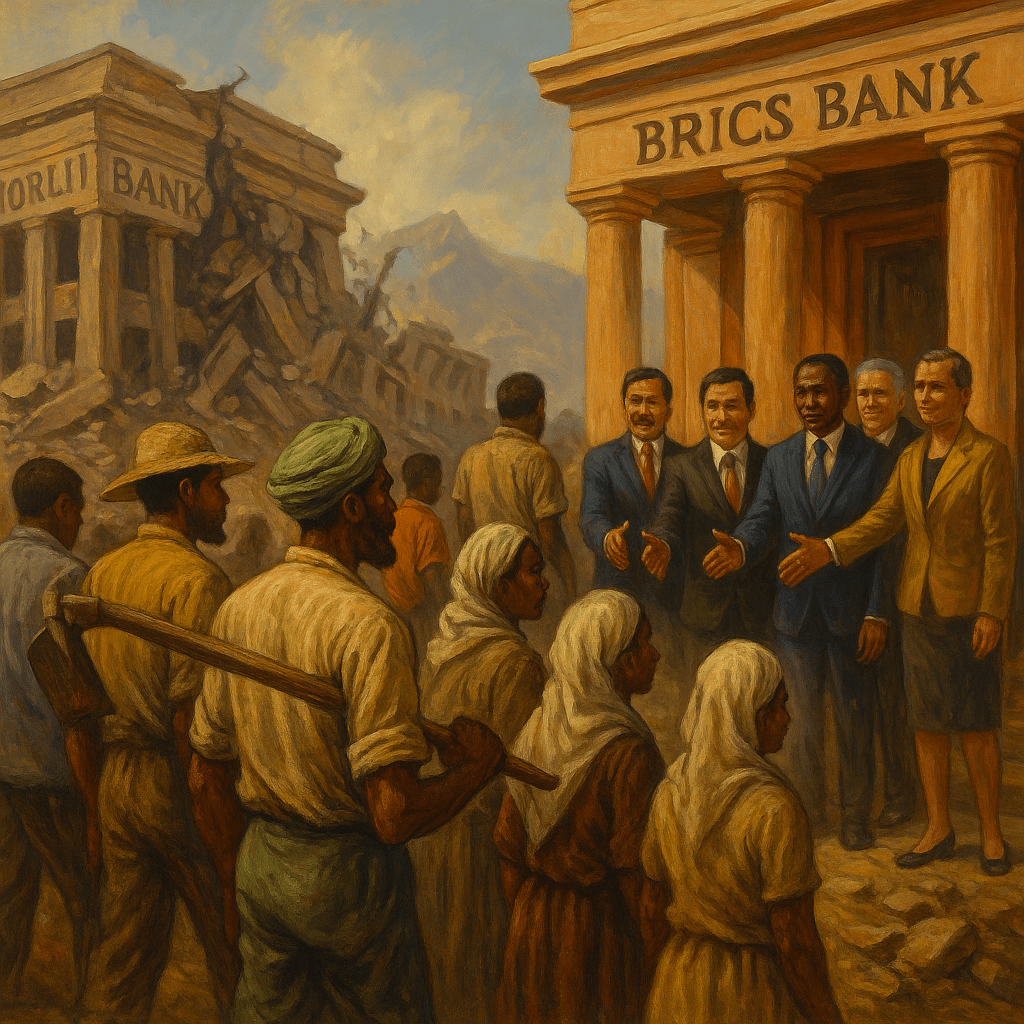
Ethiopia is now set to become the fourth African member of the BRICS New Development Bank. While this might sound like bureaucratic news to some, it marks a potentially historic rupture in the architecture of global finance. Because for over 80 years, the rules of development have been written by two institutions: the IMF and the World Bank—colonial creditors dressed in multilateral drag. Today, Ethiopia is pushing open a door that generations of African revolutionaries fought to unlock.
I. From Bretton Woods to BRICS: A Seismic Reorientation
Let’s call it what it is: the IMF and World Bank were always weapons of empire. Born from the ashes of World War II, they were designed to rebuild Europe, discipline the Third World, and secure U.S. economic hegemony. Africa’s so-called “development” under these institutions translated into raw debt, privatization, structural adjustment, and endless austerity. The World Bank didn’t build Africa—it looted it, then sent invoices for the damage.
But BRICS represents something different. It’s not anti-capitalist, but it *is* anti-colonial in form. And for African nations, that form matters. With China, Russia, Brazil, India, and South Africa at the core, the BRICS New Development Bank offers loans without the structural adjustment death sentences. That’s not liberation—but it is breathing room. And Ethiopia, with its deep history of anti-colonial resistance, is once again positioning itself at the front of Africa’s global reorientation.
II. Ethiopia’s Defiance and the Legacy of Independence
Ethiopia is not just another African state—it is a symbol. The only African nation never fully colonized, it defeated Italy at Adwa, and inspired generations of Pan-Africanists from Haile Selassie to Kwame Nkrumah. In joining BRICS, Ethiopia invokes this legacy—not in nostalgia, but as a strategic maneuver. It is asserting sovereignty over its development trajectory, something the West has long denied African states through debt-trap diplomacy and NGO imperialism.
This isn’t idealism—it’s realism. With famine, conflict, and reconstruction underway, Ethiopia needs capital. But it also needs dignity. And dignity will never be found begging the IMF for scraps while selling off public assets to foreign consultants.
III. The Empire’s Financial Infrastructure is Crumbling
This move terrifies Washington and Brussels—not because it ends the IMF, but because it signals the beginning of the end. If African states begin to choose alternatives—BRICS, Belt and Road, or regional monetary funds—the West loses the whip hand of conditionality. It can no longer dictate policy through the backdoor of debt. It can no longer use the World Bank to privatize land, water, or energy. And it can no longer claim that neoliberalism is the only path forward.
What we’re seeing is the slow fragmentation of the Bretton Woods consensus—a consensus never made with the consent of the colonized. Ethiopia isn’t rejecting development. It’s rejecting dependency.
IV. Beyond BRICS: The Struggle Continues
Let’s be clear: BRICS is not revolutionary. It is not socialist. It is not free of contradictions. China has its own imperial tendencies. Russia is driven by multipolar strategy, not solidarity. But for African states drowning in Western debt traps, BRICS is not the destination—it is a detour away from disaster. It creates openings, space, and leverage. And in a world where financial sovereignty is survival, even small openings can lead to great ruptures.
What happens next depends not on BRICS, but on the movements on the ground: unions, youth, farmers, urban poor. They must seize the breathing space BRICS offers and fight to ensure development doesn’t mean extraction by new bosses, but reconstruction on their own terms.
V. A Crack in the Wall
When Ethiopia walks through the doors of the BRICS bank, it won’t be alone. Behind it are the ghosts of Nkrumah, Sankara, Lumumba—and the millions who were told they must starve to earn a line of credit. Now the tables are turning. Slowly. Unevenly. But unmistakably.
The West built the debt. Africa is building the alternative. And Ethiopia, as it has before, is walking toward the fire with its head high and its eyes fixed on freedom.
By any means necessary. By any bank necessary.
 Weaponized Information
Leave a comment