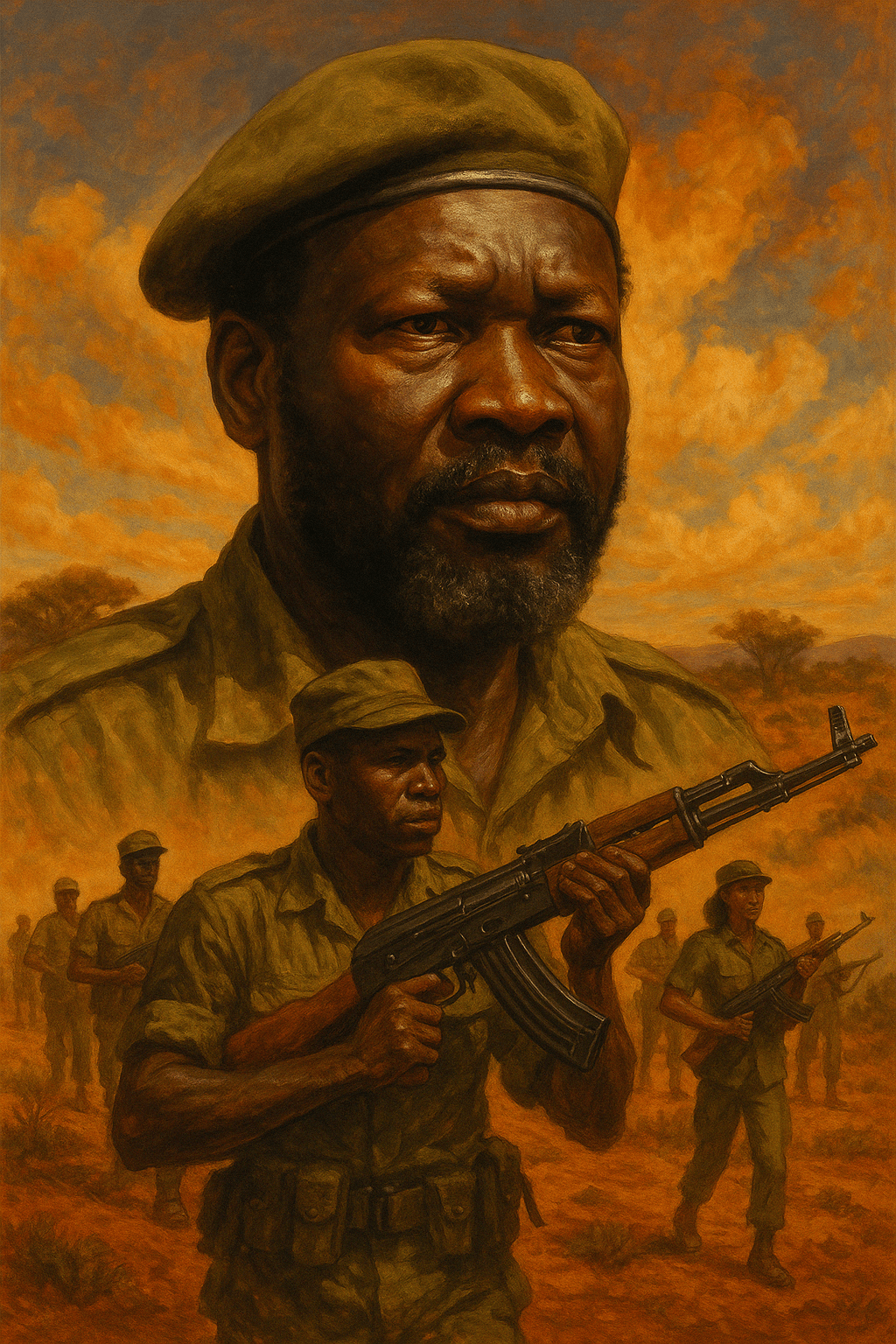
“There is no contradiction between the bullet and the ballot when the people are fighting for their lives.”
— Dr. John Garang
The Rebel Who Refused to Be Divided
John Garang was not the West’s ideal African leader. He was too educated, too disciplined, too pan-African. A Ph.D. from Iowa State University and a battlefield general in Sudan’s longest civil war. A man who understood that the struggle was not just between north and south, Arab and African, Christian and Muslim—but between the people and the state. Between imperialism and self-determination. Between comprador elites and revolutionary unity.
He walked the line between guerrilla commander and head of state, economist and liberation theorist. And in a world hellbent on carving Africa into fragments, Dr. Garang dared to dream of a united, democratic, and socialist Sudan—a New Sudan built not on revenge, but revolution.
Part I: From Scholar to Soldier — The Making of a Revolutionary
John Garang was born in 1945 into the exploited southern region of Anglo-Egyptian Sudan, under the colonial boot of Britain. He was orphaned at ten. But unlike so many children of empire, Garang’s fire wasn’t extinguished—it was lit. He earned a scholarship to study in Tanzania, then Grinnell College in the U.S., and eventually earned a Ph.D. in agricultural economics from Iowa State.
But Garang didn’t stay in academia. He returned to a Sudan where the spoils of independence had been monopolized by the Arabized elite in the north, while the south remained colonized in all but name.
Garang joined the Anya-Nya guerrilla movement but soon realized it lacked a clear political vision. So when the second Sudanese civil war erupted in 1983, he helped found the Sudan People’s Liberation Army (SPLA)—and this time, he had a plan.
Garang rejected secession as a solution. He saw the problem as deeper than geography—it was systemic. Neocolonialism, underdevelopment, ethnic division, and class stratification were ripping Sudan apart. His answer: a “New Sudan,” united under a secular, pluralistic, socialist banner.
Part II: The New Sudan—Revolutionary Unity Against Imperial Fragmentation
Garang’s SPLA was more than just a rebel army. It was a political movement with a vision for transformation. At the heart of Garang’s ideology was a commitment to pan-Sudanese liberation. He refused the binary of “north vs. south” and instead diagnosed the root contradictions: land theft, underdevelopment, state violence, and comprador corruption—contradictions enforced by both local elites and global imperialism.
The SPLA sought to dismantle not just Khartoum’s Arabized oligarchy, but the entire neocolonial structure imposed by global capital. Garang argued that any real liberation had to unite Sudanese workers and peasants—north and south, Christian and Muslim, Dinka and Nuer—against their common enemy: imperialist-backed dictatorship.
This vision put him at odds with both Washington and Khartoum. While the West flirted with SPLA support, they never trusted Garang’s anti-imperialist tone or pan-African leanings. He refused to be a puppet. He wanted power to return to the people.
Garang’s strategy wasn’t just military. He built schools in liberated zones. Developed peasant cooperatives. Initiated political education. Recruited women fighters. And despite internal contradictions and factional disputes, he remained ideologically grounded.
He didn’t want to split Sudan—he wanted to rebuild it.
Part III: Death, Division, and the Weaponization of Ethnicity
On July 30, 2005, just weeks after being sworn in as First Vice President of Sudan as part of the Comprehensive Peace Agreement, John Garang died in a helicopter crash. The official story called it an accident. But many, especially in the Global South, saw something more sinister.
His death shattered the fragile coalition holding the New Sudan vision together. The SPLA split. Secessionist voices gained ground. And by 2011, South Sudan declared independence—marking the creation of Africa’s newest state, but not its freest.
Without Garang’s unifying vision, South Sudan descended into civil war, ethnic conflict, and IMF-structured underdevelopment. Western-backed NGOs poured in, not to build socialism, but to pacify resistance and extract resources. The dream of New Sudan became a textbook case of imperial fragmentation.
But Garang’s legacy didn’t die in that crash.
His writings, speeches, and strategies still speak to the central contradiction facing all of Africa: how to build unity in the face of colonial borders, comprador elites, and foreign control.
The Unfinished Dream of the New Sudan
John Garang was not a nationalist in the narrow sense. He was a revolutionary internationalist who understood the dialectic of national liberation and socialism. He saw that the empire’s greatest weapon wasn’t just its armies or its aid—but its ability to divide, to pit brother against brother, tribe against tribe, region against region.
He saw Sudan as a battlefield not just of geography, but of ideology. And he waged that battle with the mind of an economist and the heart of a revolutionary.
In the age of technofascism and hyper-imperialism, when borders are militarized and sovereignty is sold to the highest bidder, we need Garang’s clarity more than ever. Because the New Sudan was never just about Sudan. It was a model for the whole continent—and a warning for the world.
John Garang didn’t fight for a flag or a bag. He fought for a future. A people’s future. And that fight is far from over.
 Weaponized Information
Leave a comment