By Prince Kapone | Weaponized Information | April 24, 2025
“You can’t reroute an empire that’s already off the map.”
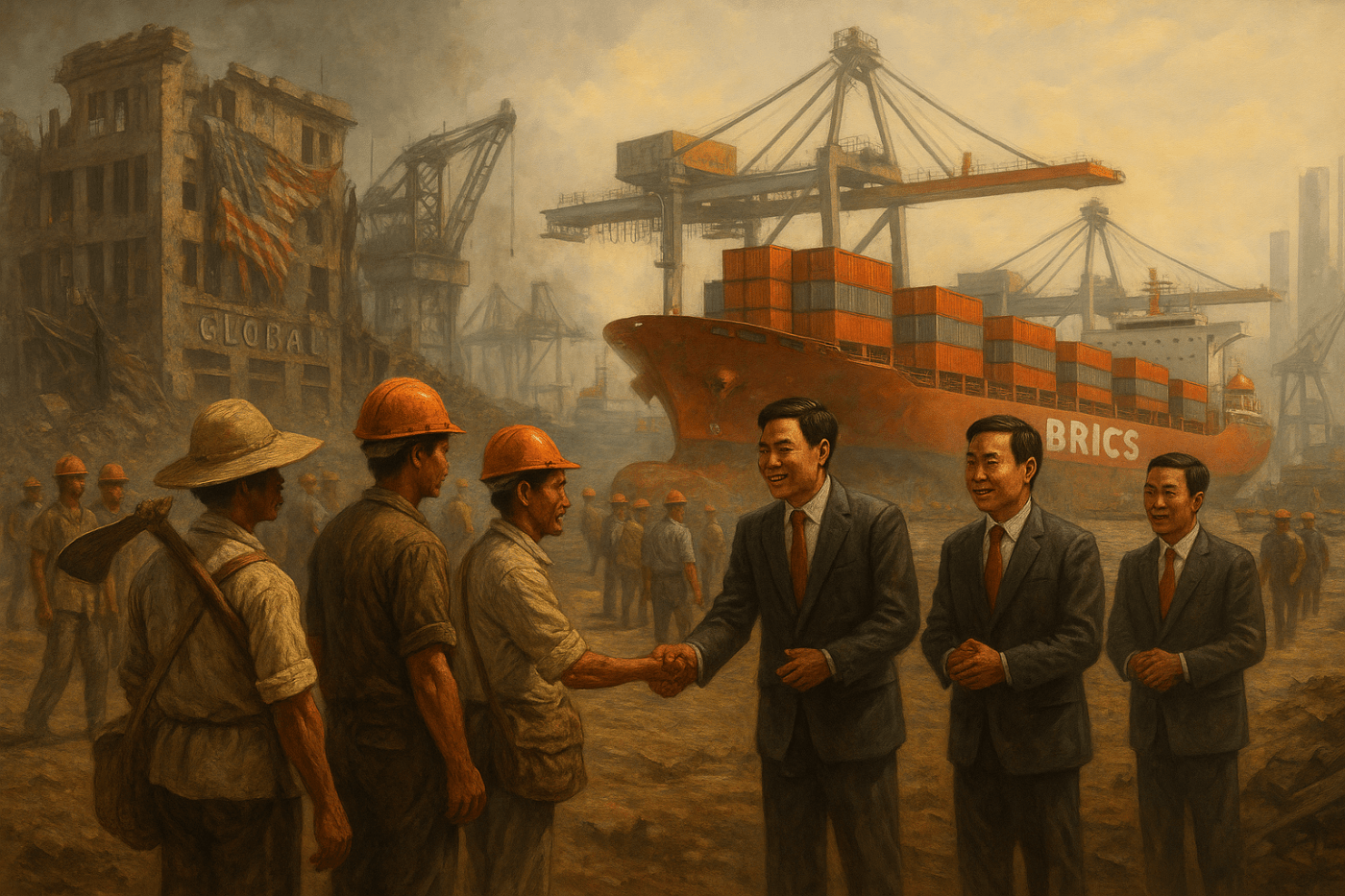
According to Bloomberg, China’s growing investments in Southeast Asia are now actively derailing Washington’s grand supply chain reengineering strategy. In other words, the plan to ‘decouple’ from China is turning into an imperial auto-strangulation. Because while the U.S. talks about strategic relocation, China is busy owning the new terrain. The empire wanted to move the chain. China just bought the factory, built the port, paved the road, and lent the money.
I. Washington’s “Decoupling” Delusion
From Trump to Biden to Trump 2.0, U.S. planners believed they could reroute global production away from China without rerouting capital itself. The idea was to move factories to places like Vietnam, Malaysia, Indonesia—countries still in the imperial sphere of influence but outside the red line of Beijing. But the flaw was obvious to anyone not trapped inside a Beltway echo chamber: capital follows infrastructure, not ideology.
And infrastructure in Southeast Asia increasingly speaks Mandarin. Chinese state banks, developers, engineers, and telecoms are embedded deep within these economies. U.S. corporations want low-cost labor—but they need ports, power grids, and broadband. China controls all three.
II. China’s Strategy: Not Isolation, but Integration
China didn’t respond to U.S. decoupling with panic. It responded with precision. Through the Belt and Road Initiative (BRI), AIIB loans, and private-public partnerships, it has made itself indispensable to the very economies the U.S. hoped to use against it. This isn’t just investment—it’s integration. And integration beats extraction every time.
Vietnam might host an American factory, but that factory runs on Chinese cement, Chinese routers, and Chinese financing. That’s not decoupling. That’s re-coding the system. The empire still holds the plug, but the power flows through Beijing.
III. What This Means for Technofascism and Hyper-Imperialism
This collapse of supply chain strategy isn’t just a logistical failure—it’s a strategic and ideological one. The U.S. empire is trying to reassert control over global labor flows while tightening digital surveillance and militarizing finance. This is the essence of technofascism: total control without total cost. But China’s moves in Southeast Asia prove that control is slipping.
Meanwhile, U.S. hyper-imperialism—its attempt to weaponize everything from the dollar to TikTok—has hit a wall. China’s ability to bend global infrastructure to its advantage is undermining the whole premise of decoupling. You can’t isolate a rival who’s already embedded in the motherboard.
IV. The Road Ahead: Realignment, Not Retreat
This isn’t a Chinese victory lap. The contradictions inside BRICS and BRI remain sharp. But it is a reality check. The U.S. cannot decouple from the system it no longer fully controls. Southeast Asia, long treated as a staging ground for imperial war and sweatshop economics, is becoming a battleground of strategic sovereignty. And China is winning—not with bombs or bases, but with bridges and broadband.
In this world-historic shift, the U.S. looks less like the architect of the future and more like an aging landlord evicting tenants from a building it no longer owns.
The chain isn’t breaking. It’s changing hands.
 Weaponized Information
Leave a comment