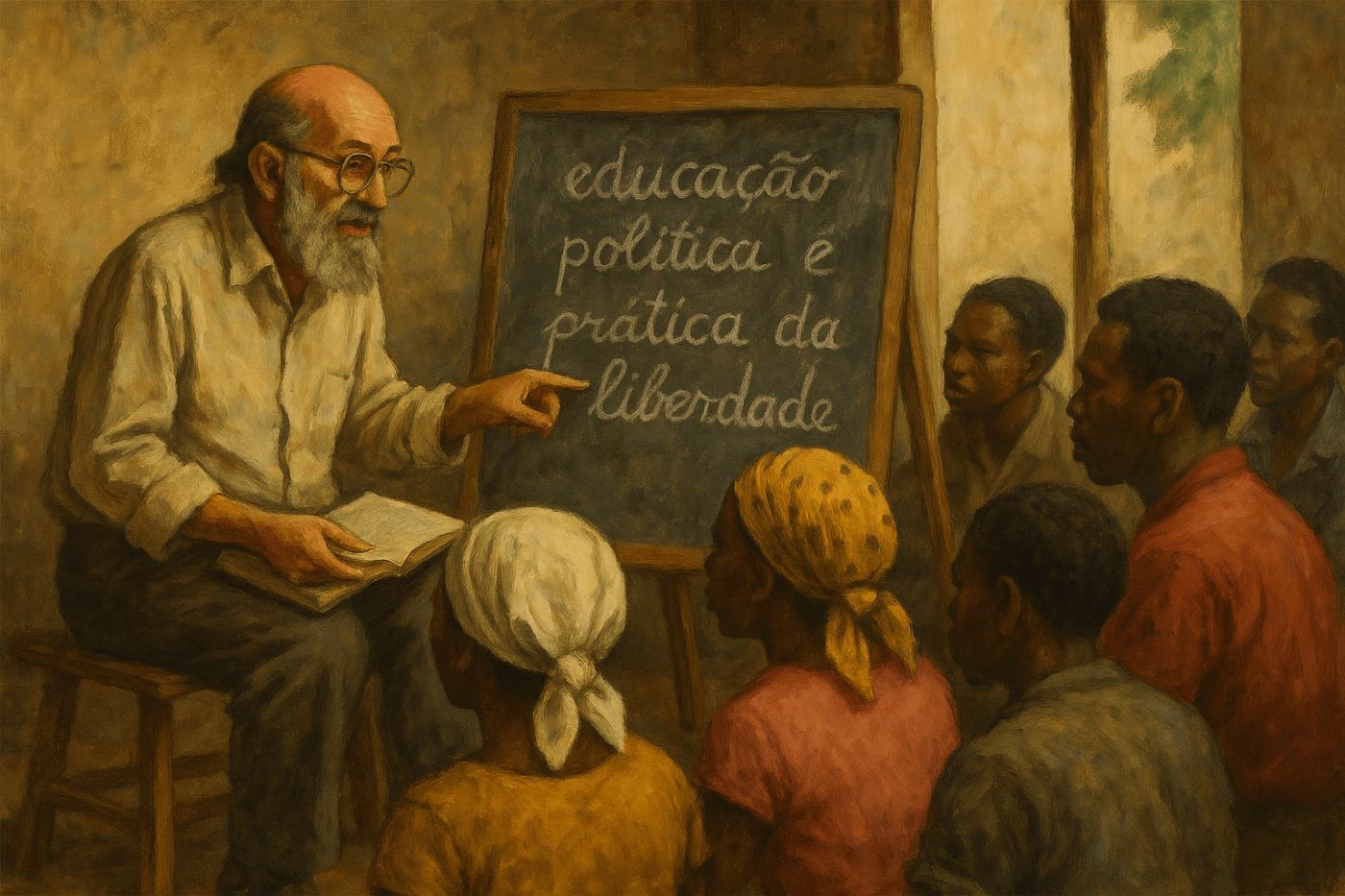
Education as Liberation or Domestication
Paulo Freire is often cited, rarely read, and even more rarely understood. Stripped of his radicalism by liberal educators and neoliberal institutions, he has been sanitized into a harmless champion of “critical thinking.” But Freire was no liberal. He was a revolutionary—an insurgent thinker who understood that education is never neutral. It either domesticates or liberates.
Born in Brazil under oligarchy and dictatorship, Freire saw firsthand how poverty was reproduced by systems of schooling that treated the poor as empty vessels to be filled with ruling-class ideology. Against this, he posed a revolutionary alternative: education rooted in dialogue, consciousness, and collective struggle.
Pedagogy of the Oppressed was not an academic text. It was a manual for insurgency—a tool for the colonized, the poor, the marginalized to name their world and transform it through praxis. Freire insisted that the oppressed are not passive. They are agents of history. But they must first unlearn the internalized logic of domination.
Freire rejected the “banking model” of education, where teachers deposit knowledge into students as if they were ATMs. He called for co-intentional education—where teacher and student learn from one another, investigate the world together, and prepare to transform it through collective action.
Freire was no liberal. He was a revolutionary strategist in the war for human dignity—and his classroom was a training ground for struggle.
Part I: Literacy, Consciousness, and the Seeds of Radical Pedagogy
Freire’s project began in the slums and sugarcane plantations of northeastern Brazil. There, he worked with adult peasants and workers who had been denied formal education by a colonial-capitalist system that feared their awakening. Teaching literacy was not about spelling or grammar—it was about power.
Freire understood that to read the word, one must first read the world. His pedagogy was rooted in dialogue—not as charity, but as a method of uncovering the lived reality of the oppressed. Each word taught was tied to a real condition: hunger, work, land, struggle. Education became an act of naming, of analyzing, of breaking the silence imposed by domination.
Through generative themes drawn from daily life, Freire helped students discover the structures that shaped their oppression. But knowledge was never the endpoint. Action was. He called this praxis: the unity of reflection and transformation. The goal was not to integrate the oppressed into a dying system, but to help them dismantle and rebuild it.
This was why Freire was jailed by the Brazilian dictatorship in 1964 and forced into exile. His work threatened the ruling order. Because he did not teach obedience. He taught insurrection.
Freire’s literacy campaigns were revolutionary not just because they taught people to read—but because they taught people to recognize themselves as subjects of history.
Part II: Dialogue, Power, and the Politics of Naming
For Paulo Freire, dialogue was not a conversation. It was an act of liberation.
Unlike the paternalistic charity of liberal education—where the “educated” speak and the poor listen—Freire insisted that education must be a mutual process of discovery. Dialogue, for him, was the space where oppressed people investigate their reality, name their condition, and develop the collective capacity to change it.
To name the world, Freire said, is the first act of freedom. Colonialism and capitalism impose silence—not just through censorship, but by denying people the vocabulary to understand their own oppression. Freire’s pedagogy offered the tools to break that silence—not through rote memorization, but through shared struggle for clarity.
The teacher was not a master but a co-learner. The student was not a vessel but a protagonist. Together, they practiced conscientização—the development of critical consciousness. Not simply an awareness of injustice, but a strategic grasp of how power operates and how it might be contested.
Freire understood that this process was dangerous. That is why ruling classes invest so heavily in “schooling”—not to empower the poor, but to train them to accept domination as natural. Freire’s pedagogy did the opposite. It taught people to speak the unspeakable: that poverty is not fate, that oppression is not divine, that revolution is not impossible.
Freire’s dialogue was not gentle reform—it was armed clarity. And that is why those in power feared it.
Part III: Exile, Revolution, and the Mozambican Connection
When Brazil’s military dictatorship exiled Paulo Freire in 1964, they believed they had neutralized a threat. But Freire’s pedagogy could not be confined to national borders. In exile, his work became more global, more radical, and more tightly woven into the fabric of anti-imperialist struggle.
He spent time in Chile, advising on agrarian reform and working with the Christian Left. Later, at the World Council of Churches in Geneva, he used his position not to retreat into abstraction, but to support revolutionary movements across the Global South. Freire was not content to theorize liberation—he embedded himself in the processes that made it real.
It was in Africa, however, that Freire’s ideas met one of their most powerful expressions: the national liberation struggle in Mozambique.
Freire worked closely with FRELIMO—the Mozambique Liberation Front—not only to develop postcolonial literacy campaigns, but to integrate his philosophy into their war of independence against Portuguese colonialism. Samora Machel, the future leader of liberated Mozambique, embraced Freire’s method as essential to building not just a new nation, but a new people.
In the liberated zones controlled by FRELIMO, literacy was a weapon. Political education was a frontline of the struggle. Children and adults alike studied not only to read, but to understand their role in the revolutionary process. Schools were not places of indoctrination, but of formation—where dialogue, work, and theory fused.
This pedagogical model would ripple through Southern Africa and beyond, influencing liberation movements in Angola, Guinea-Bissau, and South Africa.
Freire’s praxis was not limited to the classroom—it marched alongside rifles and farming tools. In Mozambique, his vision of education as transformation became an arm of people’s war.
Part IV: Legacy, Betrayal, and the Continuing Struggle to Learn and Unlearn
Paulo Freire died in 1997, but long before that, he had already been canonized—and betrayed.
In the neoliberal world of NGO-led “development,” Freire’s name is often invoked, but rarely honored. His revolutionary pedagogy has been diluted into buzzwords—“dialogue,” “empowerment,” “participation”—divorced from their militant origins. The radical edge of Pedagogy of the Oppressed has been sanded down to fit into professional development workshops, non-profit missions, and grant-funded programs designed to pacify rather than liberate.
But Freire’s true legacy cannot be institutionalized. It lives in the insurgent classrooms of landless peasants in Brazil. In the literacy collectives of decolonizing Indigenous nations. In the study groups of radical youth preparing to confront empire. In every space where learning is not compliance but rebellion.
Freire taught that education is never neutral. It either reproduces the world as it is—or transforms it. That remains true today. And the choice is even starker.
We live in a time of planetary crisis, rising fascism, and ideological warfare. The tools of schooling—standardized testing, surveillance, patriotic curricula—are being weaponized to crush critical thought. Meanwhile, universities sell “diversity” while preserving class privilege. And technocrats promote “critical thinking” stripped of any critique of capitalism or colonialism.
That is why Freire still matters.
He reminds us that education must be wedded to struggle. That those who teach must first learn from the people. That liberation is not a syllabus—it is a process of naming, reclaiming, and transforming the world.
Freire was no liberal. He was a revolutionary pedagogue whose classroom extended from the sugarcane fields to the trenches of armed struggle. And the fight to learn and unlearn—to read the world and rewrite it—remains a battlefield today.
 Weaponized Information
Leave a comment