By Prince Kapone, Weaponized Information
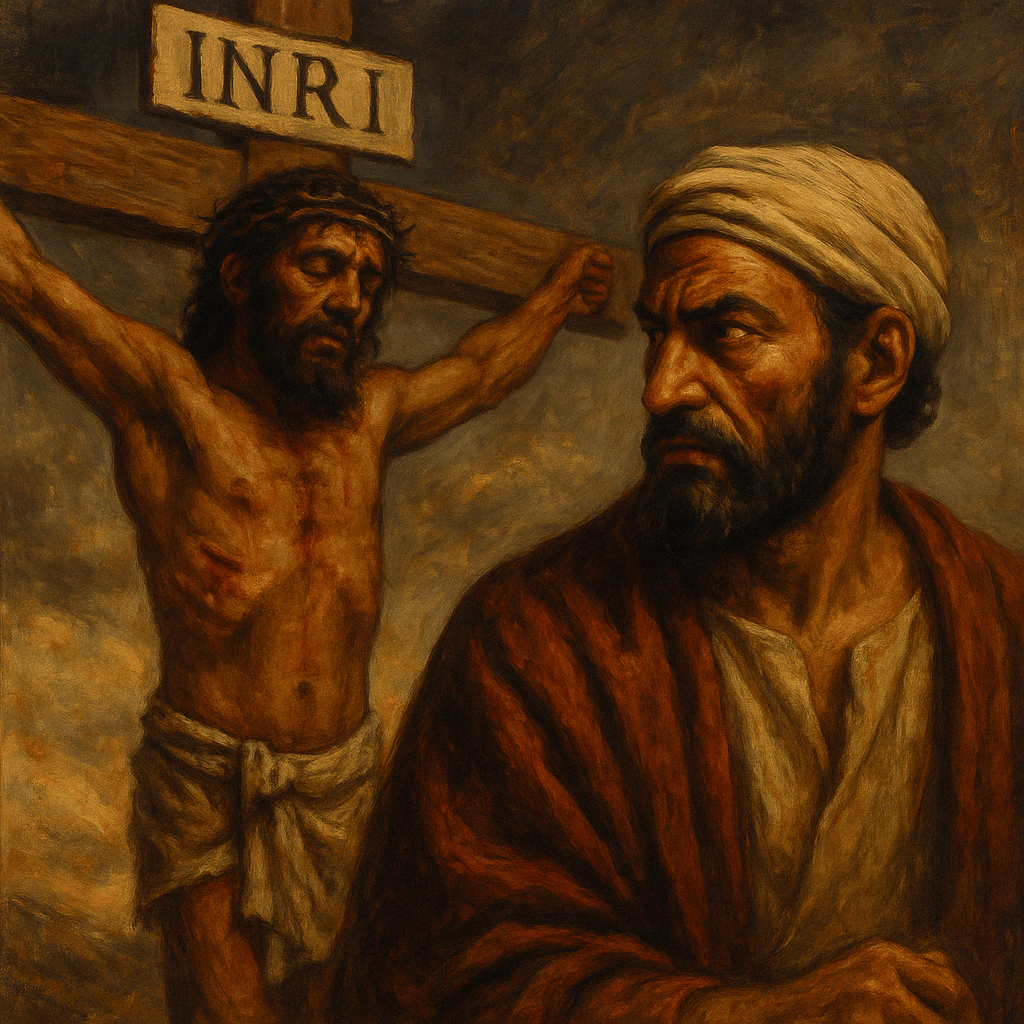
After Jesus was executed by the Roman state—publicly, politically, and with the full complicity of religious collaborators—the movement didn’t die. It regrouped. It reorganized. It survived underground, led by those who knew Jesus not as a metaphor or a mystical force, but as a man. A teacher. A revolutionary. His brother, James the Just, and the outspoken apostle Peter were the ones chosen to carry the torch. Not chosen by councils or clergy, but by history, by proximity, by trust earned on the ground.
Then comes Saul of Tarsus—a Pharisee by religious training, a Roman citizen by birth, and a man whose first known role in the story of Christianity was that of an enforcer. A persecutor. A man who worked hand-in-hand with Roman authority to hunt, arrest, and murder the first followers of Jesus. That’s not opinion—that’s in the Book of Acts. Saul was present when Stephen, the first Christian martyr, was stoned to death. He held the coats of the executioners.
And yet this man claims, one day, to have seen Jesus—not in the flesh, not among the people, not on the streets of Jerusalem—but alone, on the road to Damascus. No witnesses. No confirmation. No context. And with that unverifiable vision, he renames himself Paul and declares himself the next apostle.
When Paul finally makes his way to Jerusalem to introduce himself to the leadership—James, Peter, and the others—he doesn’t come humbly. He comes with a new program. He claims that the gospel should no longer be rooted in Jewish tradition or law. He wants to take it to the gentiles, to repackage it in language palatable to the Romanized world.
But the Jerusalem Church didn’t hand him the keys. They were skeptical. They had every reason to be. This man hadn’t known Jesus, hadn’t been part of the community, hadn’t bled with them in the struggle—and yet he came talking like he knew the mission better than the people who had built it.
So Paul leaves Jerusalem. He heads west—to the cities of the Aegean basin, where Greek language, Roman law, and Hellenistic philosophy dominate. There, he begins building his own network of converts—congregations of gentiles unfamiliar with the history, the culture, or the material stakes of Jesus’s movement. And what he teaches them bears little resemblance to the gospel of Jesus.
Gone is the emphasis on communal living, debt forgiveness, solidarity with the poor, and obedience to the law. In its place is a gospel of faith alone—a theological sleight of hand that makes salvation a matter of belief, not action.
Paul writes prolifically. His letters are filled with Stoic hierarchy, Platonic dualism, and a deep disdain for the body. Slaves, obey your masters. Women, submit to your husbands. Citizens, honor the authorities, for all power comes from God. (Romans 13.) This isn’t the Jesus who flipped tables. This is empire with a halo.
Years pass, and Paul builds his own orbit. But something’s missing: legitimacy. So he organizes a return to Jerusalem, carrying with him a caravan of wealth—donations collected from his gentile congregations. He frames it as charity. But let’s be honest: this wasn’t charity—it was tribute.
And how do James and the elders receive him? Cautiously. They don’t throw him a banquet. They tell him to go to the Temple and perform a purification ritual. It’s a test. Because rumors have reached Jerusalem that Paul’s been teaching people to forsake the Law of Moses. And those rumors aren’t wrong.
So Paul enters the Temple, accompanied by gentiles. A riot erupts. He’s accused of defiling sacred space. He’s arrested. But unlike James, who will soon be stoned to death, and unlike Peter, who will be executed, Paul doesn’t face torture or execution. He invokes his Roman citizenship. And with that magic phrase, the whole story shifts.
He is not tried by the Sanhedrin. He is escorted—under imperial guard—to Caesarea. Then to Rome. Where he is placed under house arrest and permitted to write letters, host visitors, and continue spreading his doctrine. While the original movement is scattered, repressed, and annihilated, Paul is scripting the future.
Tradition says he was eventually martyred. Beheaded by Nero. But there’s no historical record to confirm that. What we do know is that the letters he wrote—disconnected from Jesus’s teachings, soaked in imperial logic—became the backbone of the New Testament.
Three centuries later, Constantine would use those same letters to forge an imperial religion. The Council of Nicaea canonized Paul’s gospel, not James’s. The Epistles made the cut. The Gospel of the Hebrews? Lost. The Gospel of the Nazarenes? Heresy. The Ebionites were condemned and erased.
So what are we left with? A religion that teaches obedience, not resistance. Spiritual reward, not material justice. A gospel that preaches peace while blessing war. This is not what Jesus taught. It is what Paul institutionalized.
Today, when we speak of Christianity, we are not speaking of the gospel of the oppressed—we are speaking of Caesar’s Christianity. Built not on the rock of Peter or James, but on the letters of a Roman citizen who never met Jesus, who never fought for the poor, and who helped bury the revolution in robes, rituals, and Rome.
Bibliography & Sources
- Eisenman, Robert. James the Brother of Jesus.
- Maccoby, Hyam. The Mythmaker: Paul and the Invention of Christianity.
- Horsley, Richard A. Paul and Empire: Religion and Power in Roman Imperial Society.
- Fredriksen, Paula. Paul: The Pagan’s Apostle.
- Tabor, James D. Paul and Jesus: How the Apostle Transformed Christianity.
- Pagels, Elaine. The Gnostic Gospels.
- Ehrman, Bart D. Lost Christianities: The Battles for Scripture and the Faiths We Never Knew.
- The New Testament (Acts, Epistles, Romans 13).
- Josephus, Antiquities of the Jews, Book 20.
- Epiphanius of Salamis, Panarion (on the Ebionites and Nazarenes).
- Eusebius of Caesarea, Ecclesiastical History.
 Weaponized Information
Leave a comment