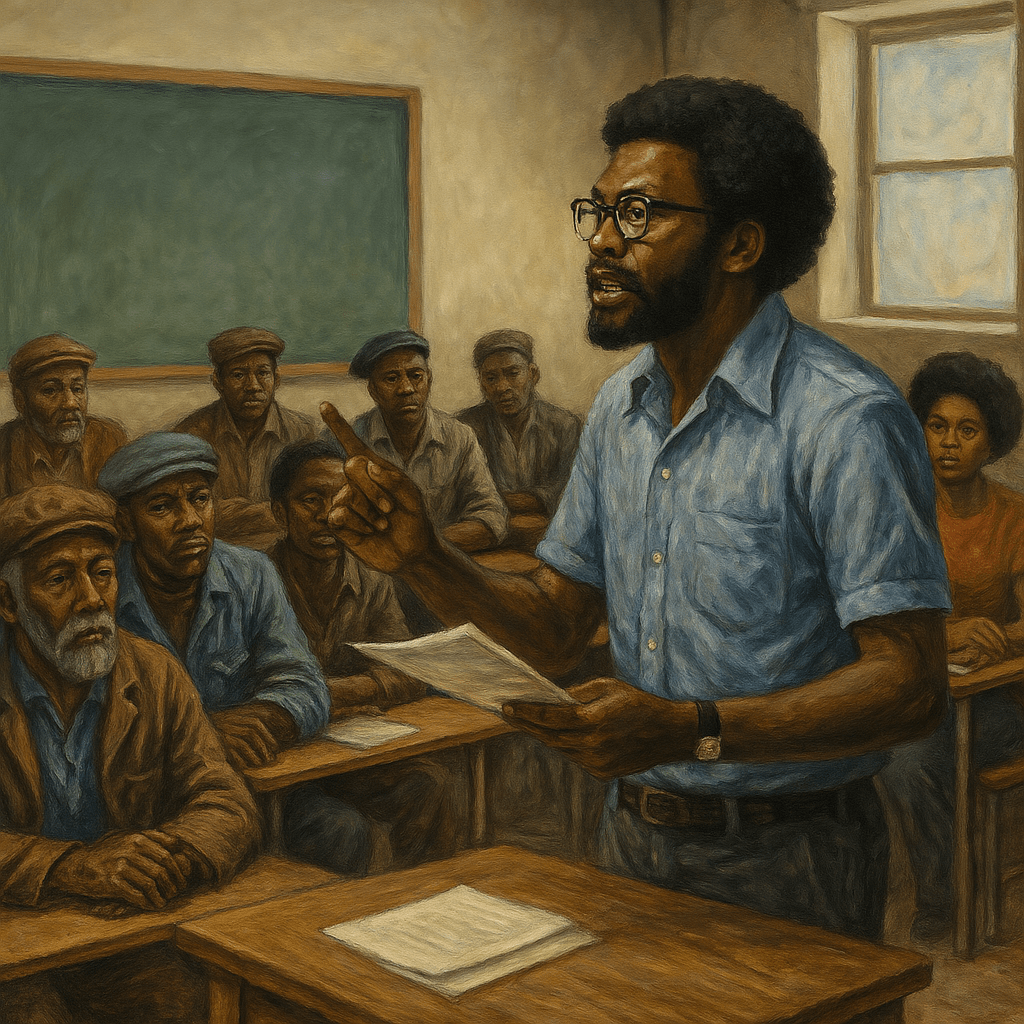
When Study Becomes a Weapon
Walter Rodney was not a university intellectual. He was a guerrilla scholar. A revolutionary historian. A Black radical who understood that knowledge—real knowledge—is a tool of class struggle.
From the lecture hall to the sugarcane field, Rodney refused to separate theory from practice. His work was not designed for tenure, but for transformation. His mission was not to impress fellow academics, but to arm the masses.
With How Europe Underdeveloped Africa, Rodney shattered the colonial lie that Africa’s poverty was a product of its own failures. He traced the systematic theft of wealth, labor, and life from the continent to the heart of European capitalist expansion. His analysis was not abstract—it was materialist, historical, and rooted in the lived experience of the colonized.
He studied empire not to explain it, but to expose it. Not to describe it, but to destroy it.
Rodney’s politics took him from Guyana to Tanzania, from Black Power organizing in Jamaica to Pan-African study groups in Dar es Salaam. He challenged puppet regimes and neocolonial collaborators with the same clarity he brought to his critiques of imperialism.
For this, he was banned, exiled, and eventually assassinated in 1980 by a U.S.-backed authoritarian regime in Guyana. But his work lives on—in classrooms, in people’s movements, in every act of liberation where study is linked to struggle.
Walter Rodney was no academic. He was a guerrilla in the war for human dignity, and his weapon was truth.
Part I: From Groundings to Global Struggle
Walter Rodney came of age in the Caribbean during a time of political ferment and Black awakening. A brilliant student, he earned his doctorate at the University of London, where he studied African history—not as a detached observer, but as a committed partisan of the colonized. His PhD on the slave trade in the Upper Guinea Coast was not written to decorate a CV—it was part of a larger commitment to expose the roots of racial capitalism.
But Rodney did not retreat into the ivory tower. He returned to Jamaica, where his “groundings”—informal political education sessions with Rastafarians, workers, and students—became legendary. He brought Marxist theory to the streets. He listened. He taught. He walked with the people.
It was for this that he was deemed dangerous. In 1968, the Jamaican government banned Rodney from returning after a trip to a Black Power conference in Canada. His deportation sparked the infamous “Rodney Riots”—a mass uprising led by students and the working class. It was the moment Rodney ceased to be an academic and became a revolutionary symbol.
Rodney would go on to teach at the University of Dar es Salaam in Tanzania, a hub for Pan-Africanism and anti-colonial thought. There, he joined a generation of African and Caribbean revolutionaries shaping new socialist visions rooted in their own histories and struggles. His work became sharper, more militant, more connected to the pulse of global resistance.
Rodney’s life was a bridge—from study to struggle, from campus to community, from intellectual labor to revolutionary action.
Part II: How Europe Underdeveloped Africa — A Weapon Against Empire
In 1972, Walter Rodney published the book that would make him immortal. How Europe Underdeveloped Africa was not just a scholarly achievement—it was a revolutionary intervention. It demolished the colonial myth that Africa’s poverty was self-inflicted. Instead, Rodney exposed how centuries of enslavement, extraction, and imperial domination systematically drained Africa of its wealth, labor, and future.
But this was no lament. It was an indictment—and a call to arms.
Rodney used Marxist political economy not as dogma, but as a scalpel. He dissected how colonial capitalism didn’t just exploit Africa—it underdeveloped it, reshaping economies, dismantling autonomous societies, and installing dependency. He flipped the narrative: Europe was rich because Africa was made poor.
The book was written for the masses. Its language was clear, its analysis sharp, its purpose unmistakable: to give the colonized world the intellectual ammunition to fight back. In study groups across the continent, in liberation movements from Guinea-Bissau to Zimbabwe, How Europe Underdeveloped Africa became a manual for consciousness.
Rodney argued that underdevelopment wasn’t a stage—it was a relationship. It wasn’t about what Africa lacked. It was about what had been stolen—and how it could be reclaimed through revolutionary transformation.
He wasn’t interested in inclusion within a global capitalist system. He wanted rupture. Revolution. A new world built by the wretched of the earth, not managed by their former masters.
Rodney’s analysis didn’t just explain history—it gave people the tools to change it. And that’s what made it dangerous.
Part III: The Struggle in Guyana and the Murder of a Revolutionary Mind
Walter Rodney could have stayed in Tanzania, surrounded by comrades, respected by radicals worldwide. But he chose to return to Guyana—his birthplace and battleground. He believed that revolution begins at home.
In the 1970s, Guyana was ruled by Forbes Burnham, a U.S.-backed autocrat who had once mouthed Black Power rhetoric but had since become a reliable steward of neocolonialism. Burnham’s regime had crushed dissent, co-opted unions, and violently suppressed political opposition.
Rodney joined the Working People’s Alliance (WPA), a multiracial socialist movement rooted in the working class and committed to ending dictatorship and transforming Guyanese society. He grounded once again—organizing sugar workers, holding mass rallies, and engaging the lumpen, the poor, and the politicized youth with his revolutionary message.
Rodney’s politics were clear: anti-imperialism, anti-racism, anti-authoritarianism. He refused to align with either Cold War bloc. He called for popular democracy, land reform, public ownership, and the full liberation of Africa and the African diaspora. His revolutionary clarity made him an existential threat—not only to the Burnham regime, but to imperial interests across the region.
On June 13, 1980, Walter Rodney was assassinated in Georgetown, Guyana. A bomb, planted in a walkie-talkie by an agent of the state, tore through his car and ended his life.
He was 38 years old.
The murder of Walter Rodney was more than a political assassination—it was a strategic execution of a revolutionary mind. And though governments denied it, people knew the truth: the empire never forgives those who dare to teach the colonized how to fight.
Rodney died as he lived—in service to the people, with his eyes on liberation and his mind sharpened by struggle.
Part IV: The Legacy of a Revolutionary Intellectual
Walter Rodney’s death was intended to silence him. Instead, it amplified his voice across generations.
His writings continue to circulate not in quiet libraries but in the hands of organizers, revolutionaries, and radical educators. How Europe Underdeveloped Africa remains a foundational text in anti-colonial studies and political education worldwide. But his influence stretches further, in posthumously published works like The Groundings with My Brothers, A History of the Upper Guinea Coast, and Marx in the Liberation of Africa. Each one reveals a mind rigorously committed to fusing theory and praxis, scholarship and struggle.
Rodney’s work did not end with analysis. He was a political visionary. He argued for a socialism rooted in the specific histories, cultures, and needs of the colonized. He saw Marx not as a prophet but as a tool—one that must be wielded critically and collectively in the service of liberation. His political framework rejected both Cold War paternalism and Western liberalism, embracing instead a radical Third Worldist commitment to the global majority.
His lectures on African history, Pan-Africanism, and revolutionary theory—compiled from Dar es Salaam to Georgetown—revealed an intellectual who rejected elitism, refused academic neutrality, and insisted on clarity over abstraction. He sought to raise consciousness not for reform, but for rupture.
Rodney lives on wherever education is used to ignite rebellion. In student movements confronting neoliberal universities. In land occupations fighting displacement. In the voices of the poor naming the system that exploits them—and daring to imagine its overthrow.
Walter Rodney was no academic. He was a guerrilla scholar. A revolutionary educator. A martyr of Black liberation. His books were not just read—they were lived. And they remain weapons in the hands of the oppressed.
 Weaponized Information
Leave a comment