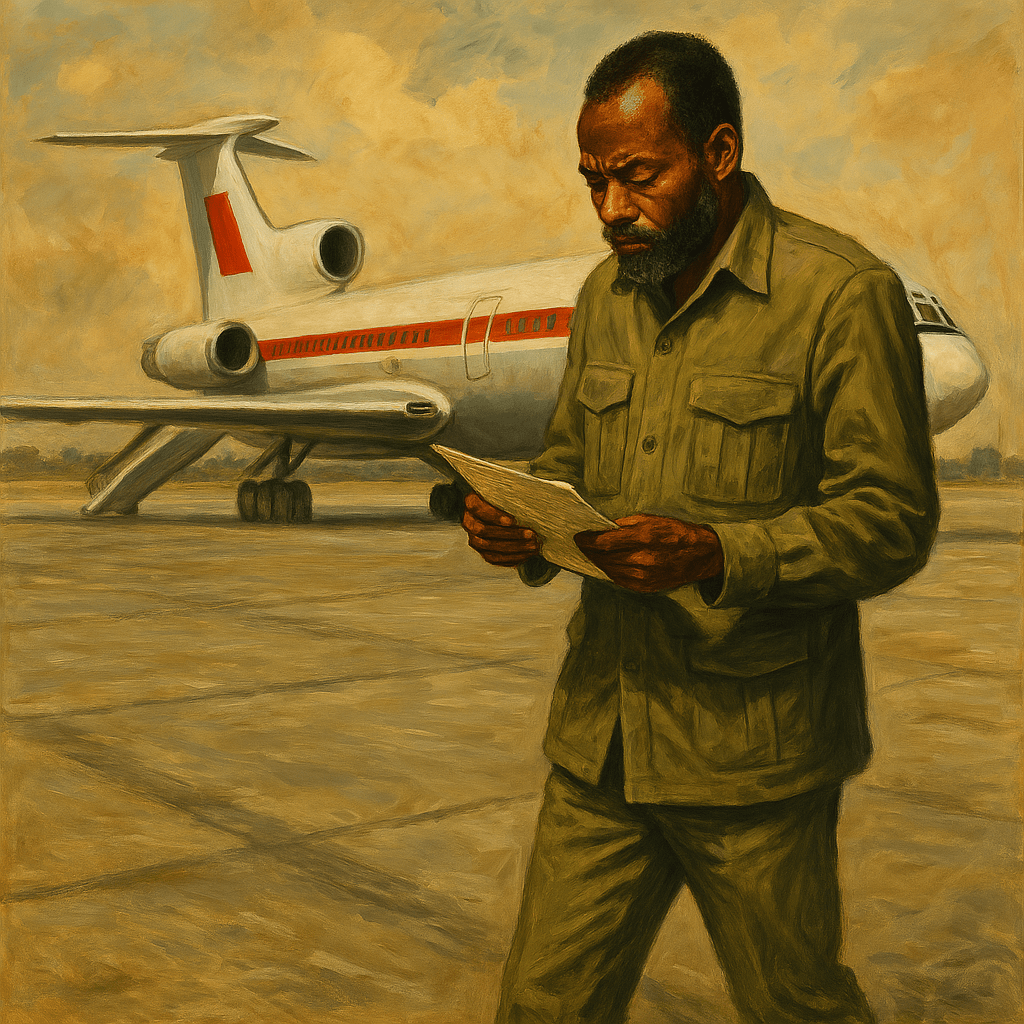
A Revolutionary Forged in Fire
Samora Machel was not merely the first president of independent Mozambique—he was its uncompromising revolutionary architect. Trained in medicine, hardened in war, and guided by Marxism-Leninism, Machel led the people’s liberation army not just to defeat Portuguese colonialism, but to destroy the colonial state in its entirety.
He was no puppet of foreign interests. Not of the West. Not of the East. Machel charted a fiercely independent path that aimed to transform Mozambique from a settler colony into a socialist society rooted in peasant and worker power.
With FRELIMO, he built schools, clinics, collectives, and party cells in liberated zones long before independence was officially won. He believed in revolutionary education and in the absolute necessity of organizing the masses. He embraced Paulo Freire’s pedagogy and applied it on a national scale.
Samora’s project was bold, creative, and uncompromising—and that made him dangerous.
He was targeted, destabilized, and eventually killed. His death in a mysterious 1986 plane crash near the South African border was no accident. It was an assassination carried out by the regional and global enemies of African liberation.
Samora was no coward. He was a revolutionary guerrilla president who chose the people over profit, dignity over diplomacy, and liberation over life itself.
Part I: From Medic to Marxist, From Peasant to Commander
Samora Machel was born into colonial subjugation in Portuguese-ruled Mozambique. His early life was shaped by the grind of peasant labor and the iron grip of racial apartheid. Yet even as a young man, Machel refused to accept subordination. He trained as a nurse—not just to heal, but to serve the people in a country where the settler regime denied basic healthcare to the African majority.
But service alone was not enough. Machel quickly saw that no amount of medical treatment could cure the disease of colonialism. What was needed was liberation. And so he left the hospital for the battlefield, trading his scalpel for a rifle, his clipboard for a revolutionary manifesto.
He joined the Mozambique Liberation Front—FRELIMO—not as a technocrat, but as a committed cadre. Under the ideological leadership of Eduardo Mondlane, and later as commander after Mondlane’s assassination, Machel transformed FRELIMO into a disciplined fighting force with a clear political mission: to not just end colonial rule, but to revolutionize society.
He emphasized political education, mass literacy, and land reform, even while the war was still raging. He built schools and clinics in the bush, treated wounded soldiers and civilians, and held cadre study groups under the stars. He studied Marx, Lenin, Fanon, and Freire. And he trained peasants not just to fight—but to lead.
Samora Machel was not molded by formal academies or foreign embassies. He was forged in the crucible of anti-colonial struggle—where theory was tested by fire, and leadership was earned in blood.
Part II: Revolution in Power, Socialism in Practice
When Mozambique declared independence in 1975, Samora Machel did not merely inherit a state—he inherited ruins. The Portuguese, in their colonial tantrum, destroyed infrastructure, sabotaged machinery, and fled en masse, leaving behind a hollow shell of a country. But Machel and FRELIMO had long prepared for this moment.
They did not seek to replicate the colonial state. They sought to build a new one—from the ground up.
Machel declared Mozambique a socialist republic, rooted in the power of peasants and workers. He nationalized land and industry, expelled exploitative settlers, and launched a mass literacy campaign that reached even the most remote villages. He treated health, education, and culture as weapons of liberation. Clinics were set up in fields. Schools were built in liberated zones. Women were mobilized as equals in the revolution.
He adopted Paulo Freire’s model of critical pedagogy and scaled it up, integrating political education into every layer of society—from the military to rural cooperatives. The people were not objects of development, they were its authors. “We are not a nation of beggars,” Machel declared. “We are a people determined to shape our own destiny.”
But this radical transformation made enemies.
The apartheid regimes of Rhodesia and South Africa, backed by U.S. and Western imperialism, funneled arms, cash, and mercenaries into destabilizing Mozambique. Reactionary forces organized under the banner of RENAMO, launching a brutal counterrevolutionary war to destroy the gains of socialism.
Still, Machel refused to capitulate. He traveled the continent, built alliances with Angola, Cuba, the ANC, and other revolutionary movements. He saw Mozambique’s struggle as part of a larger anti-imperialist and Pan-Africanist front.
For Machel, revolution in power meant revolution in practice. The people were the engine of history—and socialism was not a model to import, but a path to forge.
Part III: Betrayal, Assassination, and the Immortal Struggle
By the mid-1980s, Samora Machel stood as a beacon of uncompromising anti-imperialism in a region under siege. Mozambique was besieged by South African apartheid, sabotaged by RENAMO’s terror campaign, and increasingly isolated by the global capitalist order. Yet Machel did not flinch. He declared: “International solidarity is not charity—it is self-defense.”
He rejected the IMF’s neoliberal prescriptions. He refused to dismantle the people’s state in exchange for Western loans. And he resisted pressure from within FRELIMO to abandon socialism for elite accommodation. Machel knew that the enemy had not changed—only its methods had evolved.
Then, in October 1986, Samora Machel’s plane mysteriously crashed near the South African border after returning from a summit in Zambia. Investigations found a Soviet-made plane, experienced pilots, and no mechanical failures. Instead, evidence pointed to a decoy beacon installed by apartheid agents to lure the plane off course—a targeted assassination, carried out with imperial complicity.
Mozambique mourned. Africa mourned. The world lost one of its most principled revolutionaries.
In the aftermath, the gains of the revolution were slowly reversed. FRELIMO, under new leadership, opened the door to neoliberalism, privatization, and accommodation with imperialism. Mozambique, like so many liberated nations, was forced back into the orbit of capitalist dependency.
But Samora Machel’s legacy lives.
In the memory of peasants who once learned to read by torchlight. In the testimonies of women guerrillas who fought and governed. In the revolutionary pedagogy still practiced in pockets of radical education. And in every demand for dignity that refuses to bow to capital or empire.
Samora was no coward. He gave his life for the people—and his death reminds us that the struggle not only continues—it must be won.
 Weaponized Information
Leave a comment