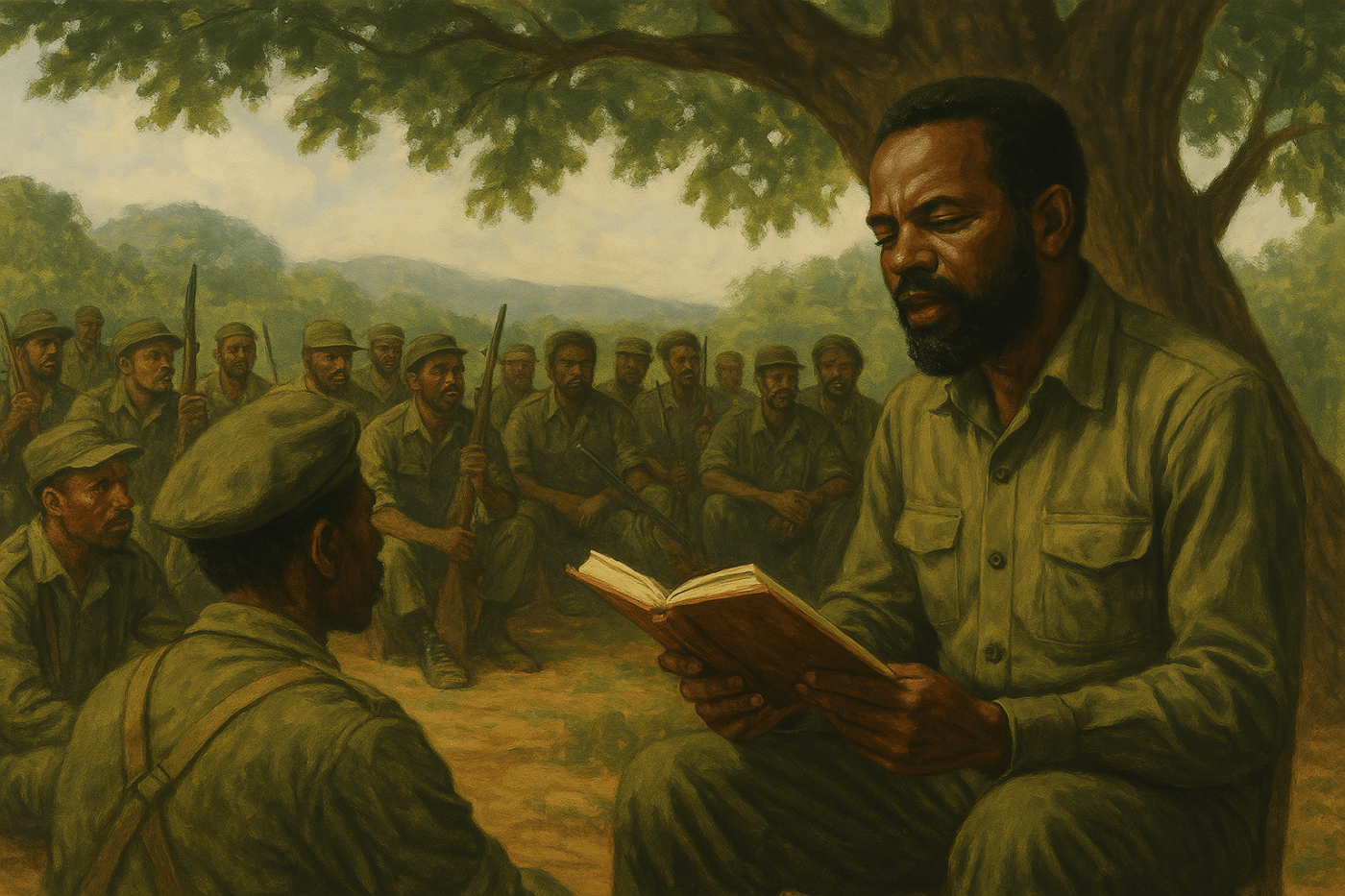
“Our contribution has to be given not only for the liquidation of the colonial system but also for the liquidation of ignorance, disease and primitive forms of social organization.”
— Agostinho Neto
The Revolutionary Lyricist
Agostinho Neto was not the West’s idea of a president. He was a poet. A guerrilla. A Marxist. And above all, a Pan-African revolutionary who believed that national independence without socialism was a hollow victory.
As the leader of the Popular Movement for the Liberation of Angola (MPLA), Neto fought not only to free Angola from Portuguese colonialism, but to make it a stronghold of anti-imperialist resistance across Southern Africa. His was a vision of total liberation—economic, cultural, and spiritual.
He fused verse and violence, diplomacy and defiance. He was a doctor who treated the wounds of his people and a commander who took up arms against the empire that inflicted them. His poems, banned by Portugal, expressed the anguish and hope of the colonized; his politics made those poems real.
Neto refused to be anyone’s puppet. Not the West’s, and not even the East’s. His commitment was to the Angolan people, to African unity, and to revolutionary struggle.
His presidency, from 1975 until his untimely death in 1979, was forged in fire—besieged by South African invaders, CIA-funded mercenaries, and internal contradiction. Yet under his leadership, Angola survived and stood firm as a liberated territory in the global war against colonialism.
Agostinho Neto was no comprador. He was the people’s poet, a guerrilla president who gave his life to the long and unfinished struggle for African freedom.
Part I: From Pen to Pistol, from Verse to Vanguard
Agostinho Neto was born into a colonized Angola where to speak, to write, to think as an African was to risk punishment. He did all three.
A gifted poet in his youth, Neto’s words painted the emotional landscape of a people trapped beneath the boot of Portuguese colonialism. His early collections—published in secrecy and smuggled beyond borders—were banned by the Salazar dictatorship. But it was not just the power of his pen that frightened the regime. It was the clarity of his politics.
While studying medicine in Portugal, Neto organized with anti-fascists and African revolutionaries in exile. His education became a front in the liberation struggle. He returned to Angola with more than a medical degree—he came back with a revolutionary vision.
In 1960, he was arrested and exiled by the Portuguese authorities. That exile did not break him. It radicalized him. Neto joined the leadership of the MPLA and helped shape it into a revolutionary vanguard party—armed with Marxism, rooted in the urban proletariat and rural masses, and committed to anti-colonial armed struggle.
When the Angolan War for Independence erupted, Neto was not just a figurehead. He traveled, organized, and directed. He fused the lyrical with the logistical, the cultural with the combat-ready. His poetry became political education. His clinics became sites of resistance. His speeches rallied fighters from Luanda to Havana.
Agostinho Neto walked the dialectical path from artist to revolutionary, showing that culture and combat are not opposites—but two sides of the same weapon in the fight for freedom.
Part II: Revolution, Sovereignty, and the Firestorm of Empire
When the Portuguese empire finally crumbled in 1975, Agostinho Neto stood at the helm of a new nation born in blood. Angola’s independence was not celebrated in calm parliaments—it was declared in the middle of war. Multiple factions, backed by foreign powers, descended on Angola like vultures. Neto’s MPLA faced CIA-backed UNITA, South African invasion forces, and internal sabotage funded by the West.
But Neto stood firm. With support from Cuba and the Soviet Union, and with the backing of Mozambique’s Samora Machel and other African liberation leaders, the MPLA declared the People’s Republic of Angola. It was not merely an act of sovereignty—it was a declaration of ideological war against imperialism in all its forms.
Under Neto’s leadership, Angola began to nationalize industry, implement land reform, and prioritize education and healthcare. The young revolutionary state extended support to the ANC in South Africa, SWAPO in Namibia, and ZANU-PF in Zimbabwe. Luanda became a headquarters of Pan-African resistance.
But the contradictions of the struggle were immense. The nation was ravaged by war. The economy was strained. Internal divisions and pressures from both Western and Soviet-aligned camps created tensions within the MPLA. Neto’s efforts to remain independent—refusing to serve as a proxy for either side of the Cold War—made him a target from all directions.
Neto understood that sovereignty meant nothing without socialism. And socialism meant nothing without unity. He fought to hold the line, not just for Angola, but for all of Africa struggling to break free from neocolonial chains.
Part III: The Tragic Loss and the Flame That Endures
Agostinho Neto died suddenly in 1979 while receiving treatment in Moscow. He was only 56. Official reports claimed complications from cancer, but for many, the timing, secrecy, and political stakes surrounding his death raised questions that history still cannot fully answer.
His death marked a profound turning point for Angola—and for the African liberation project. The revolutionary dream he fought to build was left vulnerable, and in the decades that followed, many of the socialist gains were undermined by neoliberal reforms, internal corruption, and foreign manipulation. The civil war dragged on, fueled by U.S. dollars, South African incursions, and Cold War geopolitics.
But Neto’s flame did not die.
His poetry continues to echo across the continent. His speeches remain required reading in radical classrooms. His example—of a leader who did not choose between culture and combat, who fused art and revolution, medicine and militancy—is etched into the consciousness of Pan-African struggle.
Agostinho Neto was no comprador. He did not broker liberation to serve capital. He fought for the whole of the people—and died with his integrity intact. In every poet-warrior, in every radical who builds instead of begs, Neto still lives.
 Weaponized Information
Leave a comment