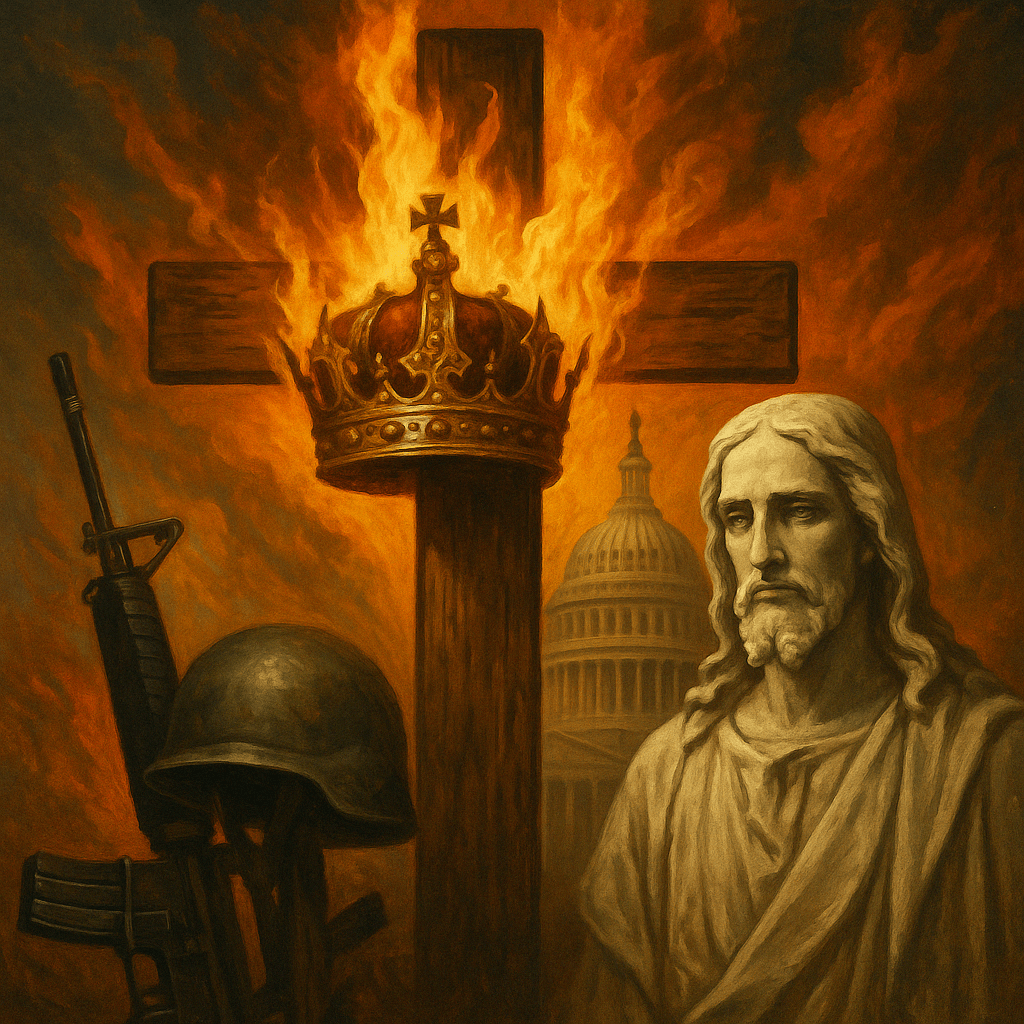
Part I: Christianity as Spiritual Counterinsurgency
by Prince Kapone, Weaponized Information
“Render unto Caesar what is Caesar’s…”
—Jesus, according to the imperial editors
I. The Gospel According to Empire
Before it was the ideological oxygen of Western civilization, Christianity was a threat. A revolutionary movement led by a poor Hebrew anti-colonial preacher, publicly executed by a Roman colonial state. A movement remembered by the poor, the sick, the enslaved—for its radical ethic of healing, feeding, resisting, and rebelling.
But that version of Christianity—Yeshua’s movement, born among the colonized masses of ancient Palestine—was crucified shortly after the Messiah himself.
Enter Constantine, Roman Emperor and architect of the imperial church. In the 4th century, as the Roman state faced crisis and internal decay, Constantine legalized and adopted Christianity—not because he believed in its liberatory message, but because he saw in it a potent ideological weapon. By fusing empire and church, he transformed the gospel into an instrument of counterinsurgency.
This is the Christianity we inherited. Not the faith of the catacombs, but the creed of the colonizers.
II. The Invention of Imperial Christianity
The early Christian movement was horizontal, communal, and in many ways politically subversive. It threatened the authority of the Roman state, not by insurrection but by organizing the oppressed into mutual aid networks that undermined empire’s moral legitimacy.
But the Council of Nicaea (325 CE), convened under Constantine’s command, rewrote the story. The chaotic plurality of early Christian belief was standardized. The state-sanctioned version of Jesus became divine, male, submissive to the Father, and above all—obedient to authority. Church hierarchies mirrored imperial bureaucracies. Bishops became governors in robes. And the cross, once a symbol of terror used to hang rebels, became the new banner of conquest.
The result? Christianity became the official religion of empire—an ideological apparatus built to domesticate the poor, spiritualize suffering, and pacify rebellion. What Marx called the “opium of the people” was not religion itself—but this particular breed of it: Christianity as painkiller and prison.
III. From Rome to the Americas: Christianity Goes Colonial
By the time Columbus set sail, the Christian empire was no longer Roman—it was global. Backed by papal bulls like the Doctrine of Discovery, Christian monarchs waged holy war on the world. Entire continents were reclassified as terra nullius—empty land, spiritually vacant, awaiting Christian stewardship. Indigenous peoples were subhuman until baptized. Those who resisted were enslaved, exterminated, or erased.
In the so-called New World, Christianity became the ideological motor of settler colonialism. It gave divine cover to genocide, slavery, land theft, and white supremacy. The settler didn’t just conquer in the name of gold—he conquered in the name of God.
In this context, American Christianity took on a uniquely violent form: a fusion of Calvinist doctrine, white patriarchal nationalism, and capitalist virtue ethics. “Manifest Destiny” was not just policy—it was prophecy.
IV. Plantation Theology and the Theology of Submission
Nowhere was Christianity more brutally weaponized than in the plantation South. Here, the Bible was split in two: one half for the enslavers, the other for the enslaved. Verses about liberation, justice, and communal life were censored. Verses about obedience, punishment, and eternal damnation were magnified.
“Slaves, obey your masters.”
“The powers that be are ordained by God.”
“Turn the other cheek.”
This wasn’t religion. It was spiritual warfare waged by the master class.
Even the rise of the Black church—one of the most resilient and creative institutions ever forged in captivity—was shaped and surveilled by the white ruling class. Ministers were promoted for preaching patience. Spirituals were tolerated as long as they didn’t spill into revolt. But beneath the hymns, something older smoldered: the gospel of insurrection.
That’s Part II. But we’re not there yet.
V. Evangelical Empire and Theocratic Capitalism
In the modern United States, Christianity has metastasized into an all-consuming culture industry: part mega-church, part militia, part media empire. American evangelicals don’t just worship Christ—they weaponize him.
This is the era of:
- Prosperity gospel: God rewards the rich.
- Evangelical Zionism: End-times foreign policy.
- Christian nationalism: Patriotism with a pulpit.
- Dominionism: The belief that Christians must seize control of every aspect of society—government, education, media, economy.
Today’s Christian Right doesn’t hide its ambitions. It doesn’t want religious freedom—it wants theocracy. It wants women back in the kitchen, queers back in the closet, workers back on their knees.
This is not faith. It is counterinsurgency in clerical disguise.
VI. Christianity in the Age of Technofascism
Under Trump 2.0, Christianity plays the role Constantine designed it for: ideological infrastructure for fascism.
It sanctifies:
- Militarized policing
- Surveillance and censorship
- Colonial borders
- Corporate greed
- Anti-woman, anti-queer repression
Groups like the Army of God, Moms for Liberty, and the architects of Project 2025 are not deviations from Christianity. They are its imperial form taken to logical extremes. The spiritual wing of a fascist state.
This is the Christianity that serves empire. The Christianity that crucifies rebels and calls it justice. The Christianity that burns books, bans abortions, and prays over drone strikes.
This is Christianity as counterinsurgency.
VII. What Comes Next: The Gospel According to the Oppressed
But this is not the only story.
There is another tradition—an underground current flowing through the catacombs, the plantations, the prisons, the pueblos. A theology of liberation. A faith forged in struggle. A Christ who overturns tables, breaks chains, and walks with the condemned.
That’s Part II.
We will journey from the revolutionary Christianity of the early persecuted church…
To the fire sermons of Nat Turner…
To the prophetic voices of James Cone, Oscar Romero, Martin Luther King, and the radicals of Latin American Liberation Theology…
Not the Christianity of Caesar—but of the cross and the slave ship. Of the sugarcane and the border wall.
Of the people, not the priests.
 Weaponized Information
Leave a comment