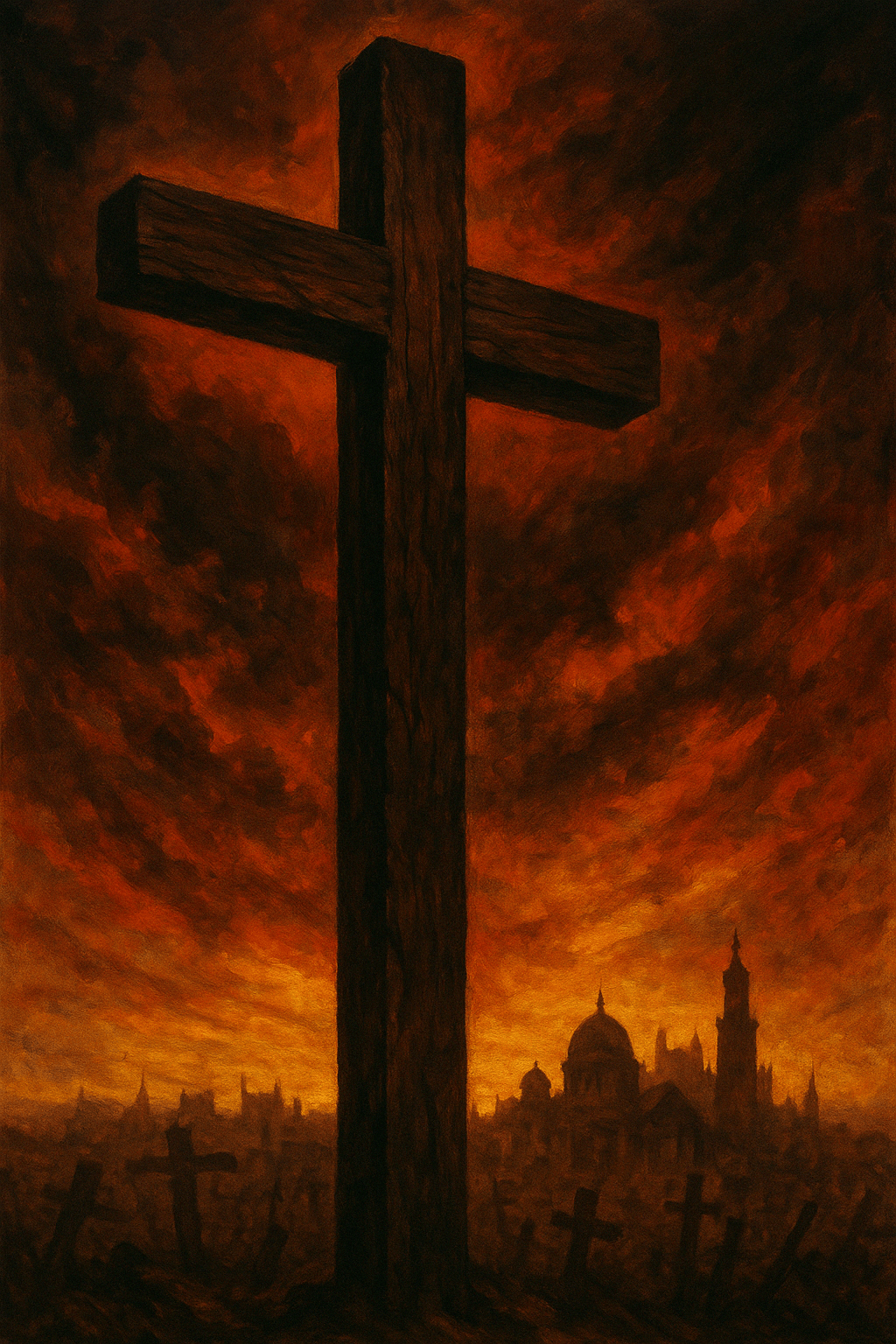
by Prince Kapone, Weaponized Information
“They turned an execution device into a holy relic—and called it redemption.”
—A Comrade
Read Part I:
In the Name of the Father, the Empire, and the Holy Profit Margin
Read Part II:
The Gospel According to the Oppressed
I. A Symbol Hiding in Plain Sight
To the average Christian, the Cross is a symbol of hope. A sign of sacrifice. A badge of salvation.
It’s worn around the neck, displayed on altars, branded on megachurch walls and militia flags alike.
It evokes tears, reverence, and submission.
But to the Roman Empire that perfected its use, the Cross had one meaning only: terror.
It was not a metaphor. It was not divine. It was not holy. It was a tool of execution.
A spectacle of public punishment. A form of state-sanctioned torture designed to humiliate, dismember,
and psychologically dominate rebellious subjects of empire.
That this instrument of state violence became the central symbol of a religion that now sanctifies
the very systems Jesus opposed—this is not a divine mystery. It is an imperial con job.
II. The Cross as Colonial Propaganda
Crucifixion was never just about death. It was a theater of power.
The Romans used it to display what happened to anyone who dared disrupt the “Pax Romana.”
It wasn’t about justice—it was about control.
You rose up? You hung.
You spoke out? You were nailed in public.
You threatened the social order? You became a symbol of failure.
And then, centuries later, the empire flipped the meaning. Constantine, the same emperor who merged
state power with church authority, claimed to see a cross in the sky accompanied by the words:
“In this sign, conquer.” And conquer he did.
The Cross became not a symbol of resistance to empire, but of empire’s moral legitimacy.
III. The Sanitization of State Violence
By making the Cross sacred, the empire pulled off a masterstroke of ideological warfare.
They took the state’s most grotesque method of execution and turned it into:
- A sacrament
- A talisman of obedience
- A license for conquest
The same Rome that crucified Christ then baptized his method of death and rebranded it as redemption.
Not only was the revolutionary killed—the memory of his execution was transformed into the very tool
used to pacify future generations of the oppressed.
This is psychological counterinsurgency, perfected long before the CIA.
IV. “Take Up Your Cross”: The Theology of Suffering
In imperial Christianity, believers are taught to “take up their cross” and follow Christ.
But what does that mean when the Cross itself was a weapon of empire?
- It means accept your suffering.
- It means obedience is holy.
- It means to suffer is to be righteous.
- It means poverty, pain, and persecution are spiritual virtues—not social injustices to be overturned.
This is not theology—it is ideological pacification dressed in divine language.
The Cross becomes a spiritual leash, binding the exploited to their own misery while teaching them to call it salvation.
V. From Crucifixion to Colonization
The Cross did not stay confined to theology. It marched across continents.
It was carved into swords and shields, sewn into crusader banners, branded on flags planted in colonized soil.
- It came with the conquistadors.
- It came with the slavers.
- It came with the missionaries who baptized children before killing their parents.
The Cross became the logo of Western civilization—not as liberation, but as domination.
The empire didn’t abandon crucifixion. It just learned to crucify entire peoples more efficiently.
VI. Toward a Revolutionary Reclamation
But the story doesn’t end with empire. Just as the crucified Christ was reclaimed by
Nat Turner, Óscar Romero, James Cone,
and enslaved African people singing “Were You There When They Crucified My Lord,”
so too must the Cross be torn from the hands of power.
The Cross can mean something else.
- Not salvation through submission—but resurrection through revolt.
- Not suffering as holiness—but resistance as sacred.
- Not obedience to Caesar—but the end of Caesar’s world.
To wear the Cross must no longer mean praying for the empire to be more merciful.
It must mean preparing to overthrow it.
VII. Decoding the Symbol
The Cross is not neutral.
It is not holy by nature.
It is a battlefield of meaning.
Empire made it into a brand.
The church made it into a relic.
But the oppressed can make it into a rallying cry.
If the Cross is to have any future beyond being a religious trademark of technofascism,
it must return to its original meaning: a site of imperial violence, yes—
but also the moment empire was challenged by a carpenter from the ghetto of Galilee.
“They meant it as a warning. We made it a weapon.”
—Liberationist proverb
 Weaponized Information
Leave a comment