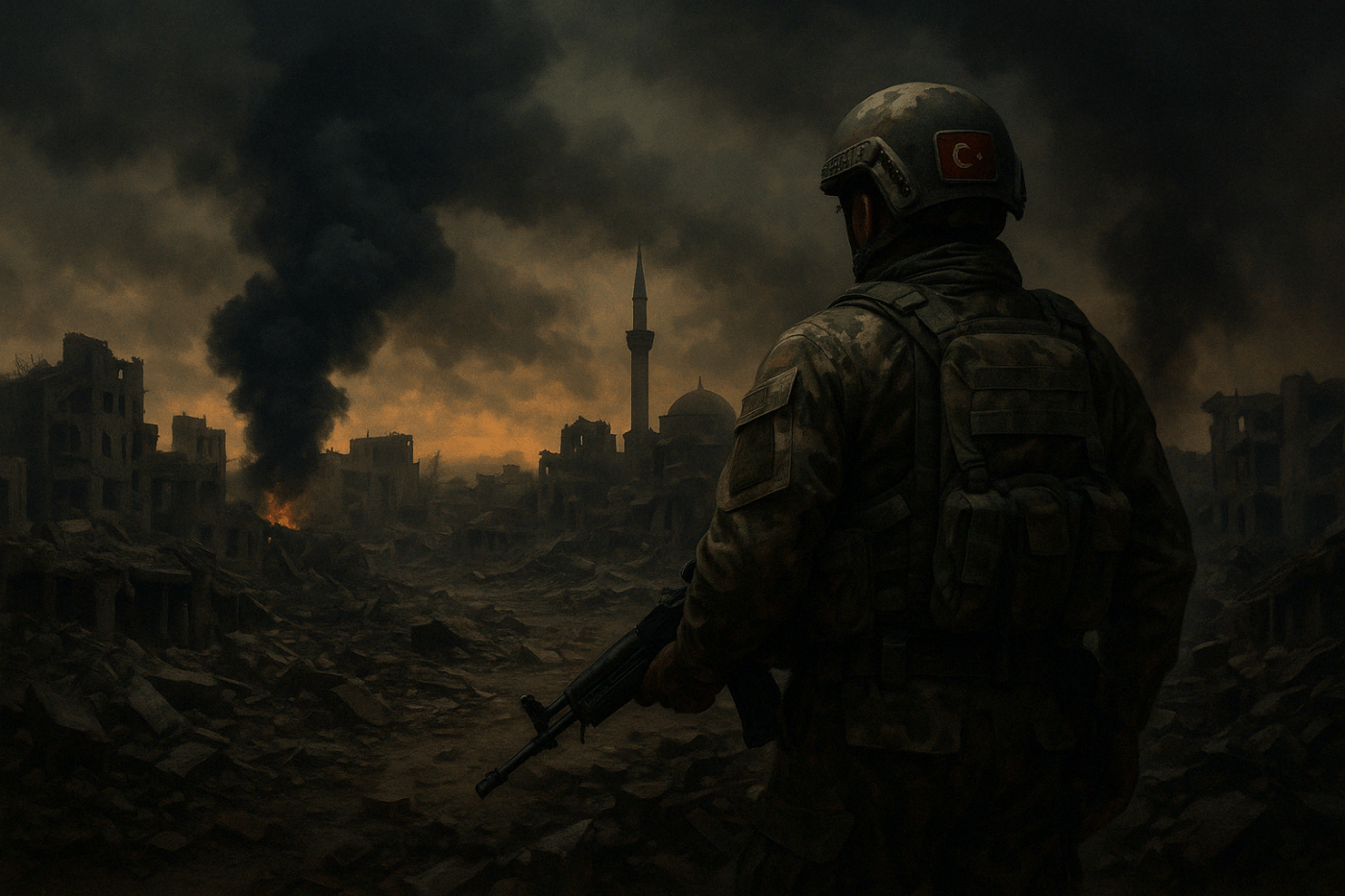
By Prince Kapone | Weaponized Information
It’s hard to make sense of Turkey these days without recognizing the chaos that defines the whole global order. The headlines call it a “strategic tangle”—but it’s less tangle, more survival. Turkey is moving like a man walking through a collapsing house, dodging beams as the roof caves in. And in the middle of all this, it’s staking claims in post-Assad Syria, cutting quiet deals while the world isn’t paying attention.
After the fall of Bashar al-Assad in late 2024—a collapse triggered as much by internal degeneration as external maneuvering—a patchwork of forces has stepped into the power vacuum. At the center of it: Turkish-backed militias, Islamist factions like HTS, and a provisional government scrambling to gain legitimacy. It’s not the revolution Syrians supposedly hoped for. It’s more like a managed transition—engineered, in part, from Ankara.
Now Turkey is reportedly moving to take control of Syria’s T4 airbase—a strategic site long targeted by Israel and once shared by Iran and Russian forces. This isn’t just about air power. It’s about real estate in the rubble of the old regime. It’s about setting up shop before others beat them to it. Turkey is betting that if it controls the air, it controls the narrative. And maybe, just maybe, it can rewrite the map.
But the move is bigger than just Syria. It’s about positioning Turkey as something more than NATO’s disgruntled middleman. Erdoğan’s state wants to be a regional power with independent footing in a multipolar world. It’s why they’re negotiating access to Syrian airspace. It’s why they’re building up military installations from Libya to the Caucasus. It’s why they talk like rebels in Brussels but act like bosses in Idlib.
Of course, back home, things are less stable. Inflation is ripping through the economy. The lira is weak. Unemployment remains high. Erdoğan’s legitimacy hangs on a careful balance of military theater abroad and managed crisis at home. But he’s not a one-man show. The Turkish ruling class has wagered everything on regional assertiveness: pipelines, drone exports, military bases, soft power campaigns in Africa and Central Asia. They’re not just playing empire—they’re hedging their future on it.
But here’s the contradiction. Turkey is trying to act like a sovereign regional power, while still chained to the economic dependencies of a semi-peripheral state. It’s still tied into Western capital flows. It still owes debts in U.S. dollars. It still relies on European trade, Gulf investment, and Chinese infrastructure. The balance Turkey is striking—between NATO and Russia, between Europe and the BRICS, between Islamism and neoliberalism—isn’t a masterclass in strategy. It’s an act of necessity. There’s no clear way forward, so Ankara is improvising in every direction at once.
And Syria? Syria has become the testing ground. The Assad regime may be gone, but all semblances of national soveriegnty fled with him. The new Syrian order is still an occupied zone, a fractured battlefield carved up by foreign interests. Turkey’s role in this isn’t about stabilizing the region—it’s about anchoring its own future in the cracks of someone else’s collapse.
This is what the so-called “strategic tangle” really is: a symptom of a decaying imperial system, not a master plan. There’s no endgame here. No long-term vision. Just tactical maneuvering amid geopolitical entropy.
Turkey isn’t rising. It’s reacting.
And in that sense, Turkey tells us something about the world itself: how middle powers are scrambling for space in a world where the old empire is dying, but the new world hasn’t yet arrived. The global order is in freefall—and Turkey, like others, is just trying to survive the descent without crashing.
 Weaponized Information
Leave a comment