Written by: Prince Kapone, Weaponized Information
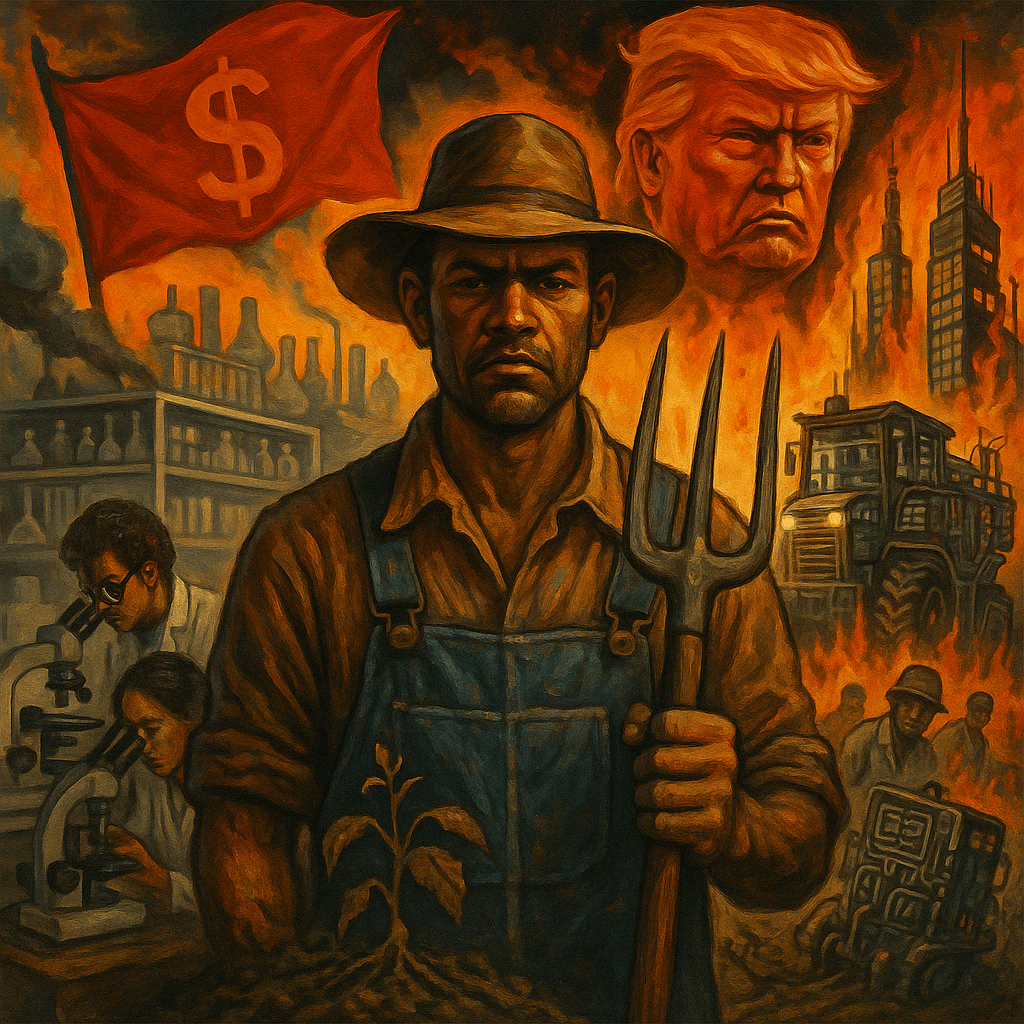
From shuttered labs at California’s famed land-grant university to small farmers left staring at empty inboxes, the impact of President Donald Trump’s 2025 freeze on federal agricultural research funding has been swift and devastating. In a matter of days, a sweeping directive from the White House halted grants, closed down experiments, and shut out scientists across the country. What might seem like yet another budget skirmish is in fact something far more ominous: a deliberate strike in a structural class war against the public. This isn’t just bean-counting—it’s technofascism in action, a domestic front in a broader campaign to consolidate power over food, data, and knowledge itself.
The chaos unleashed by Trump’s order was immediate. Announced in late January as part of a broader drive to “reshape” the federal government, the freeze targeted thousands of research programs and aid initiatives at once. Minutes before the policy was to take effect, a federal judge temporarily blocked it, noting the sweeping directive would disrupt programs serving tens of millions. The White House grudgingly rescinded its blanket memo under legal pressure, yet in practice much of the damage had already been done. Agencies were left paralyzed, and Trump’s team signaled it would continue with targeted cuts to any programs deemed ideologically unpalatable or “not in the national interest.”
Nowhere has this aggressive agenda hit harder than in the agricultural research sector. At the University of California, Davis—long a crown jewel among land-grant agriculture colleges—projects ground to a halt as federal support evaporated overnight. Poultry genetics studies were abandoned mid-stream; fruit and vegetable test plots went dry in the field. A program to help small farmers insure against crop losses was abruptly terminated and handed off to overseas partners when its U.S. Agency for International Development (USAID) grant was killed. All told, millions of dollars in research funding disappeared in a flash, from both USAID and the U.S. Department of Agriculture (USDA), choking off a lifeline that made UC Davis and its peers “a model for the world” in public agriculture science.
Technofascism and Counterinsurgency in the Heartland
Why would an American president wage war on his own country’s agricultural knowledge base? The answer lies in an ideological project best described as technofascism: a merger of reactionary political power with high-tech tools of control, all directed at suppressing dissent and autonomy. As George Jackson observed a half-century ago, fascism in the U.S. has always been “imperialism turned inward”—the methods of empire brought home to quash internal opposition. Trump’s freeze is technofascism in action, a form of domestic counterinsurgency against any centers of power not fully subordinate to the ruling class agenda. In this case, the “insurgents” are public-sector scientists, educators, and the farmers and communities they serve.
From day one, Trump’s administration signaled that only certain science would be permitted. On his very first day back in office, he ordered agencies to terminate all grants related to diversity or equity, and to suspend any “Green New Deal”–related climate initiatives. In other words, research with even a whiff of social justice or environmental responsibility was marked for elimination. This is the crux of technofascist strategy: purge the knowledge institutions of any programs that empower marginalized groups or challenge corporate interests. In place of open inquiry, impose political litmus tests. In place of public good, demand fealty to an “America First” dogma.
The consequences have been brutal. Crucial science on food security and climate resilience has been strangled by edict. New USDA grants are tied up in court battles, and federal online grant portals were literally frozen—no new applications in or out. Researchers awaken at 3 a.m. with panic attacks after receiving form-letter notices that their projects are terminated as “not in the national interest”. The message from the regime is clear: knowledge that doesn’t serve the narrow interests of the oligarchy is dangerous, even criminal. By weaponizing bureaucracy to starve these projects, the state acts as the enforcer for monopoly capital, conducting a preemptive strike on any grassroots innovation that might shift the balance of power. It is a counterinsurgency of the mind, waged through budget cuts and bureaucratic sabotage.
Assault on Food Sovereignty and the Land-Grant Legacy
This funding freeze is also an assault on food sovereignty—people’s right to control their own food systems. The land-grant university network was born out of the Civil War era promise that knowledge should be a public trust, not a private luxury. Since the 1860s, institutions like UC Davis, Iowa State, and dozens of others have existed to democratize agricultural innovation, from developing hardy crop varieties to training generations of working-class agronomists. Trump’s actions aim to dismantle that very legacy. By choking off federal support, the administration is effectively pulling bricks from the foundation of the land-grant system, letting it crumble so that private interests can snatch up the pieces.
We see this clearly in the plight of researchers and farmers on the ground. “It’s a sort of powerlessness,” says Jason Myers-Benner, a small-scale farmer in Virginia who’s been left in limbo by USDA’s sudden funding freeze. Last year, Myers-Benner’s family farm received a modest $18,000 grant through the Sustainable Agriculture Research and Education (SARE) program to breed winter peas that enrich the soil with nitrogen and trap carbon. It’s exactly the kind of farmer-led, climate-smart innovation that SARE has supported for decades. But now, with federal checks on hold, he’s left staring at an empty inbox, “disgusted” at how the government has treated the farmers who dared to ask for collaboration. Small farms trying to build resilience are hung out to dry, their locally rooted solutions treated as expendable.
Meanwhile, USAID’s renowned agricultural labs—like the Feed the Future program—are being gutted overnight. At UC Davis, Dr. Tara Chiu’s project helping poor farmers in Africa and Asia manage climate risk was shut down with a curt email, leaving her and her colleagues scrambling. Another team, working on how to feed a growing global population under climate change, saw their horticulture lab funding axed and were told to transfer their field trials to partners overseas. In essence, the U.S. is abandoning research that helped empower Global South farmers to achieve food sovereignty, deeming it “not in the national interest.” This is imperialist recalibration at work: Washington would rather those farmers remain dependent on U.S. agribusiness exports than have the public sector help them become self-sufficient.
Trump’s freeze thus attacks food sovereignty on two fronts. Domestically, it undermines the ability of American communities to develop region-specific, sustainable farming practices outside the control of Big Ag. Internationally, it withdraws support for programs that foster independence in formerly colonized nations. Both serve the same goal: to tighten the grip of empire and monopoly capitalism over who grows what, where, and how. As we have consistently said at Weaponized Information, we are witnessing the crisis of hyper-imperialism: a phase of global capitalism marked by monopoly finance capital, tech-military integration, and permanent warfare. Cutting off collaborative agricultural science is a form of warfare by other means—a silent weapon to ensure no alternatives to the imperial food regime can take root. The beneficiaries, of course, are the handful of giant agribusiness and tech conglomerates that dominate everything from seed patents to meatpacking to farm data analytics.
Monopoly Capitalism Feeds at the Trough
Behind this freeze lies the cold logic of monopoly capitalism. Decades of neoliberal policy already weakened public agricultural research—USDA data shows federal funding for ag R&D had fallen by about one-third over the past two decades, stagnating at roughly $5 billion a year (about the same as in 1970 after inflation). Private industry has filled some gaps, but corporate R&D is driven by profit, not the public interest. Now, Trump’s onslaught threatens to collapse what remains of the public-sector pillar entirely. If it falls, the vacuum will be filled by agribusiness giants whose interest in “innovation” rarely goes beyond proprietary GM seeds, pesticides, and farm machinery that lock farmers into dependency. It’s telling that while U.S. public research investment has been slumping, top competitors like China and Brazil have massively boosted theirs—China is now the world’s largest funder of agricultural R&D. Yet Trump’s answer to this competitiveness challenge is to double down on American disinvestment, betting that corporations and oligarchs will somehow pick up the slack.
The early signs of this corporate consolidation are evident. Trump installed industry-friendly operatives and even tech billionaire cronies to oversee the “reform” of federal science agencies. At the National Science Foundation, new awards were reportedly frozen on orders from a so-called Department of Government Efficiency led by Elon Musk. We should have no illusions about what this means for the USDA and land-grant colleges. It’s a hostile takeover. Today it’s DEI and climate programs on the chopping block; tomorrow it could be the Hatch Act funds that keep agricultural experiment stations running, or the Smith-Lever funds that support county extension agents. Starve the public institutions, and you can privatize the carcass. Agro-chemical and seed corporations, Wall Street investors in farmland, Big Tech firms peddling AI-driven “digital agriculture” – they are all lining up at the trough, ready to devour the public’s intellectual commons.
This is class war in its purest form. The victims are not only scientists and farmers, but ultimately all of us who eat food and rely on a stable climate. By sabotaging research into crop diseases, soil health, climate adaptation, and sustainable farming, Trump’s coalition is ensuring that the costs of the climate crisis and market volatility fall hardest on workers and the poor. Even the U.S. farmers it claims to champion will suffer: a recent study in PNAS warned that without reinvestment in ag research, American crop yields will stagnate or fall as climate pressures rise, leading to more frequent food shocks by mid-century. That, in turn, will become a pretext for even greater government payouts to agribusiness – a vicious cycle of dependency. During Trump’s first term, farm country received a record $217 billion in federal payments, more than any four-year period since the 1930s, including bailouts for his own trade wars. Now, even as his administration floats new bailout checks to placate growers angered by tariff backlashes, it is slashing the very programs that produce long-term solutions. The message: Big Ag will be subsidized to stay afloat, but public science that might reduce the need for such subsidies will be left to wither.
Imperialist Recalibration and Resistance
Trump’s freeze on agricultural research is not a fluke or temporary tantrum—it is part and parcel of a systematic imperialist recalibration. Faced with a declining hegemonic position globally, the U.S. ruling class is fortifying its hold on key strategic sectors (food, energy, tech) by handing them fully to private monopolies and using state power to crush any democratic oversight or alternative models. In practice, that means treating the American public itself as an occupied population to be controlled. The land-grant university system, born of a deal to educate the masses, is being repurposed or destroyed to serve a new deal with the devil: the reign of technocracy and capital without accountability. It’s the domestic face of what Washington has long done abroad – using food as a weapon. To put it clearly, the empire would rather starve the tree of knowledge than let the roots of people’s science grow deep and free.
Yet amid this bleak offensive, resistance flickers. Faculty, students, and farm advocates are mobilizing to defend what’s left of their research programs, and lawsuits continue to challenge the legality of Trump’s diktats. Land-grant universities, for all their flaws, remain decentralized and embedded in communities; they are not so easily turned into monolithic propaganda factories. The fight for food sovereignty is alive in movements of farmers, Indigenous seed savers, and agroecologists who are determined to keep knowledge free and bottom-up. And globally, the very countries dismissed by Trump’s “America First” ethos are forging ahead with their own innovations, often in collaboration with each other. The imperial center may be turning inward and eating its seed corn, but the periphery is seeking new ways to break the monopoly of Big Ag.
In the end, Trump’s war on agricultural research lays bare the fundamental truth of this moment: the masters of the U.S. empire are rearranging the deck chairs, not to save the ship, but to ensure they alone hold the lifeboats when the ship goes down. This is the logic of technofascism and monopoly capitalism – a logic that values power over life, private profit over the public good. By freezing federal research, they are attempting to freeze history, to block the development of knowledge that could empower the many. It is up to the proletarian intellects, the tillers of soil and science alike, to melt that ice with the heat of collective struggle. In the battle between technofascist austerity and the promise of food sovereignty, our solidarity and refusal to submit are the insurgent seeds that can still grow in the cracks of a broken system.
 Weaponized Information
Leave a comment