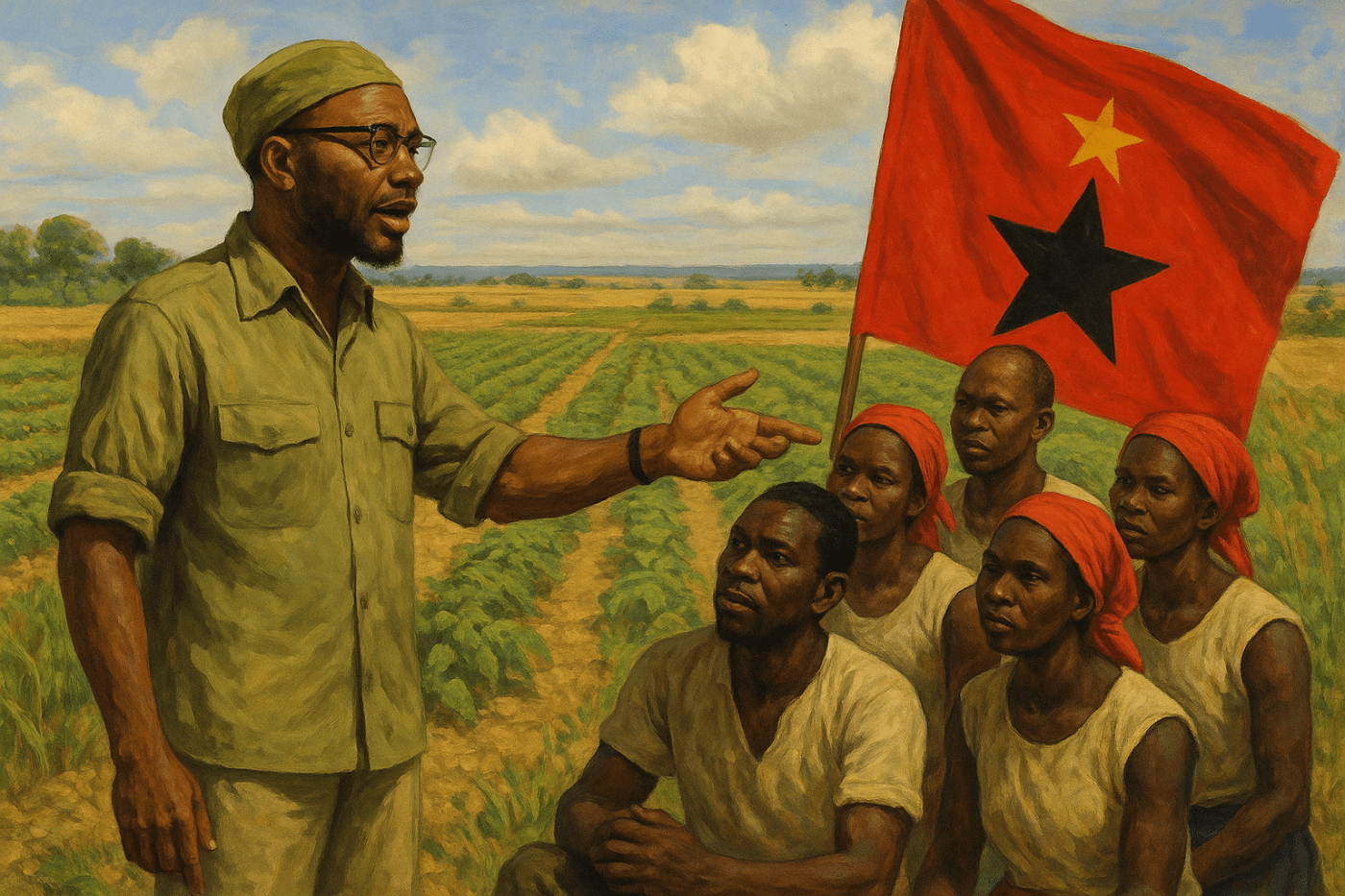
The Strategist of Liberation
“Always bear in mind that the people are not fighting for ideas, for the things in anyone’s head. They are fighting to win material benefits… for a better life, and for their children’s future.” — Amílcar Cabral
Amílcar Cabral wasn’t a mascot for anti-colonial struggle. He was its engineer. In a world where imperialism tried to reduce revolution to raw emotion or blind rebellion, Cabral brought scientific precision, clarity of purpose, and an unshakable revolutionary ethic. He wasn’t just leading a war against the Portuguese—he was building the political and ideological infrastructure for a socialist future in Africa.
The Western media and liberal historians want you to remember Cabral as a charismatic leader, maybe even a poet. What they don’t want you to see is the Marxist strategist, the disciplined party-builder, the theorist of class suicide, and the architect of people’s war. He was not simply anti-colonial—he was anti-capitalist, anti-imperialist, and anti-petty-bourgeois opportunism in all forms.
Cabral helped organize and lead the PAIGC (African Party for the Independence of Guinea and Cape Verde), one of the most successful liberation movements in modern history. He understood that armed struggle without political education was suicide. That ideology without organization was nothing. And that freedom without socialism was just recolonization by another name.
He didn’t beg the West for recognition. He didn’t ask Moscow for permission. He built the revolution from the ground up, starting with the peasants, the workers, and the exploited. In doing so, he created liberated zones that functioned as dual power structures—where Portuguese colonialism was made irrelevant, and the people began to govern themselves.
This article is not about romanticizing Cabral. It is about restoring his image as a revolutionary scientist of liberation. He was no pawn. He was the quiet storm that broke the back of empire.
Part I: Born in Empire, Trained to Destroy It
Amílcar Cabral was born in 1924 in Portuguese-occupied Guinea-Bissau, a colony where the vast majority of the population labored under semi-feudal conditions for foreign capital. But unlike many African leaders of his era who were groomed by the colonial system for managerial roles, Cabral studied the system from within—so he could destroy it from without.
After earning a scholarship, he went to Lisbon to study agronomy—the science of land. But land, in a colonial economy, is not just soil; it’s capital, class structure, and political power. Cabral didn’t just study how to grow crops—he studied who owned the land, who worked it, and who reaped the profit. He used his training to conduct a comprehensive agricultural census of Guinea-Bissau—and in doing so, mapped out not just fields and plantations, but the class terrain of colonial domination.
It was in Portugal where Cabral made contact with other African and anti-colonial intellectuals, including future revolutionaries from Angola, Mozambique, and Cape Verde. He became a founding member of clandestine anti-imperialist study groups that would later become the nucleus of liberation movements across Lusophone Africa.
Cabral read Marx, Engels, Lenin, and Fanon, but his genius was in synthesis. He translated theory into the concrete needs of his people. He understood that ideology alone could not win liberation—but without ideology, struggle would become aimless, easily co-opted, or worse, turned into ethnic or tribal bloodletting.
By the time he returned to Guinea-Bissau, he was not just an agronomist or an intellectual—he was a revolutionary strategist. He had a blueprint: organize the people, build a disciplined party, politicize the countryside, and prepare for armed struggle. He knew what had to be done. And he was prepared to lead it.
Part II: Building the Party, Organizing the People
Amílcar Cabral knew that liberation wouldn’t come from speeches or symbolic protests. It had to be built. Inch by inch. Village by village. Class by class. That’s why in 1956, alongside his brother Luís and a core group of disciplined cadres, he founded the African Party for the Independence of Guinea and Cape Verde (PAIGC). But this was not just a political party. It was a revolutionary instrument of dual power—designed to guide the people, educate them, and prepare them to govern themselves.
The Party was rooted in the peasantry. Cabral knew the urban petty bourgeoisie would not lead the revolution. Too many compromises, too much dependency on colonial favor. The peasantry, though impoverished and untrained, had something more valuable: a willingness to fight, learn, and transform.
PAIGC began by listening—sending cadres to live with villagers, learn their languages, study their customs. They helped organize farming cooperatives and taught basic literacy. They trained guerrilla fighters, but more importantly, they trained political educators. For Cabral, revolution wasn’t just armed struggle—it was mass political development. Every zone liberated from the Portuguese had to become a zone of dual power: schools, health posts, collective farms, and people’s assemblies.
Discipline was absolute. PAIGC guerrillas were not permitted to mistreat civilians, steal from peasants, or act without political guidance. Cabral constantly reminded his comrades that the people were the water in which the revolutionary fish must swim. Lose the people, lose the war.
He also warned against internal decay: opportunism, tribalism, careerism. He demanded ideological clarity and class commitment from every cadre. And he practiced what he preached—living simply, writing rigorously, and devoting his life to building power for the people, not power over them.
By the mid-1960s, PAIGC controlled large swaths of territory in Guinea-Bissau. In these liberated zones, the Party governed. The colonial state was made irrelevant. This was the essence of Cabral’s strategy: replace colonialism with people’s power before independence is won. Build the new society in the shell of the old. Train the people to govern themselves. Teach them to fight—but also to farm, to heal, to lead.
This was not just a war for flags. It was a war for a new kind of freedom.
Part III: Guerrilla Warfare as Revolutionary Pedagogy
For Amílcar Cabral, armed struggle was not simply a means of seizing power—it was a process of transforming people. He called it “revolutionary pedagogy,” a school in which the people themselves became the subject of history. Guerrilla warfare was not just a tactical necessity—it was a tool for political education, ideological development, and collective transformation.
Cabral knew that the enemy was not only Portugal, but colonial consciousness itself. Centuries of domination had instilled fatalism, tribalism, and fear. Revolution required more than weapons—it required a re-education of the oppressed. That’s why every PAIGC fighter was also a teacher. Every liberated village became a classroom. Every encounter with the masses was a chance to learn and to teach.
In the bush, revolutionaries studied Marxism, agriculture, medicine, and history. Political commissars led discussions on class struggle, the role of the Party, and the meaning of liberation. This was not abstract theory. It was rooted in daily life—in questions of land, labor, women’s participation, and collective governance. For Cabral, ideology was not a dogma. It was a weapon sharpened by struggle.
Cultural resistance was central to this pedagogy. Cabral saw colonialism not just as a system of exploitation, but as a system of erasure—of language, customs, memory, and identity. To reclaim culture was to reclaim humanity. Traditional music, proverbs, oral histories, and native languages were not romantic relics—they were revolutionary tools. The struggle to liberate Guinea-Bissau and Cape Verde was also a struggle to recover African dignity.
Cabral warned against copying foreign models. He insisted that revolutionaries must “learn from the people,” not impose ideology from above. This was a radical break from both Western paternalism and Stalinist authoritarianism. For him, the people were not inert masses to be led. They were active agents of their own emancipation—if properly organized, educated, and armed.
By turning the armed struggle into a revolutionary school, Cabral laid the groundwork for a society that could not only overthrow colonialism, but replace it with something better. Not just a new flag—but a new social order, rooted in justice, consciousness, and collective self-determination.
Part IV: Anti-Colonial Marxism Without Moscow’s Chains
Amílcar Cabral was not a puppet of the Soviet Union or China. He was not a cheerleader for foreign ideology. He was a revolutionary scientist who understood that Marxism had to be applied—not memorized. His anti-colonial Marxism was not dictated from Moscow, but born in the villages of Guinea-Bissau and Cape Verde, shaped by the daily lives of the oppressed.
He rejected both Eurocentrism and mechanical Marxism. He didn’t blindly follow the Soviet line, nor did he romanticize Chinese models. Instead, he insisted that every revolution must be rooted in its own material conditions. “We are not going to use a textbook to make our revolution,” he once said. “We must make our revolution ourselves, and in our own way.”
One of his most important contributions was the concept of class suicide. He believed that petty-bourgeois intellectuals and revolutionaries must commit class suicide—not physically, but politically. They had to kill the bourgeois mentality within themselves, abandon their privileges, and merge completely with the masses. Without that, the revolution would either fail—or be hijacked.
Cabral also centered culture as a battleground of class struggle. Colonialism, he argued, was not just political and economic—it was cultural. It imposed alien languages, destroyed histories, and tried to convince the colonized that they had no worth. For Cabral, reclaiming culture was part of reclaiming humanity. He famously said, “Culture is simultaneously the fruit of a people’s history and a determinant of history.”
Even as he fought a war, Cabral continued to theorize. He saw socialism not as a distant utopia but as a process of human liberation. He insisted that the role of the Party was not to dictate, but to guide—to serve the people by learning from them, raising their consciousness, and helping them build a new society.
Cabral proved that Marxism was not foreign to Africa. It could be made African. It could be made revolutionary. It could be made victorious. His independence was not just about flags and borders—it was intellectual, political, and ideological. It was the kind of independence that frightened colonial powers and made Western academics uncomfortable.
Because Cabral didn’t just challenge colonial rule—he challenged colonial thought.
Conclusion: Cabral Lives in Every Peasant Who Picks Up a Gun and a Book
Amílcar Cabral was assassinated in 1973, just months before Guinea-Bissau declared independence. The Portuguese couldn’t defeat him on the battlefield, so they killed him through infiltration and betrayal. But the bullet that took his life couldn’t kill his ideas, his legacy, or the movement he built.
Cabral left behind more than a liberated country. He left behind a model of revolution—rooted in theory, sharpened through struggle, and sustained by the people themselves. He taught us that revolution is not charity, spontaneity, or vengeance. It is organization. It is science. It is pedagogy. It is love—of people, of justice, of freedom.
He proved that Africans didn’t need to borrow revolution. They could generate it. Ground it in their own land, their own cultures, and their own class struggle. He showed that liberation meant nothing without socialism—and that socialism meant nothing without the consciousness of the masses.
His example continues to haunt imperialism because it was complete. He didn’t just resist—he replaced. He didn’t just critique—he constructed. He built power from below and dared to imagine a world after colonialism, not just without it.
Today, Cabral lives in every zone of struggle where peasants become cadres, where teachers become tacticians, and where revolutionaries learn to serve the people instead of command them. He lives in the red soil of Guinea-Bissau, in the speeches of landless farmers, in the writings of young militants studying dialectics in the heat of battle.
Cabral was no pawn. He was the master of revolutionary strategy. The teacher of disciplined insurrection. The griot of decolonized Marxism.
And like all true revolutionaries—he lives on.
 Weaponized Information
Leave a comment