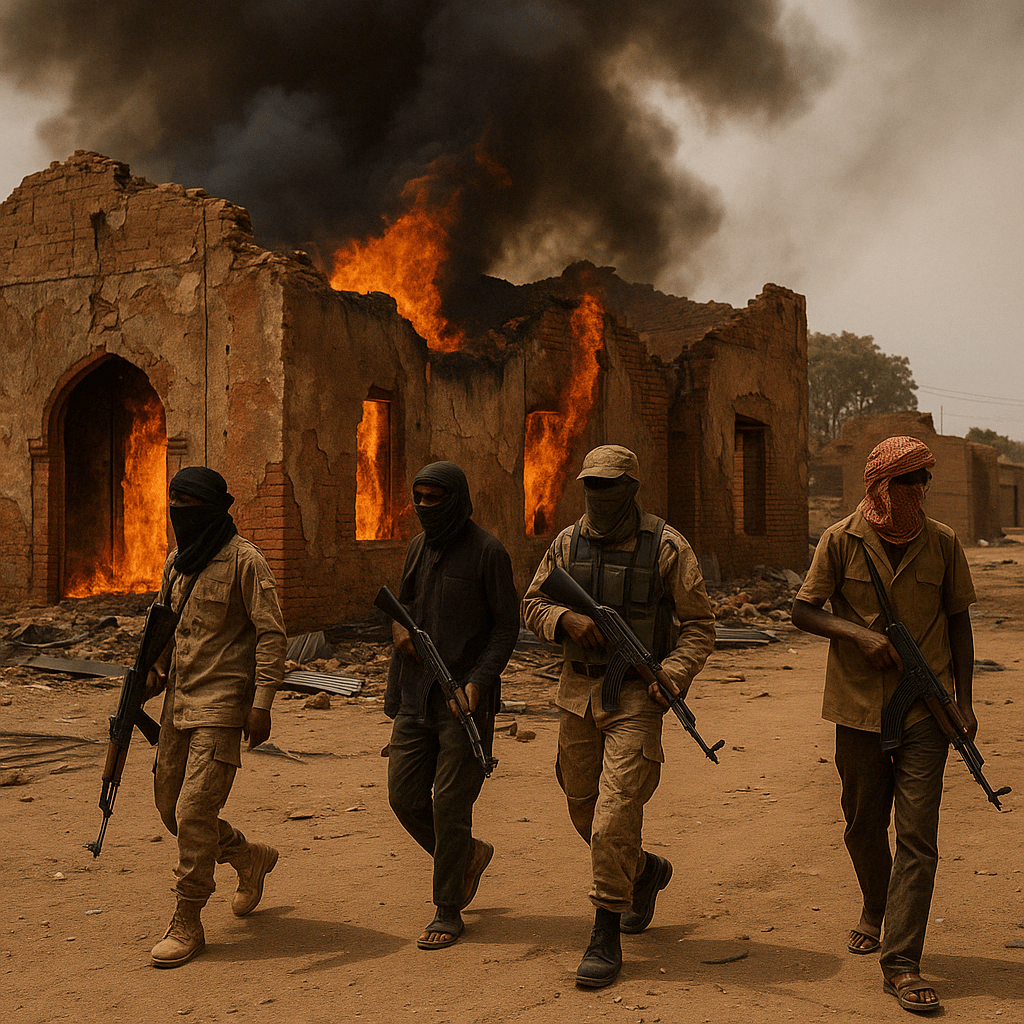
Weaponized Information | By Price Kapone
Empire Doesn’t Leave—It Evolves
When the British packed up their flags in 1956, they didn’t really leave Sudan. They just swapped out uniforms. Instead of redcoats, we got generals in tailored suits. Instead of the Crown, we got the IMF. Instead of Maxim guns, we got NGO peacekeepers, oil contracts, and Gulf-backed militias.
This wasn’t freedom. It was a rebranding of empire. Sudan didn’t step into independence—it was shoved into a trapdoor called neocolonialism. And every so-called civil war since then? Every rebellion, every massacre, every round of negotiations and ceasefires? All of it was imperial counterinsurgency dressed up as internal dysfunction.
This is the anatomy of sabotage. And here’s how it unfolded.
I. Paper Independence and the First Civil War (1955–1972)
Sudan was declared independent in 1956, but the war started the year before. Southern soldiers in Torit rebelled against Northern officers in 1955, because they already knew what was coming: a government run by Northern elites trained by the British, serving the same interests as before.
The South had no stake in the so-called national project. It had no infrastructure, no power, no representation. What it had was occupation.
The First Civil War wasn’t about tribal grievances. It was a rebellion against internal colonialism, plain and simple. And for 17 years, the Sudanese state—backed quietly by its old colonial patrons—waged war against the very people it claimed to represent.
The Addis Ababa Agreement of 1972 ended the war on paper. But it didn’t build a nation. It just paused the gunfire.
II. Enter the Oil Barons, Exit the Illusion of Peace (1972–1989)
Once the South had been battered into submission, the vultures came for the oil.
Chevron discovered oil in Southern Sudan in 1979. That was the end of the truce.
Sudanese dictator Jaafar Nimeiry, backed by the U.S., the Saudis, and sometimes even the Israelis, tore up the peace deal, broke Sudan into fragments again, and imposed Sharia law across the whole country in 1983.
The result?
- Southern autonomy revoked.
- Villages razed to clear paths for pipelines.
- A whole population treated like a security threat standing in the way of oil.
The South responded with fire. Dr. John Garang, a Southern Marxist trained in the U.S., formed the Sudan People’s Liberation Army/Movement (SPLA/M)—not to secede, but to build a new Sudan, one where the whole country could breathe.
The civil war reignited—but now the conflict was bigger than territory. It was about who gets to own the future.
III. The Partition Trap (1983–2011)
The Second Civil War became one of the longest and deadliest in modern history.
- The North got backing from China, Iran, and Saudi Arabia.
- The South got just enough help from the U.S. and Ethiopia to keep fighting—but never enough to win.
Why? Because no one in Washington or London or Riyadh wanted a truly independent Sudan. They wanted leverage, not liberation.
By 2005, the war was declared “over” with the Comprehensive Peace Agreement—brokered by the same imperial troika that had always been circling Sudan like buzzards.
- 2011: South Sudan becomes its own country.
- But it’s landlocked, surrounded, underdeveloped, and completely dependent on Northern pipelines and foreign donors.
This wasn’t sovereignty. It was a colonial extraction zone in new wrapping. They gave South Sudan a flag, but no tools. A seat at the UN, but no future.
IV. The Janjaweed and the Business of Genocide (2003–Now)
While everyone was focused on the North-South war, another fire was lit in the West: Darfur.
- In 2003, Darfuri rebels—fed up with being abandoned by Khartoum—took up arms.
- Khartoum responded with the Janjaweed, mounted militias unleashed like rabid dogs.
Entire villages were wiped off the map. Women were raped, men slaughtered, kids starved.
What did the international community do?
- Cried crocodile tears.
- Issued statements.
- Kept buying Sudanese gold.
The Janjaweed later morphed into the Rapid Support Forces (RSF), led by Mohamed Hamdan Dagalo—aka Hemedti. The RSF wasn’t just a militia. It was a private military enterprise:
- Guarding gold mines for Emirati investors.
- Fighting in Libya and Yemen for Gulf paymasters.
- Smuggling weapons with quiet nods from Western intelligence.
This was counterinsurgency in the age of technofascism: privatized, racialized, and monetized.
V. The People Rise, the Generals Tighten the Noose (2019–2025)
In 2019, the Sudanese people rose again. After decades of dictatorship, they flooded the streets, demanding a new beginning.
They got betrayal.
A sham transition. A few token civilians. The same generals holding the guns and calling the shots.
- In 2021, the military seized full control.
- In 2023, the RSF turned on the Sudanese Armed Forces.
- Now, the country is caught in a two-headed imperial war:
- Burhan’s SAF backed by Egypt and Western states.
- Hemedti’s RSF funded by the UAE and armed through transnational black markets.
Khartoum is a battlefield. Darfur is a graveyard. The international community shrugs.
But this isn’t just a power struggle. It’s a full-spectrum counterinsurgency:
- Wipe out any memory of unity.
- Control the Red Sea ports.
- Secure the gold fields.
- Keep the country too divided to resist.
From Torit to El Geneina—The Struggle Continues
Sudan today is not in chaos. It’s in checkmate—trapped by borders it didn’t draw, governments it didn’t choose, and wars it didn’t start.
But the Sudanese people keep rising. In every refugee camp, in every underground organizing cell, in every act of defiance, they show us that this is not over.
They remind us of something Walter Rodney taught us: underdevelopment is not a condition—it’s a process imposed from outside.
And what is being done to Sudan is not just war. It is genocide, orchestrated by imperial subcontractors and enforced by the logic of capital.
We stand with Sudan—not as charity, but as comrades. Their struggle is ours.
 Weaponized Information
Leave a comment