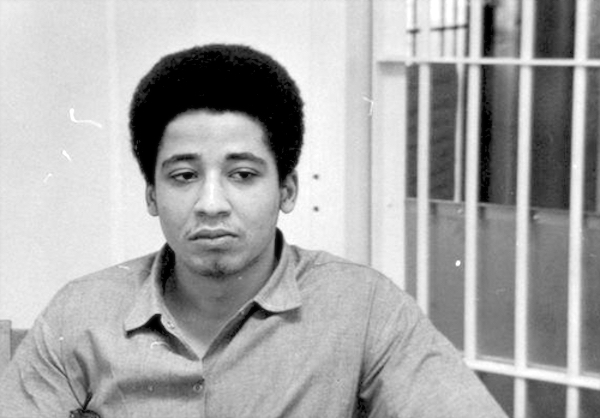
“Settle your quarrels, come together, understand the reality of our situation, understand that fascism is already here.”
— George Jackson
The People’s General Behind Bars
George Jackson didn’t go to Harvard. He didn’t sit on a nonprofit board. He wasn’t part of any liberal coalition that promised change and delivered nothing. He was a prisoner of war in a country that doesn’t admit it’s at war with Black people. He was a communist. A soldier. A theorist. And a freedom fighter who was forged inside the jaws of the U.S. prison system.
He was caged because the state couldn’t control him—and killed because they couldn’t silence him.
Jackson was the kind of revolutionary this empire fears most: one who told the truth, not just about capitalism or racism, but about the entire settler-colonial machine and how it works. He knew the United States was not broken. It was doing exactly what it was designed to do—discipline, contain, and crush the colonized poor, especially Black people.
He saw fascism not as something coming—but something already here. Something that had always been here. Something stitched into the bones of America, from the slave ships to the prisons.
His words weren’t decoration. They were weapons.
Part I: From the Block to the Books to the Barrel
George Jackson came up like millions of others—poor, Black, and criminalized before he had a chance. He was thrown in prison at 18 for a gas station stick-up, sentenced to “one year to life”—a legal sleight of hand that meant the state could keep him locked up forever if they felt like it. And they did.
But prison didn’t break him. It trained him.
He read everything—Marx, Mao, Fanon, Che. Not to show off, but to understand how empire works and how to destroy it. He didn’t just study revolution. He started building it. Inside the walls. Among the lumpen. Among those the system had already buried alive.
He joined the Black Panther Party and brought revolution into the prison yards. He turned cells into classrooms. He turned anger into ideology. He turned criminalized Black men into political cadres.
He called prison what it was: a colonial holding pen. A high-tech plantation. A lab for counterinsurgency. And he warned: if they can do it to us, they’ll do it to you too.
George Jackson didn’t just see through the system—he made others see it too. And that’s what made him dangerous.
Part II: Blood in My Eye and the Science of Revolution
In Blood in My Eye, Jackson laid it out plain. There’s no reforming this system. No appealing to its morals. No fixing it with another election or another speech from some smiling politician. This system is rotten from the root, because it was built on stolen land, stolen labor, and stolen life.
Jackson wasn’t interested in tweaking the machine. He wanted it dismantled.
He called it fascism—not as a slur, but as a scientific diagnosis. A monopoly capitalist system in crisis, managed by a militarized, technocratic state that uses fear, surveillance, and brute force to maintain white ruling-class power. Sound familiar?
He saw how they dressed it up in laws and liberal language. How they used the courts, the cops, the media, and the NGOs to pacify the people and bury the resistance. He called it what it was: a war. And in war, you don’t ask for justice. You fight for liberation.
George didn’t flinch. He told us: If you want freedom, you better be ready to struggle. Not just to march or vote, but to organize. To train. To understand what you’re up against. And to be prepared to meet force with force if needed.
He wasn’t writing for the academy. He was writing for the streets. For the comrades. For the ones who know what it means to be hunted but not broken.
Part III: Assassinated by the State, Raised by the People
On August 21, 1971, they assassinated George Jackson in San Quentin. They said he was trying to escape. But anyone who read Blood in My Eye knows—George Jackson wasn’t trying to run. He was trying to build a revolution. And that’s what scared them.
He was 29 years old. A field general cut down in the middle of the war.
But his death didn’t stop the movement. If anything, it lit a fire. Across the country, prisoners picked up his books like they were blueprints. Black and Brown revolutionaries studied his words like scripture. And the state doubled down—because they knew this wasn’t just about one man. It was about the seeds he planted.
His words still haunt the walls of every prison. His name still echoes in every uprising. His analysis—of fascism, of the prison-industrial complex, of the war against the lumpen—wasn’t just ahead of its time. It made our time.
Today, in the age of facial recognition and drone warfare, ankle monitors and predictive policing, George Jackson’s analysis is more urgent than ever. In the era of technofascism, where the empire hides its bullets behind algorithms and its chains behind “security,” we need Jackson’s clarity. We need his courage. We need his vision.
George Jackson was not a victim of the system. He was a fighter against it. He didn’t just call for change—he called for power. And power only comes through organized struggle.
George Jackson was no reformer. He didn’t write for applause or position. He wrote because he knew what time it was. He was a guerrilla intellectual in the heart of empire. A revolutionary forged in the furnace of fascism. A man who gave his life so others could find the path to freedom.
He didn’t beg the empire to be better. He fought for the world to be free. And for that, he became eternal.
 Weaponized Information
Leave a comment