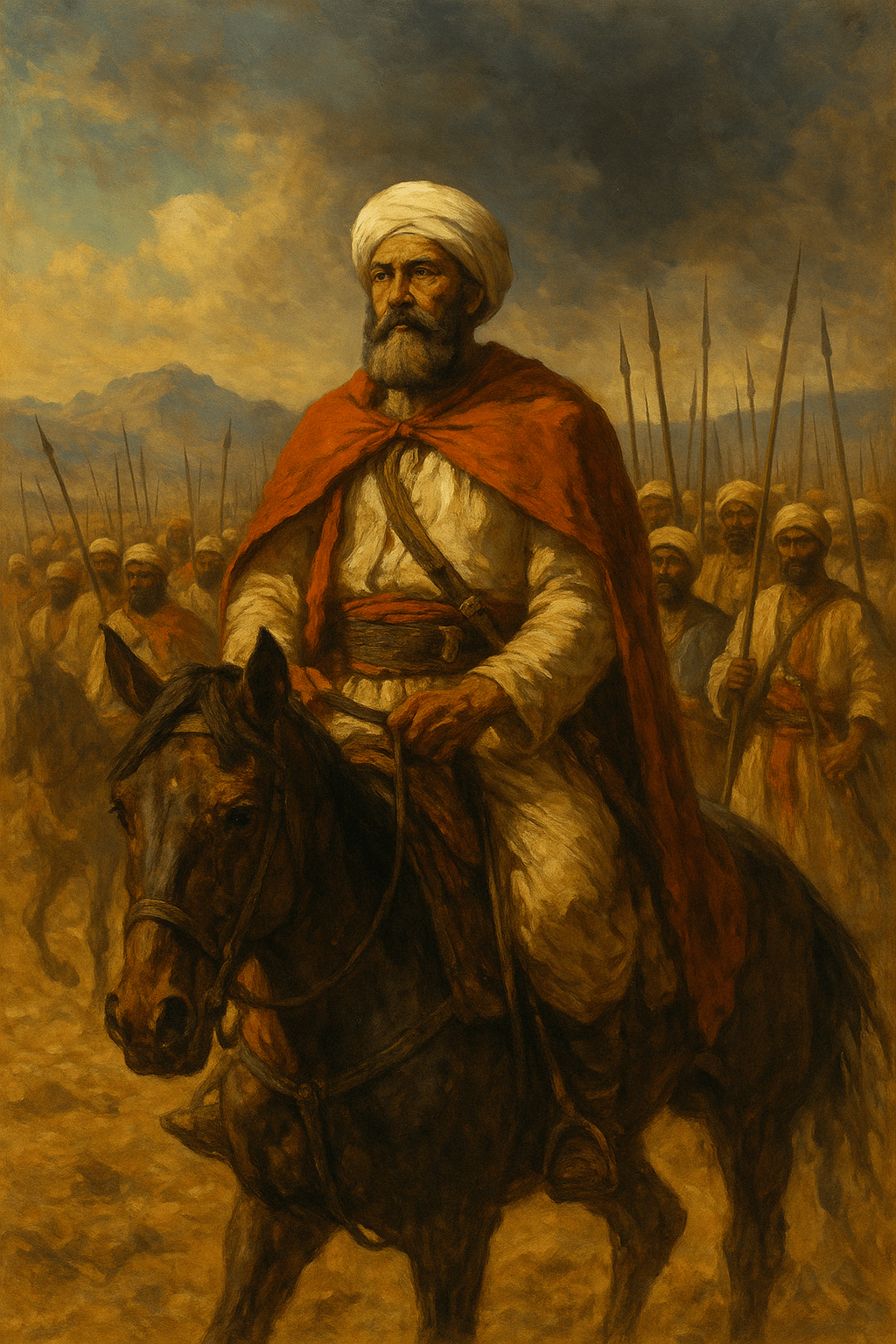
By Prince Kapone | Weaponized Information
From Khartoum to Cairo—Reframing a History Written by Empire
When I started digging into the story of Sudan’s dismemberment, I didn’t expect to end up staring into the face of Muhammad Ali—the so-called founder of modern Egypt. But history doesn’t flow in straight lines. It bleeds, folds, and echoes. And if you follow the blood, it will take you back not just to Khartoum, but to Cairo, and from there, into the core of the colonial world-system.
Muhammad Ali’s 1821 campaign into Sudan has often been painted as Egypt’s own imperial adventure—a case of Africans colonizing Africans, no different from what Britain or France did later. That framing is not just lazy—it’s dangerous. It lets Europe off the hook. It pretends that all violence is the same, that all conquests come from the same place. But they don’t. Not even close.
Ali didn’t invade Sudan because he dreamed of empire. He invaded because empire was already at his throat. Europe had just finished looting the Americas. It was devouring India, partitioning the Caribbean, and slicing through the Ottoman world. Egypt had barely survived Napoleon’s invasion. The British were sniffing around the Nile. The Ottomans were falling apart. The whole Global South was being fenced in by cannons, debt, and trade.
Muhammad Ali had two choices: consolidate, or be consumed. He chose to consolidate. That meant building an army, an economy, and a buffer zone. And that meant Sudan. It wasn’t a liberation. But it wasn’t imperialism either—not the kind cooked up in London and Paris.
This is what we now call Anti-Colonial Consolidation:
When a semi-colonized or besieged state expands its territory or strengthens its control—not to enrich capital or rule the world, but to survive in a system designed to destroy it. It’s messy, it’s contradictory, and it’s often violent. But it’s not the same as imperialism. Not by a long shot.
I. Building a Fortress in a Burning World
Muhammad Ali rolls into Egypt in the early 1800s with the Ottoman army. He’s Albanian by birth, no Egyptian roots, no popular mandate. But he’s smart. He plays the factions, crushes the feudal Mamluks, and by 1805, he’s running the show.
And what does he do? He centralizes power. He builds a new bureaucracy. He drafts peasants into a modern army. He seizes land and controls trade. He opens factories, shipyards, arsenals. He sends students to Europe to study engineering, medicine, and military science. He builds a state—not for the people, but to stop Egypt from becoming just another European colony.
Was it pretty? No. He taxed the peasants into the dirt. He used forced labor like it was nothing. He wasn’t reading Fanon or Marx. But he was trying to do something that mattered: build enough power to keep the empire out.
And for that, he needed more bodies. More resources. More space. Enter Sudan.
II. Sudan: Not a Prize, But a Shield
In 1821, Ali sent his armies south. Not to “civilize” anyone. Not to build a cotton plantation empire. He needed men for his army. He needed gold to pay for his factories. And he needed a southern flank that wasn’t wide open to European penetration.
Sudan wasn’t weak. It wasn’t backward. It had its own social formations, trade networks, and resistance movements. But to Ali, it was either absorb or be absorbed. That’s the logic of anti-colonial consolidation. The logic of a man trying to build a shield out of what little territory and leverage he had left.
Yes, it was violent. Yes, it created hierarchies. But it wasn’t capitalist imperialism. It wasn’t rooted in monopoly finance capital, in racial ideologies, in the extraction of value for European accumulation. It was reactive. Defensive. Born in a system where if you didn’t expand, you got swallowed.
We don’t excuse it. But we don’t flatten it either.
III. Ethiopia and the Subaltern Dilemma
Fast forward a few decades. Look at Menelik II in Ethiopia.
Between 1870 and 1910, Ethiopia expands into Oromo lands, Somali territory, and the southern peripheries. It’s brutal. It’s bloody. And it leaves wounds that still haven’t healed.
But Ethiopia wasn’t Britain. It wasn’t Belgium. It was the last African nation standing as the rest of the continent got carved up like a carcass.
- Italy had taken Eritrea.
- Britain had taken Kenya and Sudan.
- France was sitting in Djibouti.
Menelik wasn’t building empire. He was building a moat. He saw what happened to Algeria, to the Zulu, to the Ashanti. He knew what was coming. So he struck first—not out of greed, but out of fear.
This, again, is anti-colonial consolidation. It’s survival wrapped in the language and violence of statecraft. It created problems. But those problems were created inside the cage built by empire.
IV. Why This Distinction Matters
If we don’t name this properly, the empire gets to rewrite history. They say: “See? Africans were colonizing each other. We just did it better.”
That’s a lie. Europe didn’t just expand. It built a system: of slavery, racial capitalism, financial domination, and global apartheid. Egypt and Ethiopia didn’t do that. They didn’t invent the plantation, the Berlin Conference, or the IMF.
What they did was react—often badly, often violently—to a world that was already on fire.
Muhammad Ali wasn’t a liberator. But he wasn’t a colonizer in the mold of Leopold or Rhodes. He was a man trying to build a wall out of blood and brick before the storm consumed him.
If we don’t understand that, we mistake the flailing of the subaltern for the strategy of the master.
V. The Science of Liberation Begins with Clarity
Revolutionary history isn’t clean. It’s not about saints and sinners. It’s about contradictions. And Muhammad Ali was a walking contradiction.
He built factories, but bled the peasants. He modernized education, but crushed dissent. He invaded Sudan, not for empire, but to protect Egypt from empire. In doing so, he became a mirror of the system he feared.
That’s the tragedy of subaltern statecraft: you either resist empire, or you become a smaller version of it. And without a revolutionary rupture—without a people’s movement, without socialist theory, without international solidarity—you don’t break the cage. You reinforce it.
But history moves. And the tools he didn’t have—Marxism, Leninism, Pan-Africanism, the October Revolution—we do.
This time, it won’t be about building a state to delay the empire.
This time, it’ll be about overthrowing the empire itself.
End.
 Weaponized Information
Leave a comment