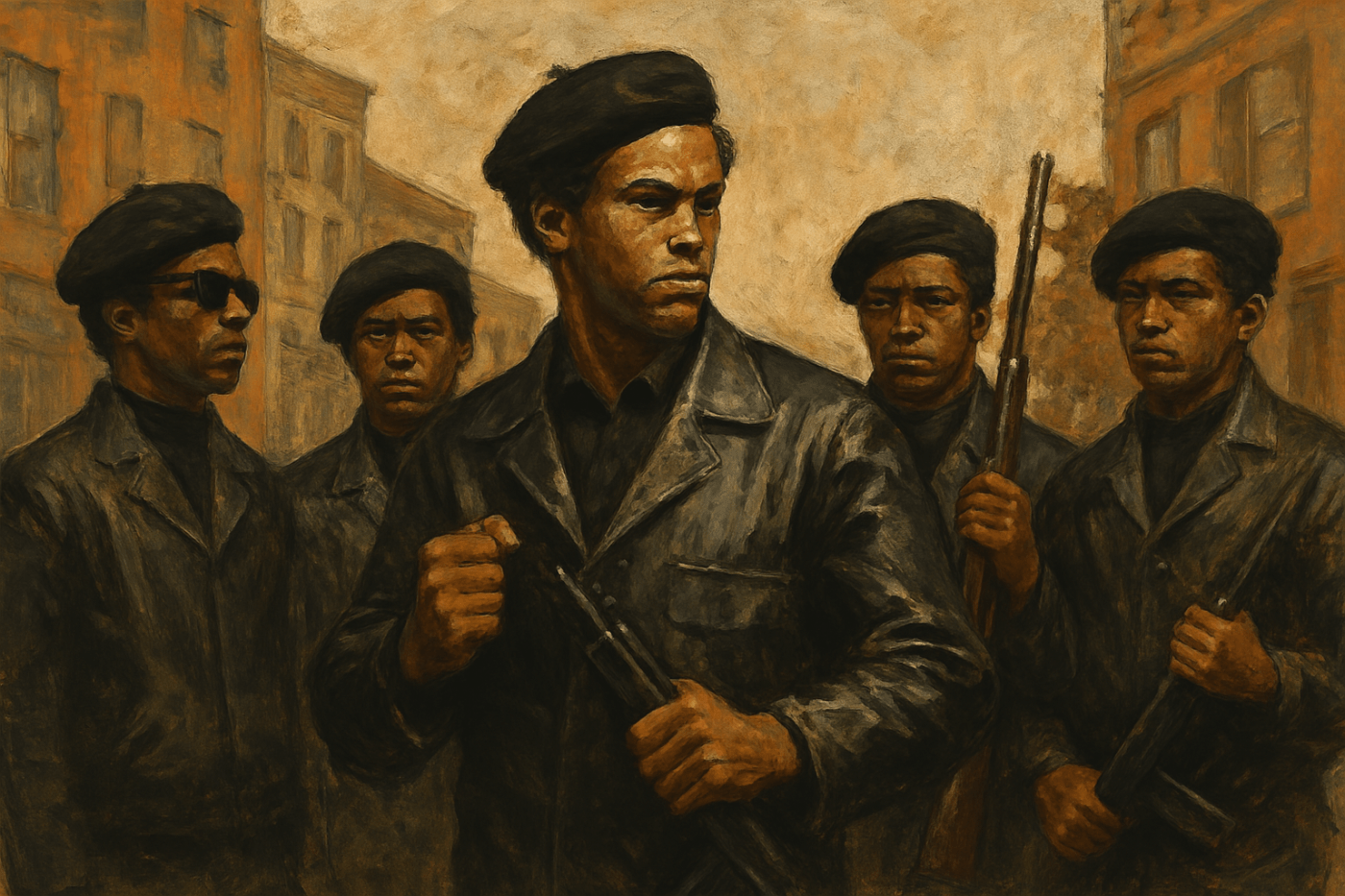
The Most Dangerous Man in America
“We do not fight racism with racism. We fight racism with solidarity. We do not fight capitalism with Black capitalism. We fight capitalism with socialism.” — Fred Hampton
To the FBI, Huey P. Newton was the most dangerous man in America. Not because he had an army. Not because he had money. But because he had something far more powerful: a plan.
Huey was not a gangster. He was not a cult leader. He was a revolutionary intellectual and a guerrilla strategist who understood the colonial condition of Black people in the United States—and dared to organize a political party to fight it. He created the most advanced revolutionary organization in U.S. history: the Black Panther Party for Self-Defense.
In the late 1960s, while liberal civil rights leaders begged for integration and reform, Huey built something far more threatening: embryonic dual and contending power. He and the Panthers did not ask the state to serve the people—they made the state irrelevant in Black communities. They fed children, educated youth, defended neighborhoods, and provided healthcare and dignity in zones the state had abandoned or repressed.
Huey understood that Black America was not simply oppressed—it was colonized. And like all colonized peoples, its path to liberation required organization, political education, and people’s power. He studied Marx, Fanon, Lenin, Mao, and matched theory with practice on the streets of Oakland. The result was a revolutionary force so effective, the U.S. government unleashed its most vicious counterinsurgency programs to destroy it.
This is why they had to turn Huey into a villain. Why they fed the myth of the thug, the lunatic, the fallen idol. Because if people remembered who he truly was—a disciplined revolutionary who tried to build socialism inside the empire—they might pick up where he left off.
Huey wasn’t a gangster. He was building power. And that’s what terrified the system.
Part I: Revolutionary Genius in the Belly of the Beast
Huey Percy Newton was not born into ideology. He was born into Jim Crow. Into police terror, ghetto poverty, and a racist educational system designed to break Black children before they could dream. He learned to read late, fought through schools that dismissed him, and navigated a system built to contain him. But Huey refused containment. He turned his survival into a science.
He studied law and philosophy, not to posture but to arm himself intellectually for battle. He read Rousseau and Hegel, Marx and Lenin, Mao and Fanon—not as a student, but as a strategist. What he found was this: the conditions of Black people in the U.S. mirrored those of colonized people worldwide. Poverty, violence, underdevelopment, police occupation—this was not simply racism. It was colonial domination.
With Bobby Seale, Huey co-founded the Black Panther Party for Self-Defense in 1966. From the very start, it was rooted in practice, not platitudes. The Ten-Point Program wasn’t a dream—it was a set of demands grounded in the lived reality of the Black working class: land, bread, housing, education, clothing, justice, and peace.
The Panthers were not just protesting—they were organizing. Armed patrols monitored police behavior. Clinics treated the sick. Free Breakfast Programs fed thousands of children every morning. Liberation schools taught revolutionary theory alongside reading and math. Every initiative was designed to meet a material need while sharpening political consciousness.
Huey’s genius was not just tactical—it was dialectical. He understood that revolution is not a moment, but a process. That the people must not just be defended, but trained to lead. That dual power is not charity—it is sovereignty being built from below.
The Party was never about optics. It was about preparing for the seizure of power, block by block, city by city. And Huey was its principal architect.
Part II: The Science of Dual Power
Huey Newton didn’t just read revolution—he theorized it, organized it, and lived it. His greatest contribution wasn’t rhetoric, but infrastructure. He understood that in order to destroy the power of the oppressor, you must build the power of the oppressed. That’s what the Black Panther Party did: it created embryonic dual and contending power in the heart of the American empire.
While politicians debated civil rights bills, Panthers provided survival. They organized more than 60 community programs across the country: free breakfast for children, free health clinics, sickle cell testing, ambulance services, legal aid, senior escort services, drug rehabilitation, even pest control. These weren’t charity programs—they were counter-state structures. They met people’s needs while exposing the state’s failures.
Huey called these programs “survival pending revolution.” But they weren’t passive. They were political education in action. Each breakfast plate, each medical checkup, each book handed to a child was part of a broader struggle to raise consciousness and prepare the people for power.
This wasn’t reformism. It was revolutionary rehearsal.
Huey and the Panthers studied the successful revolutionary movements of the Global South—China, Vietnam, Algeria—and adapted them to the conditions of the Black colony within the U.S. They knew that armed struggle alone wasn’t enough. It had to be grounded in mass organization and material transformation. The Panthers didn’t just carry guns to look militant. They carried guns because the police were a colonial occupation force—and the people had the right to defend themselves.
Dual power was not a slogan. It was a blueprint. And it worked—too well.
As the Party grew, its presence in Black communities challenged the legitimacy of the U.S. state. People didn’t just support the Panthers—they relied on them. And that is what made Huey P. Newton a target. He had done what no other Black leader had dared: he began to make the existing system obsolete.
Part III: The Counterinsurgency Machine and the Demonization of Huey
The U.S. government did not fear the Panthers because they were violent—it feared them because they were effective. In 1969, FBI Director J. Edgar Hoover declared the Black Panther Party “the greatest threat to the internal security of the United States.” Not because they were burning buildings. Because they were feeding children, organizing tenants, politicizing prisoners, and building a base of proletarian power that no mayor, police chief, or senator could control.
COINTELPRO—the FBI’s Counterintelligence Program—was unleashed like a domestic war machine. It infiltrated the Party, forged documents, spread rumors, and turned comrades against each other. Panther leaders were harassed, arrested, assassinated. Fred Hampton was murdered in his bed. Dozens were imprisoned or forced into exile. And Huey himself was targeted constantly—by local police, federal agents, and the media.
Huey went from revolutionary hero to criminal caricature almost overnight. The press stopped quoting his speeches and started printing his mugshots. Every contradiction in his personal life was amplified, distorted, and weaponized. They wanted to turn a political visionary into a cautionary tale. They called him unstable, violent, egotistical—anything but revolutionary.
But the real threat was never Huey’s personality. It was his politics. It was the fact that he was organizing colonized people into a disciplined, armed, and conscious force within the imperial core. It was that he knew the terrain, understood the theory, and had the charisma to move masses. That’s why the state did what it always does to leaders of the oppressed: isolate, vilify, and neutralize.
What they couldn’t destroy outright, they tried to bury in myth. The Panther legacy was reduced to style, to imagery, to pop culture. But the politics—the socialism, the dual power strategy, the anti-colonial framework—was erased.
And Huey, the architect of it all, was written out of history.
Part IV: Revolutionary Theory—Intercommunalism and the Global Class Struggle
Huey Newton was not content to repeat Marxist orthodoxy. He understood that revolution was a living science, and that theory must evolve with conditions. By the early 1970s, as U.S. imperialism deepened its global grip through finance, media, and military power, Huey advanced a new framework: revolutionary intercommunalism.
According to Huey, classical notions of nation-states and national liberation had to be reexamined. The U.S. empire was not simply a state—it was a global system that had dissolved the independence of weaker nations, turning them into satellites of corporate and military control. The “nation” had become hollow. In its place, the world had been reorganized into communities—some with power (like the ruling class in the U.S.) and most without (like colonized communities worldwide).
This wasn’t a rejection of nationalism—it was a refinement. Huey still believed Black America was a colony, but he now saw it as part of a planetary system of exploitation that required a global strategy of resistance. The old categories of First and Third World were dissolving. In their place, he saw oppressed communities—connected by conditions, not geography.
Intercommunalism meant building power not by borders, but by class position. It meant linking the struggle in Oakland to the struggle in Angola, Palestine, Vietnam, and the Caribbean. It meant organizing where people lived, worked, and suffered—not waiting for nation-states to change. It was a theory forged in prison, sharpened by global struggle, and grounded in revolutionary realism.
Huey’s intercommunalism made the Party internationalist in orientation. It aligned with anti-colonial struggles, anti-capitalist movements, and socialist revolutions from Cuba to Mozambique. He saw that liberation could not be local—it had to be global, decentralized, and rooted in material self-determination.
Conclusion: Huey Lives in Every Struggle for Power
Huey Newton was not a gangster. He was a revolutionary theoretician, tactician, and builder of power. He did not seek attention—he sought liberation. He did not glorify violence—he organized defense. He did not chase fame—he chased freedom.
The Black Panther Party he co-founded was not perfect. It was young, besieged, and experimental. But it did something no other organization in U.S. history had accomplished: it built embryonic socialist governance in oppressed communities under siege. It gave the people food, medicine, education, and protection—and taught them how to fight for themselves.
The empire had to destroy it. And to do that, it had to destroy Huey. Not just his life, but his legacy. Turn him into a mugshot. Strip him of ideology. Reduce him to spectacle. But they failed. Because every revolutionary who builds dual power today walks in Huey’s footsteps.
He lives in mutual aid that teaches political education. In health clinics run by the people. In housing takeovers, street patrols, freedom schools, radical defense formations. He lives wherever the oppressed move from protest to power.
Huey Newton was not what they say. He was not a criminal. He was not a cult leader. He was not a fallen star. He was a scientist of revolution. A son of the colony. A leader of the future.
And that, more than anything, is why they still lie about him.
 Weaponized Information
Leave a comment