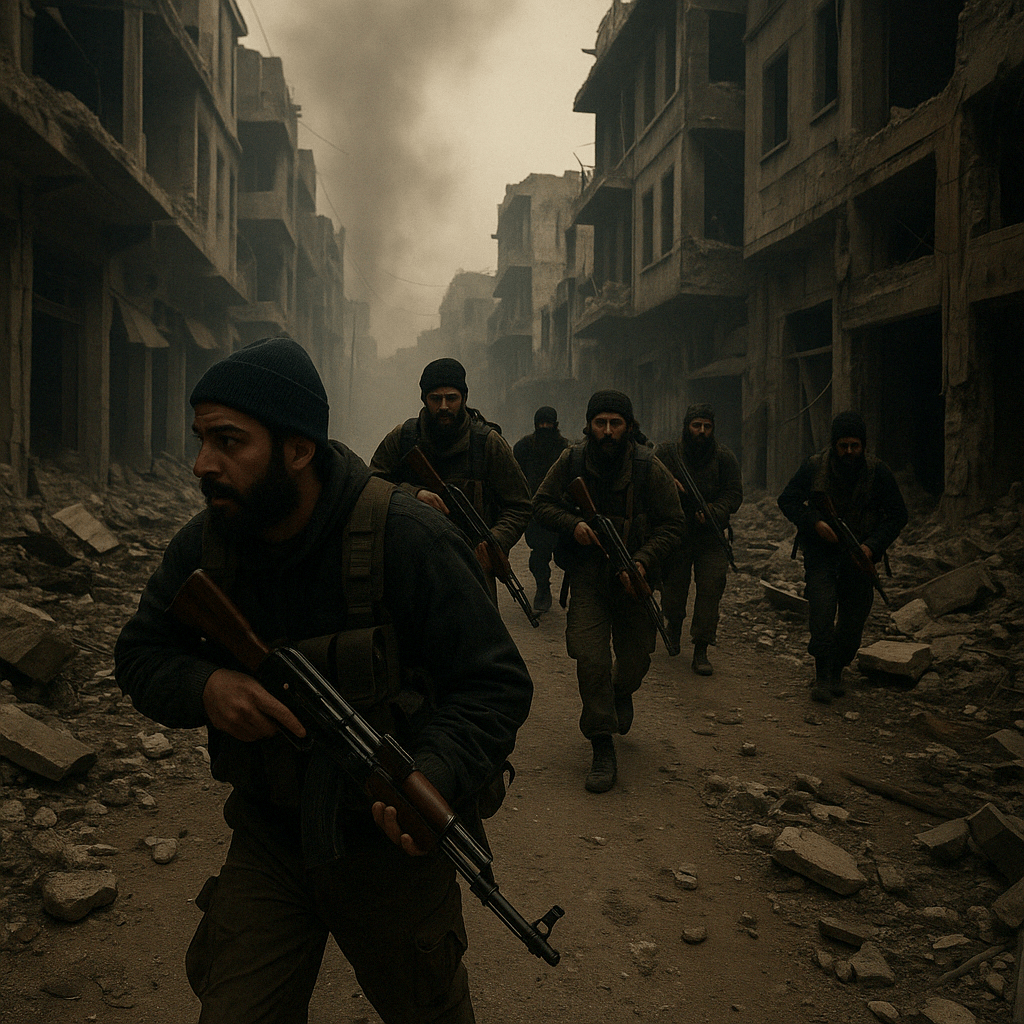
What empire installs, it cannot control. The failed coup inside Syria’s so-called transitional government shows that you can change the puppets—but the strings always tangle. And the people still ain’t free.
I. A Crack in the Puppet State
You can dress up a warlord in a suit, give him a fake parliament, and call it democracy—but at the end of the day, it’s still a puppet show. And right now, the strings are snapping.
A few months after the fall of Assad—toppled by years of U.S.-engineered war and CIA-backed jihadists—the regime of Abu Mohammad al-Jolani is already wobbling. Not from a popular uprising, but from a coup attempt inside his own house. Another faction of imperial errand boys tried to take over the contract. They failed. But their failure tells us more than their success ever could.
II. From Assad to Al-Qaeda: Empire’s Favorite Makeover
Let’s rewind. The U.S. didn’t just trip into Syria. It poured billions into burning the place down. Operation Timber Sycamore—the most expensive covert op in Langley’s history—trained, armed, and funded every reactionary with a beard and a grievance. The goal? Break Syria’s alliance with Iran and Russia, and shatter any illusion of sovereignty in the region.
It worked. Eventually. Assad fell. But in his place came HTS, led by al-Jolani—a man who once pledged loyalty to al-Qaeda and now smiles for cameras at U.N. summits. Washington calls this a “transition.” Damascus calls it occupation with better branding.
And Jolani didn’t waste time proving his loyalty. In March 2025, his forces massacred over 200 Alawite civilians in Latakia. The Western press barely blinked. The State Department shrugged. The empire doesn’t care what the puppet does—as long as he dances when the music plays.
III. A Coup Inside a Coup
So now, a new faction tried to snatch the throne. HTS commanders left out of the loot circle. Ex-Ba’athist defectors with grudges. Maybe even some Turkish backers hedging their bets. The details are murky—intentionally so. But what’s clear is that this new regime, stitched together by mercenaries, technocrats, and foreign handlers, is already rotting from the inside.
Empire thought it was installing stability. What it built was a gang war in a government building.
IV. The Proxy Crisis Model
This is what we call hyper-imperialism. Not direct rule, not old-school colonies—but managed chaos. The U.S. doesn’t need to govern Syria. It just needs to make sure no one else can—especially not the Syrian people.
Jolani’s regime is a textbook case: sectarian fear as social policy, privatization of public goods, foreign advisers writing domestic law. The whole show is run out of embassies, intelligence briefings, and think tank cocktails. But you can’t outsource legitimacy. You can’t drone strike your way to popular support.
V. The People Haven’t Spoken—Yet
This coup attempt wasn’t the revolution. It was the fallout of empire’s arrogance. But revolutions are born in the cracks of the old order—and the cracks are showing.
From the neighborhoods of Aleppo to the camps in Lebanon, people remember. They remember the bombs, the lies, the betrayal. And they are not fooled by bearded bureaucrats with Western funding.
The real fight is still ahead. And it won’t be won by warlords or strongmen—but by a new generation willing to build what both the Ba’ath and the jihadists destroyed: revolutionary unity, class power, and national liberation from below.
VI. Conclusion: Coup Season Is Just the Beginning
Empire can shuffle the deck all it wants. Jolani, Karzai, Guaidó—pick your puppet. But none of them can hold the center. They weren’t made to.
The U.S. tried to replace Syria with a client state. Now the client can’t keep its house in order. And behind the infighting, the mass graves, and the gaslit headlines, something else is stirring.
The people haven’t had their say yet. But when they do, it won’t be a press release. It’ll be a reckoning.
 Weaponized Information
Leave a comment