By Weaponized Information
“I left South Africa because I didn’t want to be conscripted and forced to oppress Black people,” Elon Musk once claimed, spinning a liberal fantasy of self-exile. In reality, the world’s richest white settler didn’t flee apartheid—he fled a decaying racial order that was no longer tenable in its old form. Today, from his perch as techno-overlord of Tesla, SpaceX, and X (formerly Twitter), Musk fires off tweets mocking South Africa’s post-apartheid governance while projecting himself as a global savior of civilization. The contradictions are staggering—but revealing.
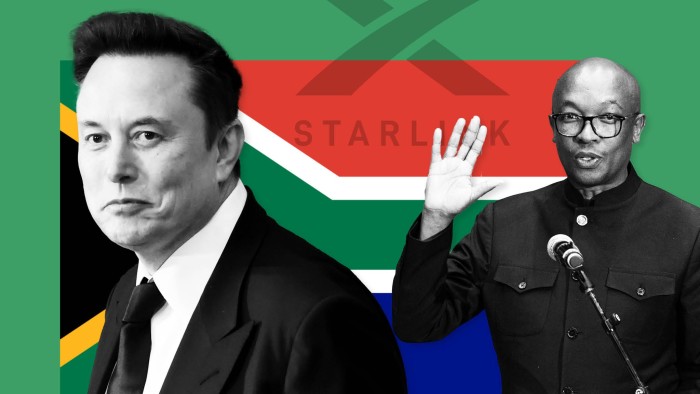
Musk’s recent attacks on the South African government, including veiled threats to cut off internet service via Starlink and inflammatory comments about the ruling ANC, aren’t just the tantrums of a billionaire with a fragile ego. They reflect a deeper neocolonial psychosis: the fantasy of a settler capitalist who believes that his technological empire entitles him to lecture, punish, and even replace democratic governments—especially those led by formerly colonized peoples.
White Flight, Capital Flight, and the Settler Tech Messiah
Musk’s story is often told as a Horatio Alger tale: from a young South African geek to a Silicon Valley god. But this mythology whitewashes the blood-soaked privilege he inherited. Musk’s father, Errol Musk, was involved in the emerald trade in Zambia during the 1980s, exchanging a plane for emeralds and importing them into South Africa [Business Insider]. While Errol Musk did not own an emerald mine, the family’s involvement in the trade reflects the broader context of wealth accumulation during apartheid.
When Musk relocated to North America, he didn’t abandon white supremacy—he updated it for the digital age. From surveillance cars to space militarism, his business empire fuses monopoly capital with state violence. It is not just capitalism; it is technofascism: the synthesis of Big Tech, Big Oil, and Big Brother under the direction of a colonial capitalist class clawing for permanent rule in the face of global decline.
His contempt for South Africa’s Black-led government is no anomaly. It is settler-colonial entitlement dressed in the garb of “rationality,” “innovation,” and “free speech.” When Musk attacks the ANC or promotes disinformation about “white genocide” in South Africa, he taps into a global far-right network that sees decolonization as the true crime [Washington Post].
Technofascism vs. African Sovereignty
The dispute over Starlink in South Africa isn’t just about internet access. It’s about control. Musk demands the right to operate above national law, outside of state regulation, and with no responsibility to the people whose land he exploits. He seeks not partnership, but dominion—a digital settler who wants to privatize the very airwaves.
But South Africa, like many African nations, has asserted its sovereign right to regulate foreign tech firms. Its communications authorities have refused to be bullied into granting Starlink special exemptions. And rightly so: Musk’s network is more than a business—it’s a surveillance platform with military applications, closely tied to U.S. imperial objectives [The Africa Report]. His tantrum at South Africa is the rage of a technofascist facing resistance from a people he thought would remain subordinate.
Weaponized History: From Cecil Rhodes to Elon Musk
Musk may drape himself in the language of the future, but his politics are as old as settler colonialism itself. Like Cecil Rhodes before him, Musk believes Africa is a playground for white capital. Like the British Empire, he wraps plunder in the rhetoric of civilization. But the Global South has learned from history. The ANC government’s pushback—however limited—signals the growing refusal of African states to bow before Silicon Valley’s empire.
This isn’t just a cultural or diplomatic spat. It’s part of a broader global struggle: between a decaying imperial core desperately clinging to control through technofascist networks, and a rising Global South determined to chart its own path. Musk, like Trump, represents the fascist wing of capital—one that will not hesitate to use every tool of economic coercion, information warfare, and privatized surveillance to crush dissent and recolonize the planet.
But history moves forward. The age of Rhodes is dead. The future belongs not to billionaire settlers but to the people who have resisted empire for centuries—and will continue to do so in the face of its digital reincarnations.
 Weaponized Information
Leave a comment