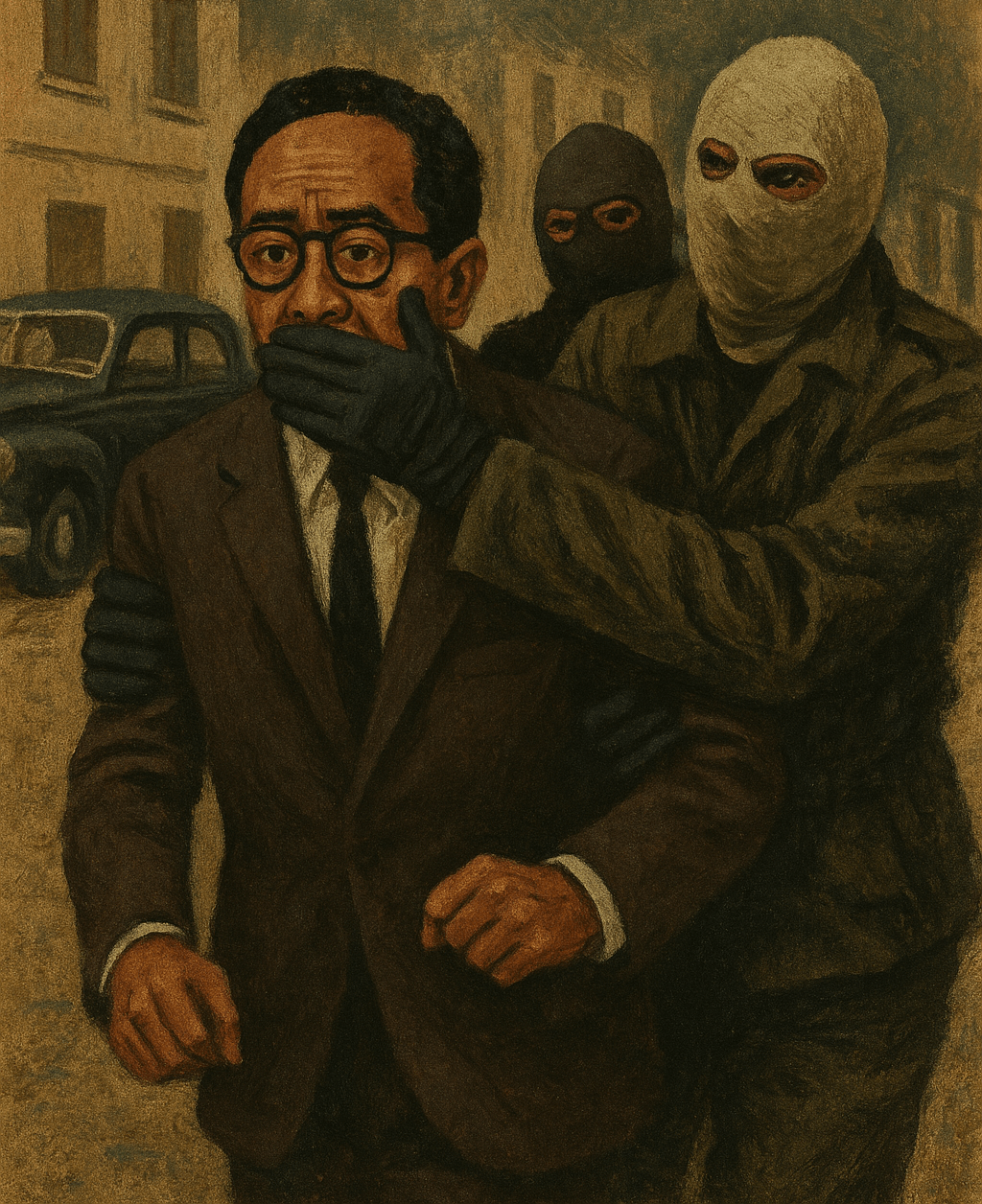
A Revolutionary Disappeared
Mehdi Ben Barka did not die a martyr on the battlefield. He did not perish in a heroic last stand. He was disappeared—abducted in the streets of Paris in 1965, tortured, murdered, and vanished without a trace. His body was never found. His name became a whisper. But his work lives.
Ben Barka was not a traitor. He was a threat.
A Moroccan anti-colonial leader, socialist theorist, and architect of the Tricontinental Conference, Ben Barka envisioned a new world—a unified front of Asia, Africa, and Latin America, rooted in anti-imperialism and revolutionary socialism. He sought to unite the Global South not just in struggle, but in strategy. He understood the necessity of theory, and the urgency of militant internationalism.
He knew that the decolonization wave would be turned back if it failed to become a social revolution. He knew that independence without transformation was a mirage. And he refused to betray that principle.
His disappearance was no mystery. It was a message. The French state, Moroccan monarchy, Mossad, and CIA all had their fingerprints on the case. Because Ben Barka was not simply organizing conferences—he was organizing history’s grave-diggers.
Ben Barka was no traitor. He was a revolutionary of the highest order. And the world still owes him justice.
Part I: From Moroccan Nationalism to Revolutionary Socialism
Mehdi Ben Barka was not born a Marxist. He came of age in a colonized Morocco where nationalist aspirations were shaped by monarchy, Islam, and the political terrain of the French protectorate. He entered politics not as a revolutionary, but as a nationalist reformer, determined to end colonial rule and build an independent state.
But independence came at a cost. In 1956, Morocco formally broke from France. Yet what emerged was not liberation—it was a neocolonial monarchy backed by the same imperial interests that had ruled the country for decades. The palace and its Western allies celebrated sovereignty while preserving the colonial class structure. Land remained concentrated. Wealth flowed outward. The people remained impoverished.
Ben Barka saw through the illusion. And he broke with the monarchy.
He founded the National Union of Popular Forces (UNFP), a socialist alternative to the traditional nationalist parties, and began to articulate a deeper vision of liberation—one that would address not just colonial occupation but capitalist underdevelopment, imperialist control, and elite betrayal. His base was not the court, but the people: the workers, students, and peasants who had fought for independence and received nothing in return.
From the ashes of nationalism, Ben Barka forged a revolutionary analysis. He traveled, studied, and engaged with radical thinkers across Africa, the Arab world, and Latin America. He became convinced that the anti-colonial struggle could not succeed in isolation. It required coordination. Unity. Theory. It required a tricontinental strategy to confront global imperialism.
And that is what he set out to build.
Part II: Tricontinentalism and the Global South’s Revolutionary Horizon
Mehdi Ben Barka understood that the era of isolated revolutions was over. The tide of national liberation had swept Africa, Asia, and Latin America, but it remained fragmented, vulnerable, and often trapped between the competing poles of Cold War imperialism. The solution, he argued, was not neutrality—but coordination. Not nonalignment—but unity in struggle.
He called it tricontinentalism: a revolutionary front of the Global South that would act not just as a bloc of states, but as a convergence of peoples, movements, and visions for anti-capitalist development. Ben Barka’s vision was clear—national independence was meaningless without economic liberation, class transformation, and solidarity beyond borders.
From Havana to Accra, from Algiers to Hanoi, he began building the intellectual and political architecture for a tricontinental revolution. In 1966, he organized the Tricontinental Conference to be held in Havana—intended to unite over 500 delegates from revolutionary parties, liberation movements, and socialist states. It would be the largest meeting of Third World revolutionaries in history.
For Ben Barka, this was not merely symbolic. It was strategic.
He envisioned the creation of a Permanent Secretariat of Tricontinental Solidarity, a mechanism to coordinate revolutionary struggles—logistics, weapons, education, media. He drafted documents on neo-colonialism, cultural warfare, and the international division of labor. He emphasized the role of intellectuals not as neutral observers, but as cadres of the revolution.
But the threat he posed was not limited to Morocco.
In France, where Ben Barka spent much of his time in exile, the political class watched nervously. In Washington, the CIA followed his movements with interest. In Israel, where he denounced Zionism as a settler colonial project and opposed Western domination of Arab regimes, Mossad began making inquiries. And in Morocco, the monarchy and its French patrons saw Ben Barka’s rise as an existential threat.
He was not just uniting revolutionaries. He was giving them coherence. And that, to empire, was intolerable.
Part III: The Disappearance of a Revolutionary and the Crime of Empire
On October 29, 1965, Mehdi Ben Barka was abducted outside the Brasserie Lipp in Paris by French police and Moroccan intelligence agents. He was scheduled to meet a French filmmaker to finalize a documentary on the upcoming Tricontinental Conference. He never made it to the meeting.
He was kidnapped in broad daylight on French soil.
For days, the French government denied involvement. Morocco stayed silent. Rumors swirled—he was in a safehouse, in a prison, perhaps alive. But weeks passed. Then years. Then decades. His body was never found.
The truth, partially revealed through leaks, testimony, and declassified documents, tells a chilling story.
The operation was planned in collaboration between Moroccan authorities, elements of the French deep state, and with knowledge—if not direct involvement—of U.S. and Israeli intelligence. Why? Because Ben Barka had become the connective tissue of the global revolution. He was too principled to be bought, too popular to be ignored, and too effective to be tolerated.
His elimination was an act of imperial counterinsurgency.
They didn’t just kill a man. They tried to kill a movement. His assassination, though denied by those responsible, was a preemptive strike against the organizational capacity of the Tricontinental. It was meant to sow fear, disrupt momentum, and decapitate the leadership of the Global South.
And in part, it worked.
The Havana conference went forward, but the absence of Ben Barka was a wound that never healed. He was supposed to preside over it, to articulate its vision. His documents circulated, but his voice was missing. The movement continued—but under siege.
Ben Barka became a symbol—not of defeat, but of dangerous clarity. Of a man who connected the dots before they could be erased. Of a revolutionary who frightened the empire not with violence, but with vision.
Part IV: Memory, Militancy, and the Struggle He Left Behind
Mehdi Ben Barka’s murder was never solved—not because it was unknowable, but because it was unspeakable. The states involved had too much to lose. France denied. Morocco lied. The CIA buried files. Mossad refused to comment. A web of silence stretched across continents.
But revolutionaries remember.
Ben Barka’s image still adorns walls in Havana, Algiers, and radical bookstores in the Global South. His writings are cited in underground journals and study groups. His vision lives—not in the dusty archives of diplomacy, but in the fire of every struggle that dares to connect land reform to education, anti-imperialism to socialism, national liberation to proletarian power.
He was not a figure of nostalgia. He was a strategist of revolution.
He understood that imperialism was no longer about occupation alone—it was about dependency, debt, cultural domination, and the suppression of autonomous development. He fought for a world where Bandung would become a barricade, where Algeria’s independence would inspire Bolivia’s insurgency, where the colonized would not just win flags, but wield power.
His murder was intended to destroy that dream.
But what empire failed to learn is this: when a revolutionary is disappeared, their absence does not erase their presence. It sharpens it. It turns flesh into fire. It makes memory militant.
Mehdi Ben Barka was no traitor. He was a threat to the system that fears revolutionary clarity. And though they stole his life, they could not bury his vision. That lives in us.
 Weaponized Information
Leave a comment