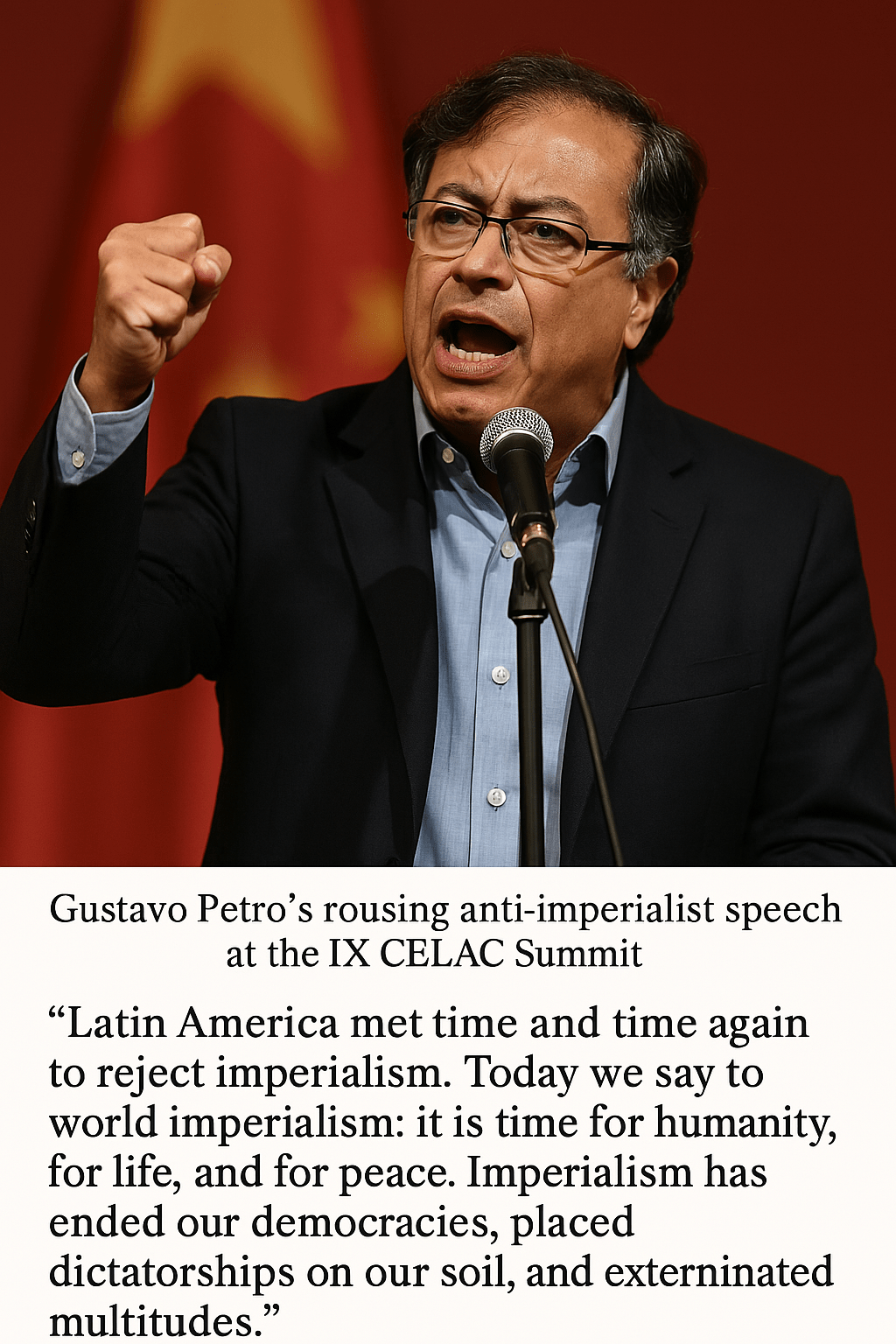
Gustavo Petro’s Full Speech at the IX CELAC Summit
Tegucigalpa, Honduras – April 9, 2025
Editorial Introduction:
At the IX Summit of the Community of Latin American and Caribbean States (CELAC) in Tegucigalpa, Colombian President Gustavo Petro delivered a sweeping and impassioned speech blending literary metaphor, political critique, and strategic vision. Drawing inspiration from Gabriel García Márquez’s “One Hundred Years of Solitude,” Petro warned of a global descent into fragmentation and destruction unless Latin America and the Caribbean unite under a new agenda of mutual aid, environmental justice, scientific reason, and democratic control over knowledge and technology. His words stood out at the summit for their clarity, historical perspective, and urgency in the face of escalating geopolitical crises.
Speech:
I greet the Republic of Honduras, Mrs. Xiomara Castro Sarmiento, and all the heads of state, presidents, ministers, foreign ministers, ambassadors of the countries that make up the Community of Latin American and Caribbean States, and in general, all the people who listen to us through the media and live broadcasts.
I will refer only to a few reflections on culture and our position in the world at this moment—the world we have now, the one we are living in.
I believe there is a global tension between two ways of solving problems: what they call multilateralism, and solitude.
Colombia had a very famous writer who wrote the most famous book in Colombia and the most universal of all: One Hundred Years of Solitude. It’s the story of Colombians killing each other for a century. Through those hundred years of solitude, we lost dreams—like Gran Colombia, for instance. We’ve lost possibilities in the world because we kept killing each other. And the problem still hasn’t ended.
If I extend this now to a global scale, I would say there’s a certain trend, a certain current, aiming for us to kill each other. And to live a century of solitude—as humanity. Because that Latin American century of solitude, the European century of solitude, the African century of solitude, the Chinese century of solitude… it has all been placed on the table. All of it, simply to preserve a power—a power that no longer serves humanity. If it did, solitude wouldn’t be necessary. Instead, multilateralism would be, which is how we have more or less managed to understand each other until now.
Multilateralism refers to the collective. Solitude implies we have no common problems and everyone must defend themselves. It’s a kind of neoliberalism taken to the extreme—from pure markets and simple society, extended now to all of humanity. Compete, defend yourselves however you can, don’t unite.
This is irrational and alien to the human species. Humanity has only survived on this planet by helping each other. According to documentaries, we even outlasted the Neanderthals. It’s in our genes—we overcame them only because they walked alone, and we walked in packs, in groups.
It was that group coordination, that mutual support, that allowed the human species to be where it is today on planet Earth.
Today’s invitation is to forget that. To ignore the million-year memory burned into our cerebral hard drive. And to behave like Neanderthals again—walking the path of extinction. Everyone goes their own way, and we’ll see what happens. But going solo means extinction. Maybe a few survive—the most powerful and most united ones.
So in this tension between multilateralism and solitude, now a global slogan, the economic dimension is just another expression. How do we in Latin America and the Caribbean respond?
I believe this is the first global meeting of states since the slogan of dismantling multilateralism was launched. And this beacon starts shining across humanity from Latin America and the Caribbean.
I have always seen the Caribbean as a beacon—since the Mediterranean merged with the Caribbean five centuries ago. It’s not just a place of hurricanes. It’s a space of ideas, of art, of revolution.
So if we’re going to frame this: do we help each other or not? Each of us can walk toward solitude as a people—and experience what we Colombians already know: a hundred years of solitude. Or, as humanity, we help each other. Two paths lie before us.
I believe we must help each other. My proposal is to deepen mutual help and collaboration in Latin America and the Caribbean. Let’s not fall into the trap of trying to solve problems alone, because we will be destroyed—or self-destruct, like Colombia has.
There is an agenda of solitude, and there is an agenda of aid. Our priority depends on which one we choose.
The agenda of solitude has only two names: migration and blockade. The agenda of aid is more complex, more difficult, but much more interesting. If we choose solitude, we talk about migration and treat migrants as criminals.
I was once insulted for saying migrants are not criminals and should not arrive in chains. Because if we accept even one migrant in chains, we are going back to the days when the first ships full of chained Black men and women arrived here.
Solitude is the chains—we can accept them and place them on ourselves, or mutual aid is taking them off. That’s why I believe we cannot accept any discussion on migration that doesn’t bring its root causes to the table.
The social difference is between North and South—not only in the Americas but globally. Poverty increasingly has a root—or several. In the climate crisis, we are running out of water, not because of us. Like the Panama Canal, we are running dry because of the greed and excessive CO2-based consumption of the rich North—and some rich in the South who follow them.
Social inequality is carbon inequality. Carbon in the atmosphere kills both rich and poor.
Migration is just the result of that geographic inequality and the climate crisis’s impact on territory. And we solve it by putting chains on migrants—sending them to criminal jails in El Salvador.
I don’t criticize whether those jails should exist or not. But I do criticize that no migrant should be sent to such a jail—because they’d be treated as criminals and slaves. And they are not. They are human beings from Latin America. And they cannot be stripped of their human dignity.
Human dignity is what gave birth to our republics—none of us are monarchies. Forgetting that is like repeating U.S. history (except for Canada). We forget what the very concept of human dignity means.
Therefore, migration cannot be discussed in solitude, in my opinion. It must be collective, shared, on the agenda of help and collaboration—not the agenda of solitude. And that could yield better, even multilateral results.
The other issue is drugs. The agenda of solitude speaks only of migration and drugs—”dangerous substances” as labeled by the UN, changing over time.
This too is a common problem. Once, these prohibited substances had a geographic source. Back then, solitude and the hundred years of solitude were Colombia’s alone. We became infamous for it 50 years ago.
Not anymore. Any bust today in Colombia includes an Italian, French, American, German, Mexican, Argentine, Uruguayan, Ecuadorian, etc.
The war on drugs is no longer a Colombian solitude. It’s a multinational, planetary issue. It relates to capitalism and markets. But we don’t confront its causes—we just spray poison and imprison peasants and youth.
Meanwhile in the North, shouldn’t they ask a simple question? Those ordering us to jail people for making cocaine walk around drunk on whiskey. So the question should be: what’s more dangerous, alcohol or cocaine? And it shouldn’t be asked ethically—but scientifically. Progressive thought must be guided by science. What does science say?
They persecuted us for cannabis. Many have died and are still dying for cannabis in Colombia. And today, cannabis walks proudly on Wall Street. So why were we killed over cannabis? Was it science? No. It was the whim of one man, while his own youth—Black and white—fought against the Vietnam War. It was a political choice, not a scientific one.
Crime appears to be constructed by the State—not because there are evil people in society. What’s more dangerous: alcohol or cocaine? There seems to be a geographic or scientific difference: the legal drug is produced in the North, the illegal one in the South.
This isn’t about protecting children. If it were, prison money would go to prevention. Everyone knows alcohol kills more than any drug—and it’s legal. Nicotine kills more than anything else—and it’s legal. And fentanyl—produced in U.S. factories—is the death drug, and it’s not from the South.
Are we still dominated? Bolivia decided to challenge the UN Commission on prohibited substances. We’ve joined them, made some progress—not much. There’s just an expert commission studying the issue. But what does Latin America as a whole say?
They tell us: “Those drunk on whiskey come to jail us.” How is that an ethical and free society? Let’s base the discussion on science—not dogma. If we had done that, there wouldn’t be prohibition, or death in Latin America. And we’ve got a million dead. Maybe more.
How many millions of migrants treated like criminals? How many people sent as if they were criminals? Is this what we accept as “dialogue”—which is not dialogue, but imposition?
Or do we rise as Latin America—left and right, all our social forces—and set a different agenda? I call it the multilateral agenda. Because instead of prohibited substances, we talk about medicines for life.
During COVID, we had one of the highest mortality rates on the planet. Our systems failed. Even the American system failed. They just sold us vaccines late. Cuba was the only country that vaccinated with its own vaccine. It showed us how it should be done.
Talking about this seems almost satanic, but Cuba set the example. Why don’t we scale that up across Latin America? Why don’t we link ourselves to life instead of death?
We could talk about many other topics. Aren’t clean energies our strength? I told Biden—though I doubt I’ll get to tell him again—”Why keep drilling, when South America has 1,500 gigawatts of clean energy potential?” Fossil fuel in the U.S. offers 1,200 gigawatts.
We could decarbonize the U.S. energy matrix. That would solve half the climate crisis. It would take investment—about $500 billion. But it would be progress for South America. We’d need electric grids to the North, like Europe. We organize around carbon, and the U.S. around clean energy.
That would be a leap forward. And the U.S. wouldn’t lose its race with China—if it took this leap instead of burying its head like an ostrich in oil and gas wells.
Let us simply embrace each other across the Americas and talk about a real America.
“Greater America,” as they say, can’t be built with them alone up there and us alone down here. With all our differences, we must embrace and help one another.
Even claiming to be “American” is unilateral.
And now, we can help. We can save humanity if we convince U.S. society it’s time to abandon oil and embrace the South’s clean energy. We’d all win—in life and economic progress.
And we could discuss other issues: fiber optics and artificial intelligence. Who will own the cloud? That cloud is nothing but the accumulated, historic knowledge of all humanity—our essential common good, beyond Earth, not ours, and must be cared for.
What made us advance as humanity? Intelligence? Human thought?
If it’s not collective, it’s not real. Human knowledge is the expression of human brains working together. Not solitary—even if there are solitary moments.
So, who owns that cloud? Musk? Facebook’s owner? Will they use our knowledge to become even richer? Or will there be collective human control over human thought—for the development of humanity and the planet?
That requires rules, regulations. It’s a construction we can only do collectively. Mr. X cannot decide. He does not represent humanity—not Africa, not the Arab world, not Latin America, not Europe, not even U.S. society.
There must be democracy in how human thought is used—what we now call artificial intelligence. It’s really human intelligence, run by new technology and transmitted by fiber optics.
What does the fiber optics map look like in Latin America and the Caribbean? If we don’t have those new highways—light-speed highways for thought and knowledge—we are not integrated.
It’s no longer the railroad—though we still need one—nor the highway, nor the airplane. It’s fiber optics.
And how are we building it collectively among us, Latin Americans and Caribbeans?
I am Caribbean and Latin American at the same time. Ralph taught me to be Latin American. Without Caribbeans, there is no Latin America. Like the Garífuna people, with whom I’d like to organize a congress to resolve our disputes with Nicaragua over San Andrés and Providencia—our Garífuna land.
I will stop here, because I must speak again, and I don’t want to ruin President Castro’s speech.
But I believe we must choose the multilateral agenda of mutual aid—not the agenda of Latin America and the Caribbean’s hundred years of solitude.
Thank you.
 Weaponized Information
Leave a comment