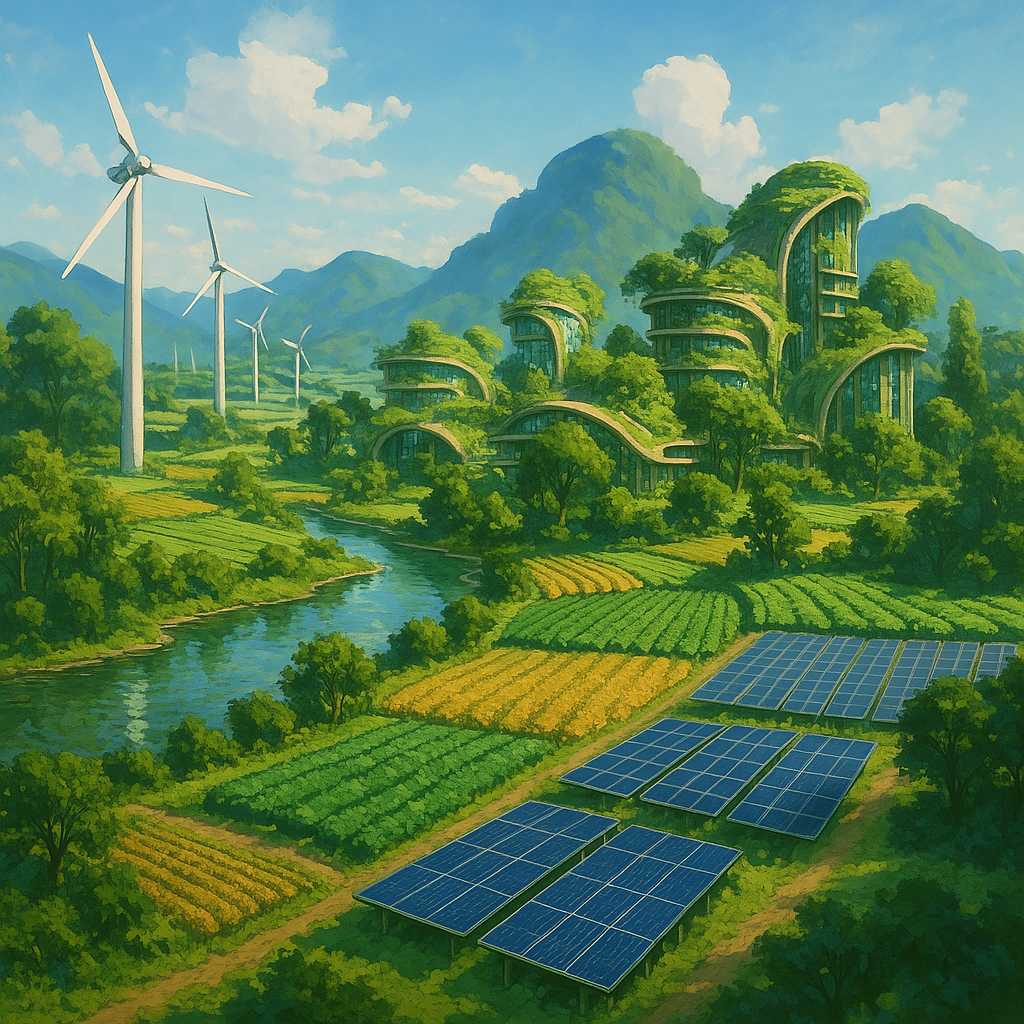
I. Why Ecosocialism, Why China?
The Earth is burning—and it didn’t set itself on fire. The floods, the heat, the poisoned rivers, the vanishing forests—these aren’t natural disasters. They’re symptoms of a system. A system built on stolen land, stolen labor, and stolen time. Capitalism. It doesn’t just exploit people. It plunders the Earth itself. And the liberal West? Its answer is more markets. More carbon trading. More green capitalism. It is, as ever, reorganizing the crisis so the rich stay rich while the world falls apart.
If there is a way forward, it will not come from Wall Street or Davos. It will come from those who still believe that history can be made by the masses. And that brings us to China.
China stands apart not because it is perfect—but because it has dared to build outside the imperial system. It is the only country that still speaks, however unevenly, in the language of planning, sovereignty, and socialism. Its model of ecological civilization is not a Western NGO fantasy. It is a real, material reorientation of a civilization-sized project. And yet, the question remains: can this model—born from revolution, forged in contradiction—become something deeper, more democratic, more emancipatory?
Can eco-civilization evolve into ecosocialism?
II. Eco-Civilization with Chinese Characteristics: A Historical Pivot
The concept of ecological civilization emerged not from Western academia, but from inside China’s post-reform contradictions. As the factories rose and the rivers blackened, the Party realized that unrestrained development could destroy the very mandate it claimed: to serve the people. In response, the state embedded ecology into law, planning, and bureaucracy. Not just as a gesture, but as a pivot.
By 2018, eco-civilization was written into the Constitution. Ecological red lines were drawn. Deforested hills were reforested. Carbon targets were set in stone. Cadres were no longer judged solely by GDP, but by how clean the skies were above their cities. In a world of capitalist chaos, this was a milestone. It was—and remains—something no capitalist government has attempted.
But planning, even rational and technocratic, is not liberation. It can clean the air and still displace the people. It can restore forests while excluding the hands that once cared for them. The Party has made enormous advances. That’s a fact. But socialism—real socialism—is a process, not a prize. And it must be pushed further.
III. From Communes to Commons: The Revolutionary Legacy of China’s Green Development
The roots of China’s ecological development do not begin with carbon markets or international climate summits. They were planted decades ago—by peasants, cadres, and scientists working shoulder to shoulder in the countryside, reshaping landscapes through mass mobilization, collective labor, and revolutionary purpose. If today’s eco-civilization promises a greener future, we must remember the red past that made it possible.
This is not nostalgia. It’s history as infrastructure. The socialist legacy of the commune era—often dismissed or forgotten—is in fact a vital foundation for the ecosocialist transitions China may yet realize.
During the 1950s–1970s, under the leadership of the Communist Party, China’s People’s Communes organized tens of millions of peasants into collective labor units that did far more than grow grain. They built irrigation systems, reforested hills, leveled terraces, and stopped erosion. They transformed deserts into orchards. They restored fertility to exhausted soils.
As Joshua Eisenman shows in Red China’s Green Revolution, the communes were sites of innovation—where local knowledge, state support, and socialist planning met. Agricultural R&D was decentralized, collective, and grounded in use-value, not profit. Ecological problems were tackled through organization, not market incentives. That legacy still lingers in the land—and in the minds of those who remember.
What made this era uniquely powerful was not just its outcomes, but its method. The masses were not passive recipients of policy—they were participants in transformation. Ecological governance came from the village, not just the ministry.
This is the spirit ecosocialism seeks to revive: not to replicate the communes as they were, but to recover their core principle—that those who work the land should help decide how it is used, restored, and sustained.
Today, as China builds “green development zones” and ecological red lines, the specter of the commune haunts the soil. But this ghost need not be buried—it can be called upon. The same rural spaces that once built irrigation canals by hand could now build food sovereignty cooperatives, regenerative agroecology zones, and democratic ecological councils.
Ecosocialism in China does not have to begin from scratch. It can evolve from the socialist institutions that already exist—by reintroducing mass participation, collective ownership, and ecological purpose into the heart of planning.
The communes may have dissolved, but the vision of a people-led ecological transformation lives on.
To build the commons of the future, we must remember the communes of the past—not as a model to imitate, but as a legacy to deepen. They were not perfect. But they were bold. They proved that when the people move together, even mountains can be made to bloom.
Let today’s ecological civilization draw not only from data models and finance mechanisms, but from the living memory of red soil and collective labor. Let the past be a resource. Let the revolution be regenerative.
IV. What Is Ecosocialism? A Revolutionary Ecology
Ecosocialism is not just Marx with solar panels. It is the full realization of what Marx began: understanding that capitalism’s destruction of nature is not a bug, but the system itself. Its logic is endless growth, endless profit, endless expropriation. It doesn’t care what it breaks, so long as it extracts.
Ecosocialism means reversing the rift between humans and nature, and between humans and each other. It means:
- Common ownership of energy, land, water
- Democratic ecological planning—not just by scientists, but by peasants, workers, women, Indigenous communities
- Production for life, not profit
- Regeneration of the Earth alongside the liberation of the people
It is not utopia. It is the unfinished task of revolution.
V. The Fault Lines Inside Eco-Civilization
Let’s be clear: China is far ahead of the imperialist core. But it is not immune to contradiction. The eco-civilization model, while historic, still carries the weight of uneven development, top-down control, and world-system pressure.
- Cadres plan from above; villagers are often not invited into the room.
- Green development zones displace farmers to make way for tourists.
- Lithium is extracted from Latin America to fuel the green transition, not always with consent.
- Carbon trading, though efficient, treats pollution as a commodity rather than a crime.
These are not the flaws of socialism. They are the growing pains of a revolution still unfolding. The struggle now is to deepen—not abandon—the socialist horizon.
VI. How Eco-Civilization Can Become Ecosocialism
The leap from eco-civilization to ecosocialism will not come through slogans. It will come through class struggle, cultural renewal, and the expansion of revolutionary participation.
- Let ecological governance belong to the people—through rural councils, worker cooperatives, Indigenous assemblies.
- Let green infrastructure serve the poor first, not just the export economy.
- Let environmental education teach not just conservation, but consciousness.
- Let land be returned—not just reforested, but de-enclosed, re-communalized.
This is not a break with the Party—it is its highest calling. To serve the people by empowering them to serve the Earth. To complete the revolution not by reverting to the past, but by stepping boldly into a future where socialism means survival.
VII. Conclusion: History Is Still Ours to Make
China stands at a fork in the river. One path leads to eco-modernization—cleaner air, greener GDP, but still tethered to global capital. The other leads to ecosocialism: a society that breaks with commodification entirely, that returns land and power to the masses, that rebuilds the metabolism between humanity and nature.
The state has laid the foundation. Now the people must build. Not in opposition, but in unity. Not by rejection, but by radicalization.
Let eco-civilization be the bridge. And let ecosocialism be the destination.
But what does that transformation look like on the ground—where rivers are dammed, forests restored, and sovereignty contested? For that, we turn to a living case: China’s Lancang River Basin, the upper reach of the Mekong. Here, the contradictions of green development, socialist planning, and ecological sovereignty converge. And here, the struggle for ecosocialism becomes not a theory, but a terrain.
 Weaponized Information
Leave a comment