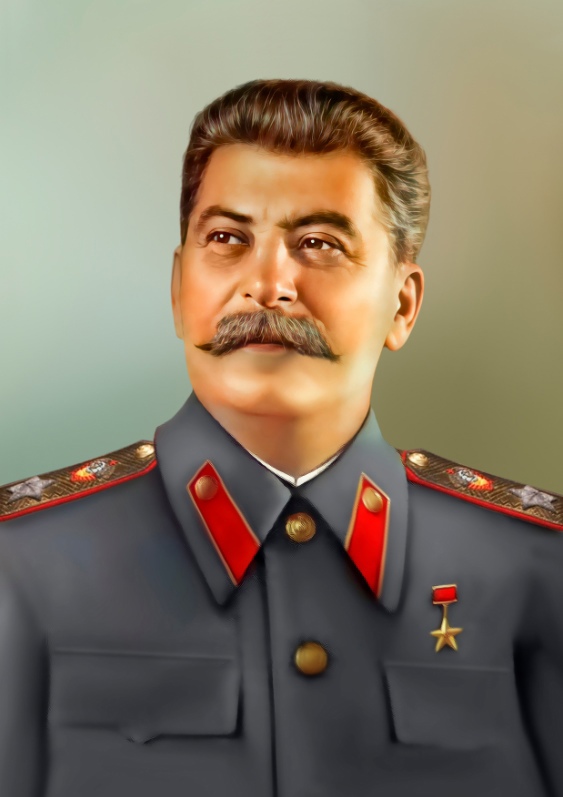
Why Stalin Still Matters
“The genius of Stalin is universally recognized… He was a great personality, far beyond the average tyrant or dictator of history.” — Winston Churchill
Joseph Stalin remains the most slandered figure of the 20th century. He is portrayed as a paranoid despot, a bloodthirsty tyrant, the twin of Hitler. These are not critiques grounded in history—they are myths constructed by those who feared what Stalin represented: the possibility that the working class could take power, hold it, and use it to transform the world.
This article does not aim to canonize Stalin. We are not in the business of building cults or statues. We are revolutionaries. Our task is to understand power—how it is won, how it is defended, and how it is vilified. And in a world where empire wears the mask of democracy and genocide goes by the name of humanitarian intervention, we owe it to ourselves to separate propaganda from truth.
Stalin still matters because he represents something the ruling class cannot allow: a victorious, armed, and organized working class with state power. That is why they turned him into a monster.
Part I: The Myth and the Moment — Who Created the “Black Legend”?
The “Stalin as monster” narrative was not born from the oppressed. It was crafted in the halls of power.
Its modern birth was Khrushchev’s 1956 “Secret Speech,” where Stalin was blamed for all of socialism’s contradictions. This was not a moral reckoning—it was a palace coup. Khrushchev needed to consolidate power and wash the blood off his own hands. So he exhumed Stalin’s body not to bury it, but to make a spectacle of it. From there, the CIA and the Cold War intellectual machine took over.
Funded by capitalist think tanks and imperialist governments, the anti-Stalin narrative was shaped by those who had every reason to fear what Stalin represented. Hannah Arendt’s “totalitarianism” theory equated fascism with communism, erasing the fact that it was the Red Army that crushed Hitler. Trotskyist exiles fed the flames, bitter over their own irrelevance. Liberal academics turned the class war into a morality play.
But history is not a parlor game. It’s a battlefield. And on that field, Stalin’s role was decisive.
Part II: Stalin’s Crimes? Historical Context and Class War
The charges against Stalin are numerous: purges, forced labor, famine, personality cult. But when you dig deeper, when you strip away the Western moralism, what you find is a man struggling to survive in a world dominated by imperialism, fascism, and internal counter-revolution. To understand Stalin’s actions, you need to ask: What were the alternatives?
In the early 1930s, when Stalin was pushing for rapid industrialization, the USSR was besieged on all sides. The imperialist powers had already turned the Soviet Union into a pariah state. The Great Depression had brought global capitalism to its knees. The Western powers refused to recognize the USSR or trade with it, while Hitler and his fascist cohorts were building up their war machine in preparation for a second world war. The threat was existential.
It was in this context that Stalin implemented the first Five-Year Plan. The Soviet Union needed to industrialize to defend itself. There were no other options. Stalin’s forced collectivization of agriculture was not done for vanity—it was done to feed a rapidly industrializing population, to fund the army that would eventually stop the fascists at Stalingrad.
Yes, millions died in the process. But consider the alternatives: the endless wars waged by imperialism, the genocidal policies of Western colonialism, the slaughter of the working class in capitalist states. Stalin’s actions, as brutal as they may seem in hindsight, were not an aberration—they were a product of class war.
The purges and show trials are interpreted not merely as paranoia but as a continuation of civil war against class enemies and internal sabotage. The Soviet Union could not afford to be soft when the imperialist powers and internal enemies were circling like vultures.
Stalin was not perfect. No revolutionary leader is. But to demonize him based on selectively quoted figures, and propaganda from the very forces he fought, is a betrayal of the working class struggle.
Part III: Stalin, Fascism, and the Global South
There is one fact the Western left often chokes on: without Stalin, fascism would have triumphed. It wasn’t American liberalism or British parliamentarianism that stopped Hitler’s war machine—it was the Soviet Union, under Stalin’s leadership, that broke the back of the Nazi empire at Stalingrad.
Stalin built the only force on Earth capable of destroying it. Over 80% of Nazi casualties in WWII were inflicted by the Red Army. This was the product of state planning, political will, and the mobilization of a people trained in proletarian discipline.
But Stalin’s role didn’t end in Berlin. Under his leadership, the USSR armed, trained, and supported anti-colonial movements from Vietnam to South Africa. The contrast is clear: Stalin gave guns to liberation struggles. The West gave chains.
Ask yourself: who benefited from the destruction of the Soviet Union? Was it the global working class—or the IMF, NATO, and Wall Street?
Part IV: The Left That Hates Stalin – Who Do They Serve?
The most venomous lies about Stalin rarely come from outright capitalists. They come from within the so-called “left.” From Trotskyist sects, anarchist salons, and academic Marxists who’ve never risked a damn thing. Their critiques are not material—they are moralistic. They do not seek understanding, they seek distance. They want to be liked. They want to be pure. They want socialism without blood, revolution without rupture, power without punishment.
These people recite death counts like they’re reading sports scores, but they never ask why. They never ask who was trying to kill the revolution. They never ask who funded the saboteurs. They don’t care.
They don’t hate Stalin because he failed. They hate him because he dared to succeed. Because he tore down aristocracy, broke the backs of Nazis, and stood with the colonized against imperialism. And for that, they will always fear his name.
Conclusion: The Legacy of Power
Stalin was not a god. He made mistakes—sometimes grave ones. But he was not a monster. He was a revolutionary. A worker. A fighter. A man who bore the weight of history on his shoulders while surrounded by wolves.
The ruling class wants you to fear him because he dared to build what they always said was impossible: a workers’ state that defeated fascism, crushed the old aristocracy, and stood shoulder to shoulder with the colonized. He dared to use power not as a slogan, but as a weapon.
We do not glorify suffering. But we do not flinch from it either. Because the world we live in—the one built by the so-called “free” capitalist democracies—is soaked in blood. And if you’re going to judge Stalin, you better judge them first.
The time has come to tear down the myths. To reclaim our history. To understand that Stalin, for all his contradictions, was one of us—a militant in the struggle for a new world.
And that, comrades, is why they still lie about him.
 Weaponized Information
Leave a comment