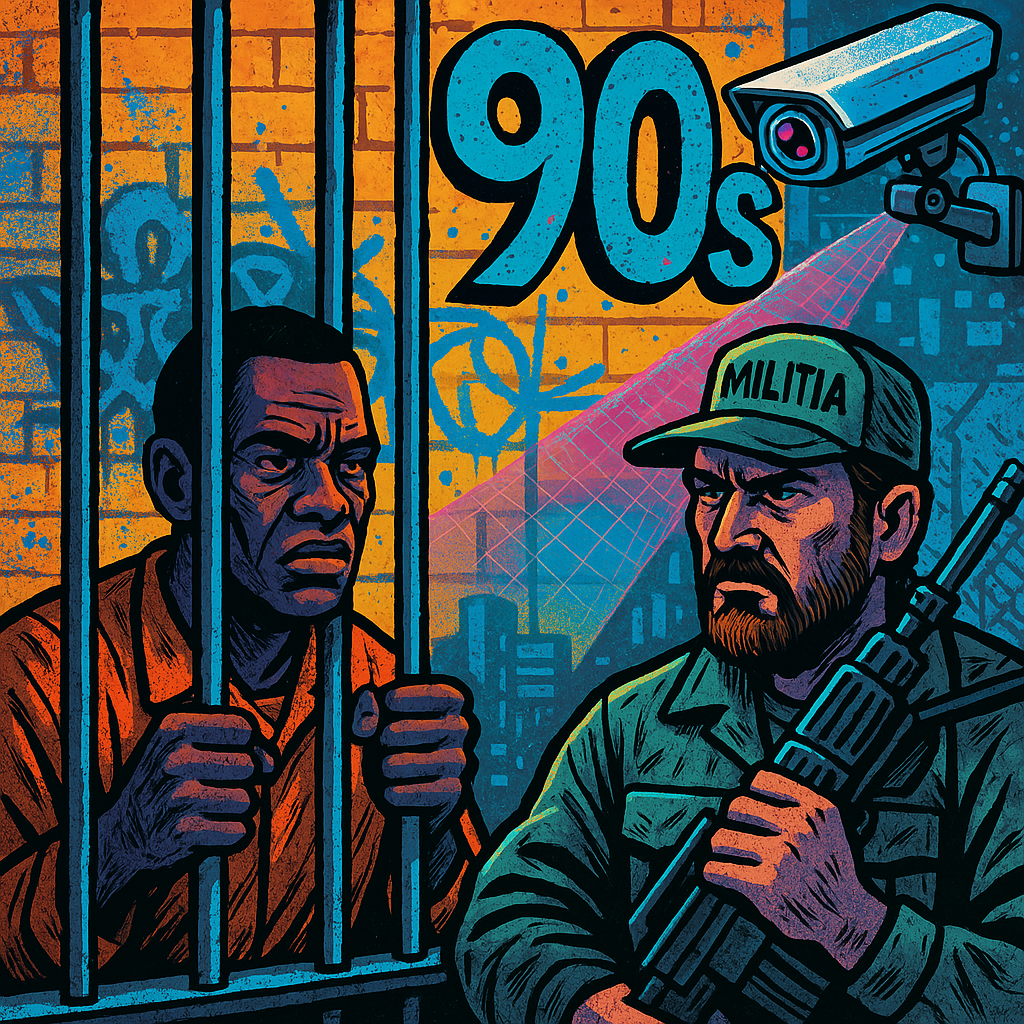
I. The Empire Triumphant—Or So It Thought
The 1990s opened with the swagger of a global victor. The Soviet Union had collapsed. China was being groomed into the global market. The Berlin Wall was rubble. And in Washington, neoliberals—both red-tied and blue-tied—declared the “end of history.” Capitalism had won. The U.S. stood unchallenged.
But that illusion was only skin-deep. Behind the façade of peace and prosperity, the settler empire was cannibalizing its own internal structure while preparing to expand its dominion abroad through war, technology, and finance.
The 1990s were not a postwar period. They were a counterrevolutionary consolidation.
II. Mass Incarceration Becomes Normalized
By this decade, the war on Black life had become institutionalized. Clinton’s 1994 Crime Bill—pushed by both parties and sold with bipartisan dog whistles—flooded the streets with cops, militarized local departments, and laid the groundwork for the largest prison boom in world history.
The U.S. didn’t just incarcerate more people than any nation on Earth—it specifically targeted the Black, Brown, and Indigenous poor. Surveillance spread across housing projects, stop-and-frisk became standard practice, and prison construction became an economic development plan in rural white America.
This was not just the continuation of 80s policy. This was the normalization of neoslavery and colonial containment.
III. Neoliberalism’s Digital Reboot
At the same time, a new economy was being born—one not in steel or coal but in silicon. The 1990s saw the convergence of Wall Street finance and emerging digital infrastructure. The internet, once a military and academic tool, became a commercial playground. Venture capital flowed into tech start-ups. Automation crept deeper into industry. Whole sections of the U.S. working class—Black and white—were rendered obsolete overnight.
The “new economy” wasn’t new—it was a digital scaffolding for a leaner, meaner form of global imperialism. Wealth concentrated. Inequality exploded. Surveillance capacities expanded. The information age wasn’t about knowledge—it was about control.
IV. The Lumpenization of the Settler Working Class
While Black and Brown workers were being caged, white workers were being discarded. NAFTA gutted industrial towns. Union jobs vanished. Benefits were slashed. Entire regions—Appalachia, the Rust Belt—began to rot economically. And in that rot, a different kind of political fungus began to grow.
Militia movements exploded. White nationalism flourished underground. Ruby Ridge, Waco, and ultimately the Oklahoma City bombing revealed an increasingly armed and paranoid settler base—resentful of the federal government but still loyal to white domination.
This wasn’t a rebellion against empire—it was a demand to be restored to their rightful place atop it.
V. The New Black Middle Class and the Myth of Inclusion
Even as mass incarceration swallowed up the colonized poor, a thin layer of Black professionals was hoisted up as proof that America “had changed.” Wall Street firms, universities, and the Democratic Party found room for more Black faces—but only those committed to the status quo.
A new narrative was born: that racism was now a personal problem, not a structural one. That success was about hard work, not stolen wealth. That we were living in a “colorblind” society. And when Clinton signed welfare “reform” in 1996, the myth of multicultural neoliberalism was complete: cut aid to the poor, blame the victims, and smile for the camera with a Black cabinet member beside you.
This was liberal settler-colonialism with a new coat of paint.
VI. U.S. Empire Recalibrates: From the Gulf to the Balkans
Globally, the 1990s were not peaceful. They were a laboratory for the new hyper-imperial order. In 1991, the U.S. unleashed its war machine on Iraq—not to defeat a global rival, but to discipline the Global South. The message was clear: we own the oil, we write the rules.
NATO destroyed Yugoslavia—justified through human rights language but rooted in dismantling a socialist-aligned regional power. In Haiti, the U.S. supported and funded a coup against Aristide, Black liberation theologian and populist president, and reinstalled a brutal regime. And everywhere else—Latin America, Africa, Southeast Asia—U.S.-backed economic “adjustment” programs imposed neoliberal austerity and privatization.
The Cold War ended. Colonialism never did.
VII. Global Apartheid and the Race/Class System
This new imperialism relied on a racialized world order. Global labor was divided just like U.S. labor had been—an elite core of tech, finance, and logistics workers, mostly white or comprador bourgeoisie; a massive surplus population of global poor, disposable and displaced.
Just as the U.S. used prisons to manage its colonized underclass, it used borders, trade rules, and military force to discipline the Global South. The empire exported factories, imported goods, and kept migrants out—unless their labor was exploitable.
The dialectic was clear: race and class weren’t separate. They were co-constituted at every level of the global hierarchy.
VIII. Seeds of Technofascism
By the decade’s end, the conditions were ripe for a new form of rule. Surveillance technology had advanced. Private tech firms were cozying up to the state. A permanent war economy had been established. The working class was fragmented and demobilized. Settler panic was rising. Colonized communities were in lockdown. And Big Tech was growing powerful enough to become a class in its own right.
All that was missing was a trigger.
That would come in 2001. But the architecture of technofascism—state-corporate fusion, algorithmic policing, settler surveillance, mass incarceration, military dominance—was already in place.
IX. Conclusion: The 1990s as Precursor and Portal
The 1990s were not an era of stability—they were a bridge. A transitional moment between the end of one cycle of U.S. imperialism and the violent birth of another. The empire didn’t collapse—it adapted. It digitalized. It punished. It lied.
And as it recalibrated, the contradictions sharpened: a colonized Black proletariat under siege, a disoriented white working class turning inward and rightward, a digital elite ascending without accountability, and a Global South awakening again.
The storm was coming.
And the next stage of struggle—technofascism and hyper-imperialism—would test the limits of the entire system.
 Weaponized Information
Leave a comment