I. The Ruling Class Strikes Back
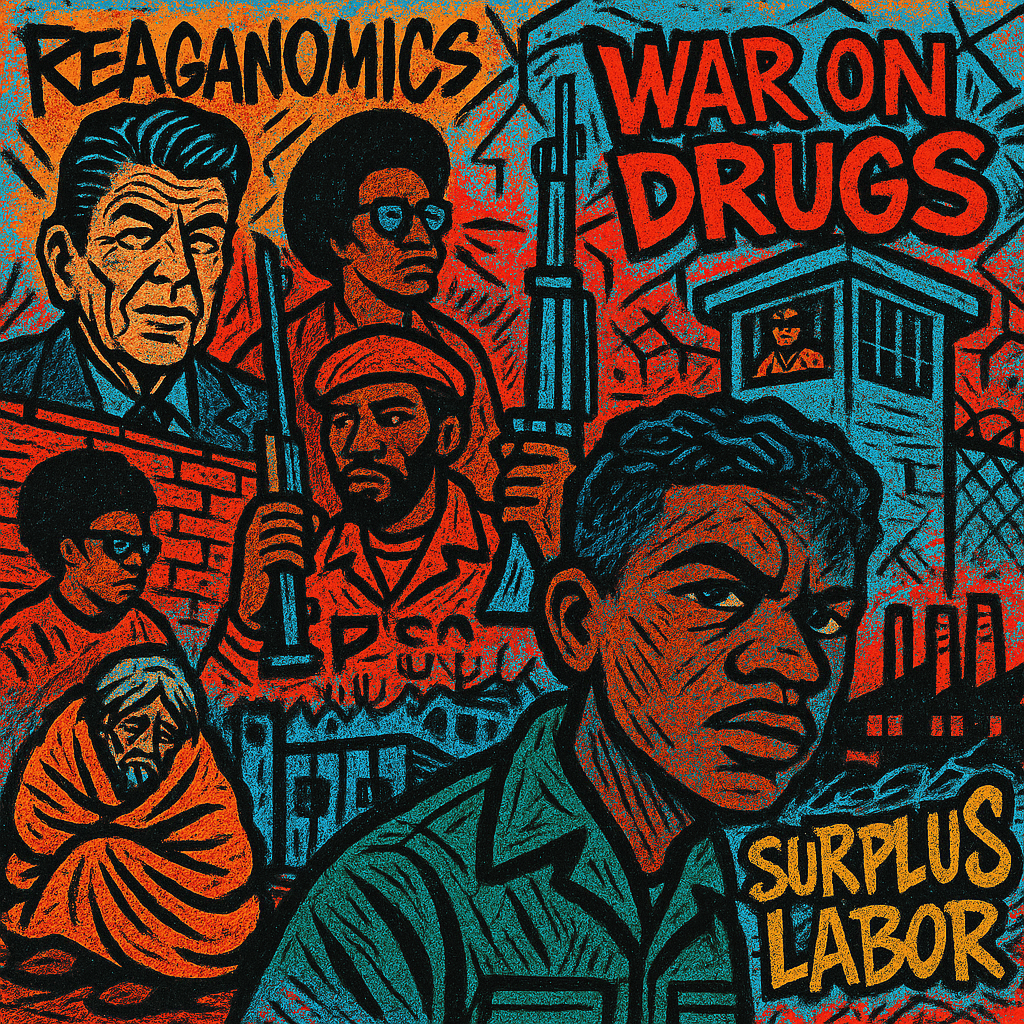
By the 1980s, the white ruling class had lost its patience. After a generation of upheaval—urban rebellions, anti-war uprisings, Black liberation movements, Indigenous resurgence, Third World revolutions—U.S. imperialism launched a strategic counteroffensive. Reagan was not just a new president. He was a new regime. His administration reorganized the U.S. empire along explicitly settler-colonial lines—reasserting white nationalism, slashing public services, militarizing the police, and doubling down on mass incarceration. This was settler revenge masquerading as economic policy.
II. Deindustrialization and the Rise of a Surplus Population
The material base of this counterinsurgency was economic. Manufacturing jobs—once the lifeblood of Black industrial labor and unionized white workers—were offshored en masse. Detroit, St. Louis, Gary, East St. Louis, Camden, Oakland—Black cities were gutted. The industrial proletariat was made disposable. The state did not reinvest—it repressed. Entire communities became surplus. The working class was split: one fragment digitized and flexible, the other criminalized and caged.
III. Reaganomics: The Ideology of Settler Restoration
Reagan’s economic policy—dubbed “Reaganomics”—was neoliberalism with a cowboy hat. Tax cuts for the rich. Union busting. Deregulation. Privatization. But its real function was to restore the cultural and material confidence of the white settler class. “Welfare queens,” “bad government,” “crack babies”—these were not neutral phrases. They were settler code, signaling that the gains made by colonized people in the 60s and 70s would be rolled back. This wasn’t about austerity—it was about reasserting racial order.
IV. The Drug War as Counterinsurgency
What the government called the “War on Drugs” was in fact a chemical counterinsurgency. With the help of U.S. intelligence operations, cocaine and heroin flooded the ghettos and barrios. Guns followed. Gangs multiplied. Then came the police. The drug war was not designed to solve addiction—it was designed to destabilize Black political formations and criminalize the remnants of the liberation movement. Where revolutionaries once walked, narcotics agents now marched.
V. The White Working Class: A Contradictory Role
While colonized workers were targeted as a threat, the white working class was offered a deal: trade in solidarity for safety. White workers were hit hard by deindustrialization—but they were not placed in ghettos, they were not mass incarcerated, they were not flooded with narcotics by the state. Many were seduced by Reagan’s nationalism, others by his tax cuts. Some resisted. Most collaborated. This contradiction would sharpen in the coming decades.
VI. The Role of the Black Petty Bourgeoisie
While the Black working class was under siege, a new managerial class was being promoted. From mayors to media pundits, Black professionals were elevated into positions of visibility—but not power. They became buffers between the state and the community. They preached respectability, denounced the so-called “culture of poverty,” and helped usher in Clinton’s neoliberal reforms. Their class role was clear: pacify the masses, legitimate the empire.
VII. The Expansion of the Prison Economy
Prisons exploded in this period—not only in number but in function. This was no longer about individual punishment. It was about managing a structurally excluded class. Black youth were labeled “super predators.” Sentences were lengthened. Juveniles were tried as adults. Prison construction became an economic development plan in poor white towns. A new caste system was being solidified—one built on cages, labor, and surveillance.
VIII. Resistance in the Belly of the Beast
But repression did not mean passivity. Black communities resisted—from the Miami uprisings to the LA rebellions to the cultural defiance of Hip-Hop’s golden age. New organizations emerged, rooted in self-defense, community mutual aid, and political education. Even as the state cracked down, it could not kill the will to rebel. The movement survived underground—dispersed, fractured, but still alive.
IX. 1992: The Boiling Point
By the early 90s, the contradictions had matured. Deindustrialization had hollowed out cities. Mass incarceration was in full swing. The white working class was drifting into reactionary politics. The Black masses were under lockdown. And then came the acquittal of the LAPD in the beating of Rodney King. South Central erupted. The rebellion of 1992 was not just a riot—it was the echo of every slave revolt, every ghetto uprising, every prison mutiny. The regime had no answer but more repression.
X. Conclusion: The Foundations of Technofascism Are Laid
From 1980 to 1992, the U.S. settler-colonial state reorganized itself for a new era. The Black industrial proletariat had been displaced. The prison state was expanding. Digital infrastructure was emerging. The settler base was consolidating. The Black petty bourgeoisie was being institutionalized. And the dream of multiracial democracy was being buried beneath a thousand concrete walls. The stage was set—not just for Clinton, but for the technofascist decades to come.
 Weaponized Information
Leave a comment