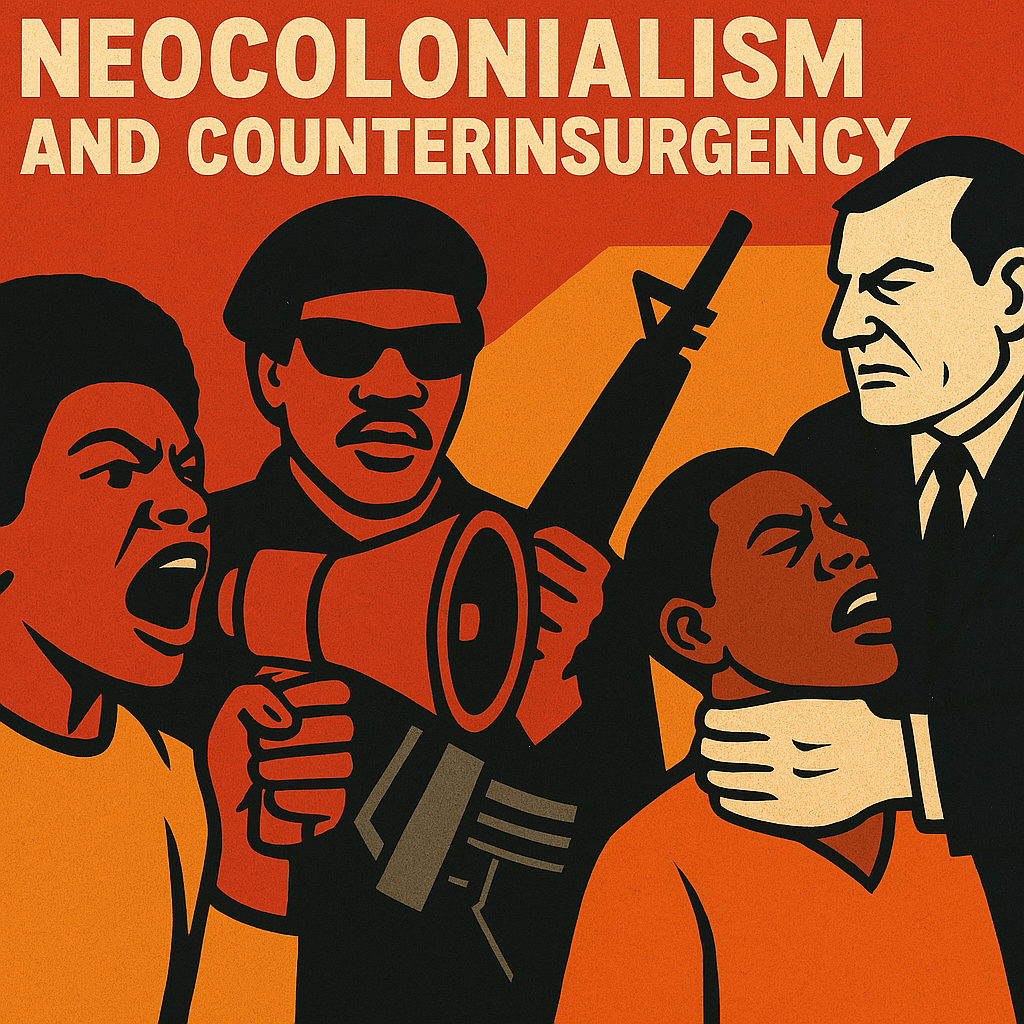
I. From Black Revolution to Black Representation
By the dawn of the 1970s, the U.S. settler state had waged a brutal counterinsurgency campaign against the revolutionary Black freedom struggle. The Black Panther Party was splintered, surveilled, and assaulted. The Black Liberation Army was underground. Fred Hampton was assassinated. Assata was in exile. George Jackson was executed behind prison walls. What had been a revolutionary groundswell by the colonized was met with the full force of the colonial state.
But raw repression was only half the play. The other half was co-optation.
In place of liberation, the U.S. ruling class offered visibility. Where the masses had demanded power and transformation, they were given “Black faces in high places”—mayors, police chiefs, school board officials, even corporate executives—who were tasked with managing the contradictions of racial capitalism, not challenging them.
II. The Rise of the Black Petty Bourgeoisie and the Death of Collective Struggle
This was the era that E. Franklin Frazier had already warned us about. In The Black Bourgeoisie, he exposed a class obsessed with individual advancement and terrified of revolutionary transformation—a class that found safety in proximity to power, not in solidarity with the masses. His insights were prophetic.
As Omali Yeshitela would later argue, the colonial state needed a native class to stabilize its empire from within. This new comprador class was tasked with pacifying the ghetto, redirecting radical demands into grant applications, and giving the illusion of democratic inclusion. Neocolonialism had arrived—in City Hall, in the nonprofit sector, in the rise of “Black capitalism” under Nixon.
The Democratic Party provided the perfect mechanism for this betrayal. Liberalism became the new language of containment. Black politicians emerged not as threats to empire, but as administrators of imperial policy in the hood.
III. The Underground Doesn’t Die—It Goes Deeper
Yet even as the state elevated a class of collaborators, revolutionaries kept fighting.
The Black Liberation Army (BLA) carried the banner of Black Power into the underground. Their actions—liberating political prisoners, expropriating resources, directly confronting state violence—weren’t just remnants of a dead movement. They were a continuation of the revolutionary struggle under siege.
Alongside them, formations like the George Jackson Brigade emerged—predominantly white, anti-racist, and explicitly anti-imperialist. Ed Mead, a comrade and real one, was one of the few white radicals who didn’t just talk solidarity—he practiced it, underground and at great personal cost. They struck at courthouses, police stations, corporate targets—the infrastructure of empire.
But the state doubled down. The BLA was hunted like fugitives. The Brigade was surveilled and dismantled. This was the deep end of COINTELPRO and domestic warfare. The state understood that revolution had not died. It had gone subterranean.
IV. Deindustrialization and the Strategic Underdevelopment of the Colony
While the armed struggle was being repressed, a quieter war was underway. U.S. capital no longer needed vast Black industrial labor reserves. The factories shuttered. Steel mills closed. Rail yards decayed. And what replaced them? Prisons and poverty.
Deindustrialization wasn’t just an economic transition—it was a tactic of colonial containment. Strip the colonized of productive labor, flood their neighborhoods with narcotics, criminalize their survival, and build a carceral state to warehouse the fallout.
It was the long war of empire—displace, disarm, destabilize, then punish. And through it all, the new Black elite held press conferences, ran “community initiatives,” and did the state’s dirty work with smiles and soundbites.
V. The Anti–Vietnam War Movement and the White Youth Breakaway
But it wasn’t just the Black revolution that shook the empire. For a brief window in the late 60s and early 70s, a massive wave of white youth—mostly students—broke from their settler class conditioning. The anti–Vietnam War movement became a mass rupture, exposing U.S. imperialism and radicalizing a new generation.
This was perhaps the closest we got to a truly multiracial revolutionary convergence. Organizations like Students for a Democratic Society (SDS) challenged both capitalism and white supremacy—though not without contradictions.
And that’s why the state moved in.
The anti-war movement was targeted with intense surveillance and disruption—COINTELPRO, and more secretly, Operation CHAOS. The government infiltrated protests, smeared leaders, and escalated repression. As the war wound down in 1975, the movement deflated. Some drifted into cultural radicalism, others into drugs and psychedelics. The revolutionary current gave way to resignation—and with it, the possibility of settler defectorship on a mass scale faded.
VI. White Labor Doubles Down on Empire
As white youth flirted with revolt, the broader white working class was entrenching itself deeper into settler chauvinism. Rather than align with colonized workers, most white labor unions resisted integration, opposed busing, and framed their struggle as one of defending “American jobs” from affirmative action and globalization.
The AFL-CIO even backed U.S. imperial operations abroad—opposing anti-colonial movements and supporting coups in the Global South. At home, white labor became a bulwark of the carceral state, staffing police forces and prison unions. It was the old pattern repeating: when class solidarity threatened to materialize, whiteness was deployed as the weapon of choice.
VII. The Global Turn: From Vietnam to Retreat
Internationally, the 1970s were a moment of fracture. The U.S. defeat in Vietnam didn’t signal liberation—it signaled a tactical retreat. Revolutionary governments in the Third World were destabilized by economic sabotage, coups, and mounting debt. The Tricontinental dream had dimmed.
Still, revolutionaries in the U.S. looked outward. The Panthers, the BLA, the Brigade—all saw themselves as part of a global struggle. Malcolm’s words echoed across borders. Robeson’s internationalism remained a guiding light. And when Du Bois, Patterson, and others submitted the “We Charge Genocide” petition to the United Nations, it was an unambiguous message: the struggle in the U.S. was part of a worldwide fight against white colonial capitalism.
VIII. Conclusion: Neocolonialism in Full Bloom
By 1980, the old forms of direct rule were replaced with a new shell game. Empire had learned how to wear a dashiki, talk about “equality,” and jail you just the same. The ghetto was pacified with politicians, the rebellion with welfare cutbacks, and the radicals with bullets.
What emerged was a neoliberal racial order: Black capitalism for the few, prison for the many. Tokenism replaced transformation. “Diversity” became the language of domination. This wasn’t progress—it was counterinsurgency, painted liberal.
But the contradictions didn’t disappear. They mutated. The fire of revolution didn’t die. It smoldered—waiting for air.
 Weaponized Information
Leave a comment