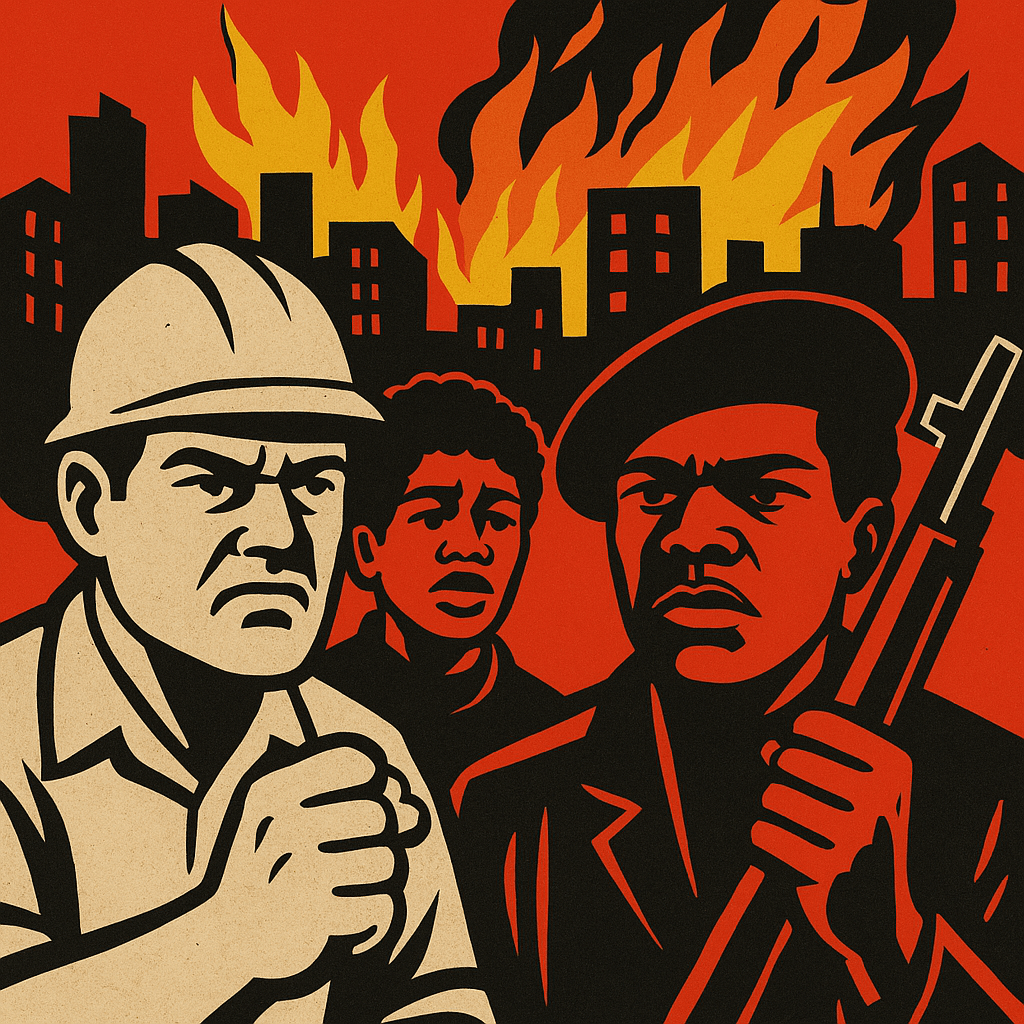
The Class Rebellion of the Colonized in the Heart of Empire
I. From the Shop Floor to the Street: A Colonial Proletariat Emerges
By the 1950s, a seismic shift had taken place within the U.S. working class. The descendants of enslaved Africans, once confined to the plantation and the sharecropper’s plot, had become the backbone of urban industry. The post–WWII industrial boom absorbed millions of Black workers into steel, auto, rail, and public sector jobs. But integration into wage labor didn’t mean equality—it meant super-exploitation under new terms.
Black people were still locked out of union leadership, restricted to the dirtiest, lowest-paid jobs, and corralled into crumbling ghettos policed like colonial outposts. The U.S. economy had modernized, but its colonial logic hadn’t changed. The ghetto replaced the plantation. The cop replaced the overseer. The boss kept his profits, and the state kept its boot on the neck of Black labor.
It was here, in the factories and housing projects, that a new Black proletariat was forged—radicalized not just by poverty, but by the clear understanding that they were an internal colony. This insight, articulated by revolutionaries like Omali Yeshitela, James Boggs, and the future leadership of the Black Panther Party, formed the basis of a revolutionary class consciousness that transcended liberal integration.
II. Civil Rights and the Illusion of Inclusion
The Civil Rights Movement, as it emerged in the 1950s, represented the first mass wave of this new Black proletariat’s political expression. But from the start, it was shaped by contradictory class forces. The petty bourgeois Black leadership—ministers, lawyers, and NGO bureaucrats—demanded access to the American dream. Jobs, voting rights, public accommodations. But for the Black working class, the issue wasn’t just civil inclusion—it was economic justice, human dignity, and power.
This contradiction sharpened through the decade. Young Black organizers, many emerging from working-class backgrounds, increasingly broke with the politics of accommodation. Ella Baker pushed SNCC toward grassroots organizing. Fred Shuttlesworth demanded direct confrontation. And in the background, Malcolm X sharpened the blade, exposing the hypocrisy of liberalism and calling for a struggle for self-determination.
III. Urban Rebellion and the Crisis of Empire
Then came the long, hot summers. From 1964 to 1967, hundreds of uprisings erupted across the country. Harlem. Watts. Cleveland. Newark. Detroit. These weren’t riots—they were revolts. And they weren’t spontaneous—they were the boiling point of decades of structural violence.
Malcolm X diagnosed it in real time: “It’s not a Negro problem—it’s a white problem. You don’t have a revolution in which you love your enemy. You don’t have a revolution in which you’re begging the system of exploitation to integrate you into it. Revolutions overturn systems.”
These rebellions were not simply about police brutality—they were class uprisings against the colonial state. Against joblessness, rat-infested housing, failing schools, and racist landlords. They were the internal expression of the same forces driving revolution in Vietnam, Algeria, and Angola. And the ruling class knew it.
IV. The Rise of Black Power: Revolutionary Nationalism and the Vanguard of the Proletariat
In 1966, the call for “Black Power” exploded into public consciousness. What began as a slogan soon became a movement, then an ideology, and finally an organizational reality. The Black Panther Party for Self-Defense, founded by Huey P. Newton and Bobby Seale in Oakland, was not simply a community group—it was a revolutionary vanguard formation, rooted in Marxist analysis, Third World internationalism, and the material conditions of the Black working class.
The Panthers understood what the Civil Rights leadership could not: that the U.S. was a settler colonial state, and that Black people within it were not a minority—they were a colonized nation. Their Ten Point Program laid out a blueprint for liberation: land, bread, housing, education, justice, and peace. Not reforms—power.
They built survival programs—free breakfast, clinics, political education—not as charity, but as a rehearsal for dual power. They armed themselves not as a spectacle, but as a principle of dignity. They allied with Puerto Rican revolutionaries, the Brown Berets, the American Indian Movement, and even poor white Appalachian youth like the Young Patriots.
This was no longer about civil rights. This was class war, under colonial conditions.
V. The White Working Class and the Limits of Solidarity
The Black Power movement revealed a harsh truth: the majority of the white working class in the U.S. was not prepared to break with settler colonialism. Instead of rising up alongside the colonized proletariat, white workers largely chose loyalty to whiteness—defending their relative privilege, upholding segregationist unions, and voting for law and order.
Even sectors of the New Left—white student radicals from SDS and beyond—struggled to fully align with Black revolutionary leadership. Some built principled alliances. Others recoiled when solidarity meant challenging settler identity, not just capitalism in the abstract.
This period exposed the colonial contradiction within the U.S. class structure: that whiteness had been constructed precisely to fragment the working class and prevent the kind of multinational unity that might overthrow the empire. And for the most part, it worked.
VI. The State Strikes Back: Counterinsurgency and COINTELPRO
Faced with the most serious domestic challenge to its legitimacy since the Civil War, the U.S. state did what all empires do: it launched a war. Not against crime or chaos—but against revolution. The FBI’s COINTELPRO program infiltrated, sabotaged, and assassinated Black leaders. Fred Hampton, just 21 years old, was drugged and murdered in his bed by the state. Huey Newton and Assata Shakur were hunted. Eldridge and Kathleen Cleaver were exiled. Dozens of others were imprisoned or killed.
But COINTELPRO was only part of the story. The state also deployed ideological counterinsurgency: pushing Black capitalism, promoting token representation, and elevating a new class of “responsible” Black leadership to replace the revolutionaries. As Omali Yeshitela wrote, the goal was to drain the radical energy of the masses by giving them Black mayors, Black cops, and Black CEOs—while the material conditions of the ghetto remained unchanged.
VII. Conclusion: The Fire This Time
By the end of the 1960s, the Black Power movement had been fractured—but not defeated. Its revolutionary insights—about the colonial nature of the U.S. state, the class position of Black people, and the global context of anti-imperialist struggle—would echo for decades to come.
This was not a civil war. It was a colonial war.
And it is not over.
Up Next:
Part 8B – Counterinsurgency, Co-optation, and the Birth of the Neoliberal Racial Order (1970–1980)
 Weaponized Information
Leave a comment