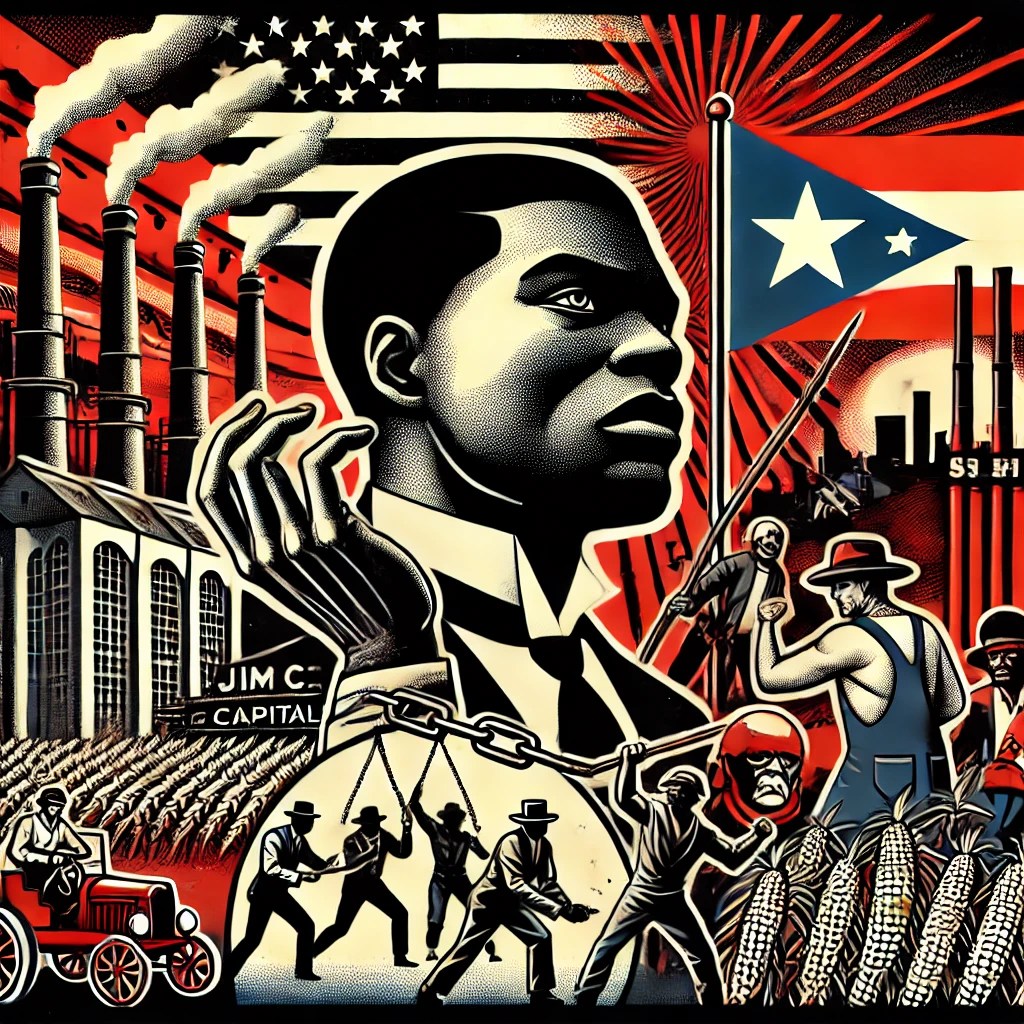
Racial Capitalism in the Age of Empire (1877 – WWI)
I. Introduction: From Reconstruction to Global Empire
With the overthrow of Reconstruction, the U.S. ruling class didn’t just restore white supremacy at home—it expanded it abroad. The period from 1877 to World War I was defined by two simultaneous processes:
- The consolidation of racial capitalism within the U.S. – Jim Crow segregation, sharecropping, Black disenfranchisement, and racial terror became the pillars of a new order, ensuring that Black labor remained an exploited, colonial labor force.
- The expansion of white supremacy into the world system. – The U.S. emerged as a global empire through conquests in Puerto Rico, the Philippines, Cuba, and beyond, modeling its colonial domination on the racial caste system perfected at home.
W.E.B. Du Bois captured this dynamic in On The African Roots of War, linking colonial terror in Africa and Asia to the racial oppression of non-white workers in the U.S. This period was not just one of repression—it was also an era of resistance.
II. White Supremacy Reinvented: From Slavery to the Jim Crow Police State
Slavery may have been abolished, but the U.S. economy still relied on an exploited racial underclass. The ruling class needed a new system of control:
- Jim Crow segregation kept Black people physically, socially, and economically confined.
- Lynch mobs enforced racial terror without the need for legal trials.
- Debt peonage and sharecropping trapped Black farmers and workers in permanent servitude.
But this wasn’t just a Southern system. Racial capitalism shaped the entire country:
- In the South, debt peonage kept Black farmers in perpetual servitude.
- In the North, racial exclusion locked Black workers out of unions, homeownership, and higher-paying jobs.
- In the West, Mexican and Chinese workers were trapped in a parallel system of racialized exploitation.
III. The White Working Class: Police, Lynch Mobs, and Strikebreakers
White workers had a choice—fight capitalism, or fight Black people. The ruling class made sure they picked the latter.
Instead of breaking the system, they became its enforcers:
- The Wilmington Massacre (1898) – A white supremacist coup overthrew a multiracial government in North Carolina.
- The Springfield Riot (1908) – White workers, enraged by Black economic independence, burned Black homes and businesses.
- The East St. Louis Massacre (1917) – White workers violently attacked Black industrial workers, fearing competition.
White labor unions, led by figures like Samuel Gompers, excluded Black, Mexican, and Chinese workers, ensuring that whiteness remained an economic advantage.
IV. The Black Response: Building a Revolution in the Ashes
While white labor aligned with racial capitalism, Black workers and communities organized their own economic and political movements.
Callie D. House: The Woman Who Demanded Reparations
In the 1890s, Callie D. House built one of the largest grassroots movements of the era, demanding reparations for formerly enslaved people. Her National Ex-Slave Mutual Relief, Bounty and Pension Association mobilized hundreds of thousands, proving that Black people were still fighting for what was owed.
The Rise of Black Nationalism
Many Black leaders knew integration was never coming. In response, they turned to nationalism and self-determination:
- Marcus Garvey and the UNIA laid the foundation for Pan-Africanism.
- The African Blood Brotherhood fused Black nationalism with socialism, arguing that capitalism itself was the root of Black oppression.
- Mutual aid networks and labor cooperatives were created to build independent Black economic power.
V. The U.S. Becomes an Empire: Exporting White Supremacy
As the U.S. expanded, it applied the same racialized labor system to its new colonies:
- The Philippines – U.S. soldiers massacred Filipinos, referring to them as “n*****s.”
- Puerto Rico – Turned into an economic plantation under U.S. control.
- Haiti and the Dominican Republic – Invaded and occupied to maintain white supremacist economic dominance.
Du Bois was clear: colonialism abroad was just white supremacy on a global scale.
VI. Conclusion: Racial Capitalism Tightens Its Grip, But Cracks Begin to Show
By the time World War I arrived, the U.S. had fully established itself as a white supremacist empire:
- The South remained an economic prison for Black labor.
- The North was a battlefield where Black workers faced racial exclusion.
- The West and Southwest saw continued racial terror against Mexicans, Indigenous people, and Asian laborers.
- The U.S. military was massacring colonized people across the Philippines, Latin America, and the Caribbean.
Next Steps: Preparing Part 7
The next part of the series will analyze:
- The rise of Black radical labor movements.
- The Communist Party and early Black internationalism.
- How WWI sharpened the contradictions of racial capitalism.
 Weaponized Information
Leave a comment