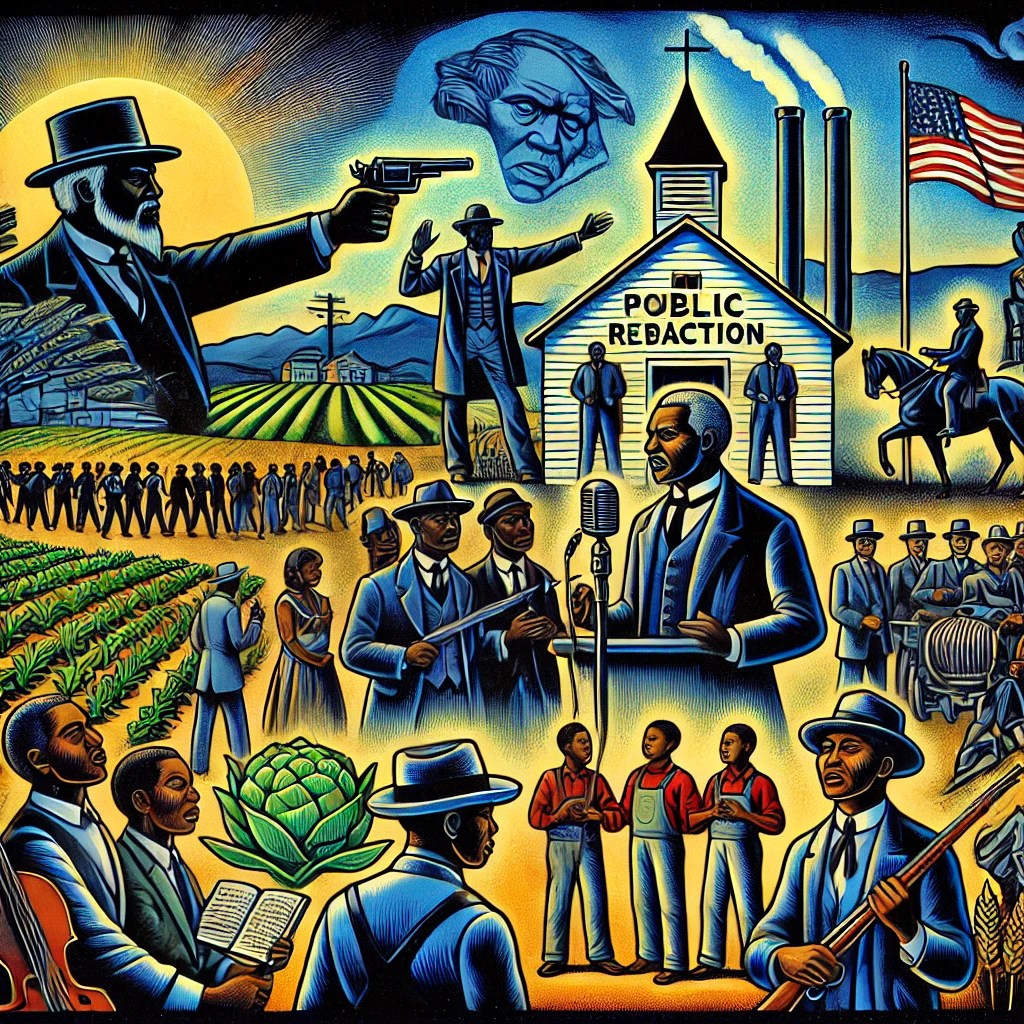
I. The Closest the U.S. Ever Came to Democracy
For a brief moment after the Civil War, the United States stood at a crossroads. The old order—where enslaved labor fueled the plantation economy—was dead, but the new one had yet to be written.
For the first time in U.S. history, Black people—formerly enslaved and free—were not only citizens on paper but actively engaged in governing the country they had built with their blood.
Reconstruction wasn’t just about rebuilding the South; it was about forcing the country to live up to the promises it had never intended to keep.
- Hundreds of Black politicians were elected to office—many of them formerly enslaved.
- Public schools were established in the South for the first time.
- Land redistribution was debated as a real possibility to break the grip of the old planter class.
- For the first time, multiracial governments were passing laws that protected workers and the poor.
But what history books don’t emphasize enough is this: Black political power in the South wasn’t about punishing white people—it was about improving the conditions of all working-class people, including poor whites.
- The Reconstruction governments created the first public school systems in the South, allowing poor white children—many of whom had been illiterate—to receive an education alongside freed Black children.
- Labor laws were passed to weaken the grip of the old planter class and improve conditions for all workers.
- Infrastructure projects were undertaken to develop roads, bridges, and transportation systems, helping poor rural communities access new opportunities.
At no point did Black Reconstruction governments seek revenge. There were no mass arrests of former enslavers, no wealth confiscation from white landowners, no racial purges of government positions. Instead, they tried to create a new, more just society.
And for this, they were violently overthrown.
II. Black Reconstruction: A Revolution in Motion
The myth of Reconstruction—the one still taught in textbooks—is that it was an era of “corruption and mismanagement,” that the South was victimized by “radical” Northern policies, and that white “Redemption” restored order.
The reality?
Reconstruction was the most radical experiment in democracy the U.S. had ever seen.
This wasn’t just about freed people “getting rights.” This was about a revolutionary transformation of American society.
- The Freedmen’s Bureau was created to redistribute land, provide legal protection, and build schools for freed Black communities.
- Black-majority state legislatures in the South rewrote laws, creating some of the first labor protections, expanding public education, and implementing civil rights legislation.
- Black cooperatives, mutual aid societies, and self-sufficient farming communities sprang up, challenging the economic stranglehold of the planter class.
W.E.B. Du Bois called this the “General Strike of the Slaves”—the moment when enslaved people walked off the plantations, forced the question of abolition, and began to reconstruct a new society from below.
And yet, for all its radical promise, Reconstruction stopped short of full economic self-determination. While some land was redistributed, the federal government ultimately refused to carry out widespread land reform. Black self-rule was tolerated only as long as it didn’t threaten the foundations of capitalism.
For men like Tunis Campbell, the lesson was clear: political power was useless without economic independence and armed self-defense.
Campbell’s experiment in Georgia’s Sea Islands wasn’t just an attempt to help freed people survive—it was a challenge to the entire economic order of the South. He and his followers established a self-sustaining Black government, independent of white oversight, where land was communally farmed, workers were protected from exploitation, and Black militias were formed to defend against white attacks.
This model—of Black self-determination and economic control—was the greatest threat to the ruling class. Because if Black people could govern themselves successfully, then what justification was left for white rule?
III. The White Counter-Revolution: How Capital Crushed Democracy
Reconstruction didn’t fail. It was overthrown.
The same capitalist forces that had backed slavery reorganized themselves and launched a full-scale counter-revolution.
- The old Southern planters called themselves “Redeemers” and formed armed paramilitary organizations like the Ku Klux Klan, the Red Shirts, and the White League to terrorize Black communities.
- Northern industrialists, after briefly supporting Black rights, abandoned Reconstruction in exchange for a deal with the South to secure their economic expansion.
- The white settler working class, promised land and wages, was weaponized as a battering ram against Black political power.
The white backlash was not spontaneous. It was systematic, organized, and backed by capital.
IV. The New Face of Racial Capitalism
By the early 20th century, the U.S. had perfected the racial order it needed for capitalism to function.
- Chattel slavery was gone, but the sharecropping system kept Black labor under white control.
- Plantations had disappeared, but factories, railroads, and industry relied on Black and Brown super-exploitation.
- Reconstruction was dead, but Jim Crow had replaced it as the new racial caste system.
The Civil War and Reconstruction had posed the greatest challenge to white supremacy in U.S. history. But in the end, capitalism adapted.
It didn’t end racial exploitation—it reconfigured it.
This is where Part 6 picks up: The Civil Rights Movement, Black Power, and the counterinsurgency against revolution.
The fight wasn’t over. It was just entering a new stage.
 Weaponized Information
Leave a comment