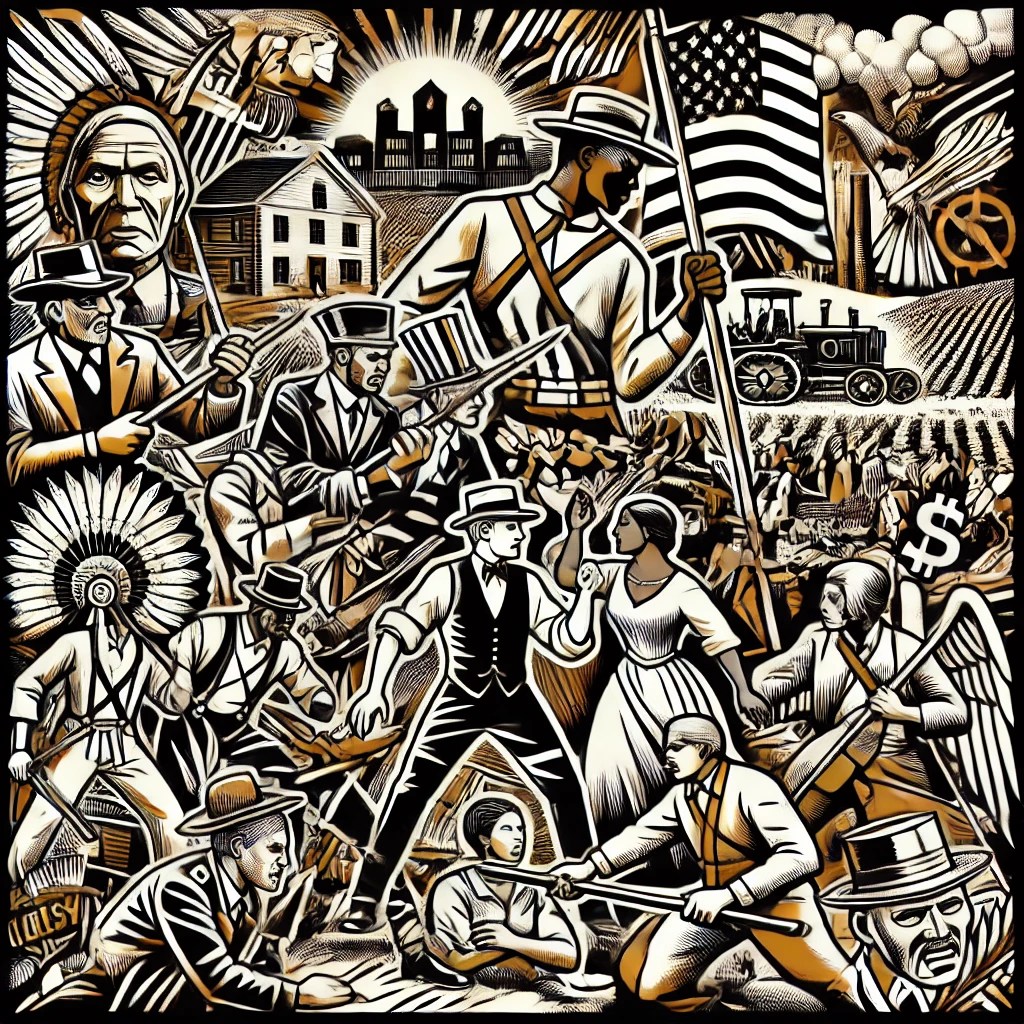
I. How to Build a Settler Nation
Let’s get one thing straight—capitalism in the Americas wasn’t built by hard-working pioneers. It was built by thieves, slavers, and genocidal land-grabbers. But even the ruling class knew they couldn’t do it alone. They needed foot soldiers—a whole population of people willing to fight, kill, and die to defend stolen land and wealth they’d never actually control.
That’s what settler colonialism was about.
Unlike the old European empires, where kings ruled from castles and peasants toiled in the fields, the settler colonies were designed to turn ordinary Europeans into enforcers of empire. It wasn’t just about stealing land or enslaving labor—it was about turning poor Europeans into a new kind of ruling class: a white settler class.
- Give them land, and they’ll fight to keep it.
- Give them wages, and they’ll guard the plantations.
- Give them whiteness, and they’ll protect the ruling class—even when they have nothing.
But here’s the problem: in the beginning, race alone wasn’t enough to keep people divided.
II. The Ruling Class’s Worst Nightmare: Multiracial Rebellion
In the early colonial days, there was no hard line between poor Europeans, enslaved Africans, and Indigenous laborers. Sure, racism existed, but for a while, poor European indentured servants, enslaved Africans, and Native resisters had more in common with each other than they did with the elites.
That was a serious problem for the ruling class.
- Runaway slaves and indentured servants formed rebel communities together.
- Black, Indigenous, and white laborers fought side by side in uprisings against the elites.
- Poor white workers were just as likely to riot against their masters as Black slaves were.
And when that rebellion spread? That’s when the elites knew they had to act.
Take the 1712 New York Slave Revolt. This wasn’t just an act of individual resistance—it was a coordinated rebellion designed to shake the colonial economy itself. Enslaved Africans, alongside some Native allies, set fire to buildings and attacked the property and infrastructure of their oppressors.
This terrified the ruling class—not just because it was violent, but because it was organized.
The colonial authorities responded with extreme brutality—executing dozens of Black and Indigenous rebels, tightening the legal screws on all lower-class laborers, and rewriting the entire social contract of the colonies.
III. Whiteness: The Ruling Class’s Greatest Scam
After the 1712 uprising, colonial governments moved quickly to ensure that poor white workers would never again unite with enslaved or Indigenous people.
They passed new laws that did two things:
- They locked Black people into permanent, hereditary slavery. No more indentured servitude—Black labor was now generational property.
- They bribed poor white workers just enough to keep them loyal. Land grants, wages, and legal protections that Black workers would never get.
This was a racial bribe—a way to make sure poor whites saw themselves as “white” before they saw themselves as workers.
- White workers could own land; Black workers couldn’t.
- White workers could carry weapons; Black workers couldn’t.
- White workers could take their bosses to court; Black workers had no legal standing.
Just like that, class war turned into race war.
IV. How the Settler Economy Became a National Project
Once whiteness was locked in as a class position, the settler economy expanded at full speed.
- Indigenous land was stolen, and white settlers were given “homesteads.”
- Plantations grew, and white workers became overseers, keeping enslaved laborers in check.
- Westward expansion became a racial project, marketed as a “civilizing mission.”
This wasn’t just about keeping rich white people rich—it was about making poor white people feel invested in the system.
- If you were white, you could “go West” and claim land. Never mind that it wasn’t theirs to take.
- If you were white, you could demand wages instead of being enslaved. Never mind that you were still underpaid and expendable.
- If you were white, you could “rise up” in the economy. Never mind that the real wealth stayed in the hands of the ruling class.
V. Why the White Working Class Became an Arm of the State
Even poor white workers, the ones who had nothing, still had one thing: power over Black and Indigenous people.
- They became the first cops—slave patrols made up of poor whites hunting down Black runaways.
- They became the first vigilantes—lynch mobs and settler militias doing the dirty work of white supremacy.
- They became strikebreakers—every time Black and white workers tried to unite, white workers sided with the bosses.
The ruling class bet on this, and for centuries, it worked.
But contradictions were growing. White settlement was expanding so fast that it was creating new conflicts—over slavery, land, and labor.
The settler economy was reaching a breaking point, and soon, the system would be thrown into chaos.
VI. The White Worker’s Contract with Capitalism
By the early 1800s, the foundation of America was set.
- Land would be stolen from Indigenous people.
- Black labor would be permanently enslaved, a colonized proletariat.
- White workers would be given just enough to live a little better and feel superior, but never enough to actually be free.
This wasn’t a temporary arrangement—this was the economic structure of the entire country.
This is where Part 4 picks up: the 19th century, when slavery, genocide, and capitalism collided—leading to the Civil War and the battle over the future of racial capitalism in America.
 Weaponized Information
Leave a comment