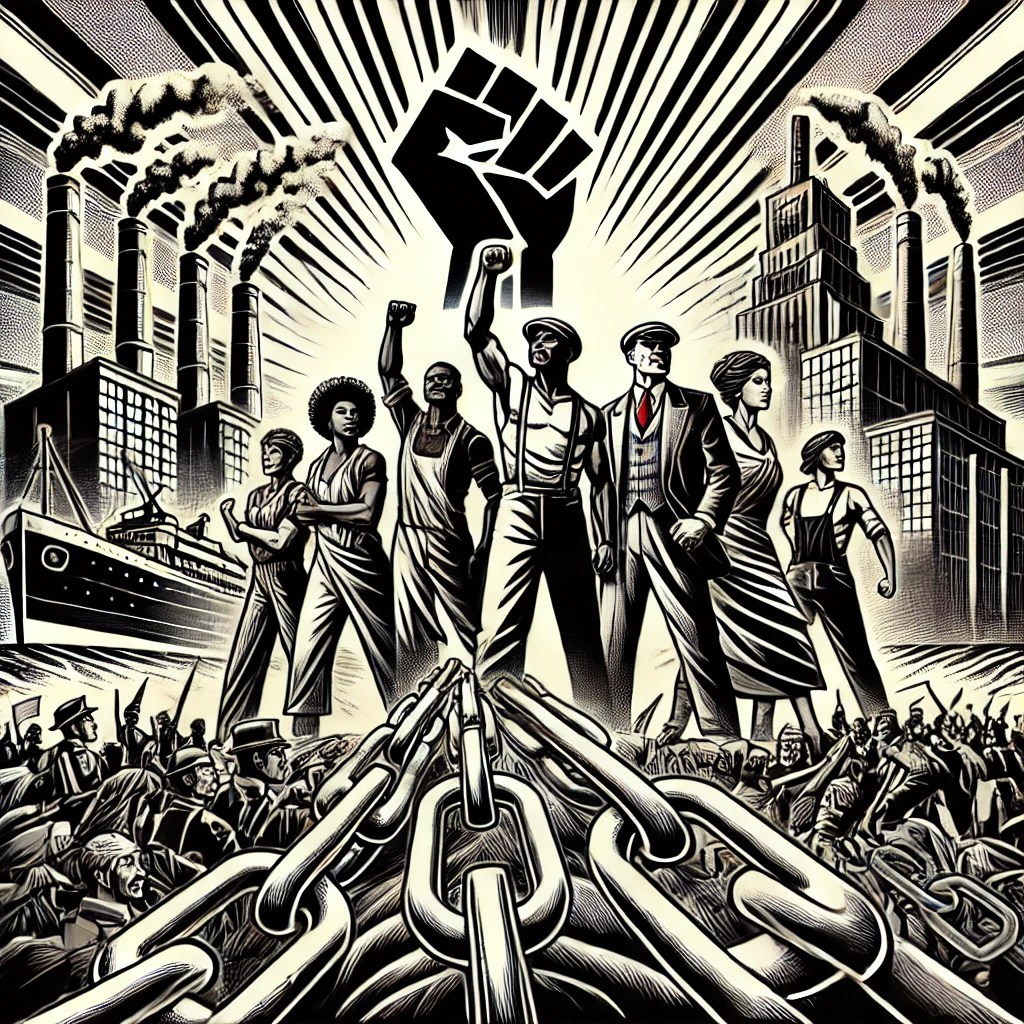
I. Capitalism Was Born in Blood, Not Innovation
Let’s kill the fairy tale before we even start. Capitalism wasn’t born in a marketplace where hardworking merchants shook hands over fair deals. It didn’t emerge from a bunch of enlightened Europeans who figured out a smarter way to do business. It was born in the belly of warships, built on the backs of enslaved people, and sharpened into existence by the swords of genocidal conquistadors and the cutlasses of European pirates.
This system didn’t rise out of feudalism naturally, like the sun setting on the Middle Ages and rising into a new, more efficient economy. It was ripped from the earth, forced into existence through mass slaughter, land theft, maritime piracy, and human trafficking on a scale so massive that entire continents were permanently altered.
What the ruling class calls the “birth of capitalism” was actually a global crime scene. The corpse of feudalism wasn’t left to decay on its own—it was hacked apart by European empires and their cutthroat profiteers, who realized there was an easier way to build wealth than waiting for peasants to pay rent.
And so, Europe turned outward—not to explore, not to trade, but to steal, kill, and enslave.
This is the true history of capitalism:
The attack on Africa and the beginning of the transatlantic slave trade.
The conquest of the Americas and the mass extermination of Indigenous peoples.
The rise of European piracy as a direct tool of capitalist accumulation, raiding the Indian Ocean trade networks and disrupting centuries-old commerce.
The creation of the first global racial labor hierarchy, which determined who would be masters and who would be permanent workers.
This is where modern capitalism comes from. Not industry. Not ingenuity. But conquest, plunder, piracy, and racial terror.
II. The End of Feudalism and the Birth of a New Kind of Plunder
Before capitalism, Europe was trapped in a dead-end economy. Feudalism had run its course. The land was divided up between kings, nobles, and the Church, and the peasants were locked in a cycle of subsistence farming, paying their lords in crops and labor while living in permanent poverty.
But Europe had a problem: it was broke. The aristocracy was bleeding itself dry through endless wars, and the peasantry, constantly revolting, was more of a burden than a reliable workforce.
Something had to give.
The ruling class had two choices:
1. Redistribute land and wealth, giving peasants better conditions.
2. Find a new source of wealth outside of Europe, something they could exploit without having to share.
Guess which one they chose?
The birth of capitalism wasn’t about efficiency—it was about looting on a global scale.
The Portuguese began raiding Africa’s west coast in the 1400s, stealing people, gold, and resources.
The Spanish stumbled into the Americas in 1492 and realized there was an entire world they could kill their way into owning.
The British and Dutch built massive naval fleets—not for trade, but for war, conquest, and enslavement.
But before they could dominate global trade, they had to break the world’s existing economic order.
III. Piracy, Theft, and the European Hijacking of the Global Economy
Before the European conquest of the Americas, the wealth of the world was not centered in Europe. The major hubs of trade, production, and innovation were in China, India, the Middle East, and East Africa.
For centuries, these regions had been tied together by a vast Indian Ocean trading network, linking the wealthy commercial centers of Asia, the Swahili Coast, the Ottoman Empire, and the Islamic world in a sophisticated system of economic exchange. The ships that carried silk, spices, gold, and precious goods weren’t flying European flags—they were Arab dhows, Indian junks, and Chinese treasure ships.
Europe had nothing to offer in return—it was an economic backwater. But rather than compete in this trade, Europeans decided to rob it.
The Portuguese were the first European pirates of the Indian Ocean, seizing key trading ports along the Swahili Coast, looting ships, and establishing brutal naval blockades that disrupted centuries of commerce.
The Dutch followed, using piracy to break into the spice trade, looting rival ships and massacring local merchants.
Figures like Sir Francis Drake, operating under Queen Elizabeth I, raided Spanish treasure fleets and sacked colonial ports like Cartagena in 1586, seizing massive amounts of silver and gold stolen from Indigenous and African labor.
These acts of state-backed piracy were more than opportunistic theft; they were part of a broader imperial strategy, a way for rising European powers to stake their claim in a global system already shaped by colonial exploitation.
Wherever they went, European powers didn’t create trade—they violently disrupted existing networks, using warships and piracy to monopolize wealth that had previously been distributed across Asia, Africa, and the Middle East.
This was capitalism’s first great innovation: armed robbery on a global scale.
IV. The African Holocaust and the Construction of Racial Slavery
The transatlantic slave trade wasn’t just a business. It was the economic engine that built the modern world.
Europe didn’t just buy slaves from Africa—it launched an all-out war against the continent, ripping millions of people from their homes, destroying entire civilizations, and turning human beings into raw capital.
Between 12 and 15 million Africans were kidnapped and sold into chattel slavery.
European slave traders made profits so obscene that entire banking systems were built on financing slave voyages.
The plantation economies of the Americas—sugar, cotton, tobacco—became the first great capitalist enterprises, built on stolen land and stolen labor.
And what did this do for Europe?
It funded the Industrial Revolution. The factories in England and France weren’t built on “entrepreneurship.” They were built because slavery produced so much wealth that Europe could afford to mechanize production.
It created the first global class system based on race. Whiteness became the passport to power, and Blackness became synonymous with forced labor.
It made European nations superpowers, while keeping Africa and the Americas in permanent devastation.
Capitalism, from its very inception, was a racialized economic order. Race wasn’t an afterthought—it was the organizing principle.
V. The European Attack on the World Never Stopped
This isn’t ancient history. The capitalist world system we live in is still the same one that was built through the transatlantic slave trade, piracy, and colonial conquest.
The banks that financed slavery are still the biggest financial institutions in the world.
The countries that grew rich off stolen land and stolen labor still dominate the global economy.
The racial hierarchy that capitalism created is still enforced, not by slave chains, but by police, prisons, borders, and economic warfare.
Capitalism didn’t evolve past racial exploitation—it perfected it.
And the U.S.? It became the empire that Europe always wanted to be.
This is where Part 3 picks up—how the U.S. transformed the European model of racial capitalism into an even deadlier machine, one where the white working class was manufactured to serve as a permanent settler class, defending the system instead of fighting it.
The story of capitalism is the story of war. And the first shots were fired when Europe decided that the world was theirs to own.
 Weaponized Information
Leave a comment