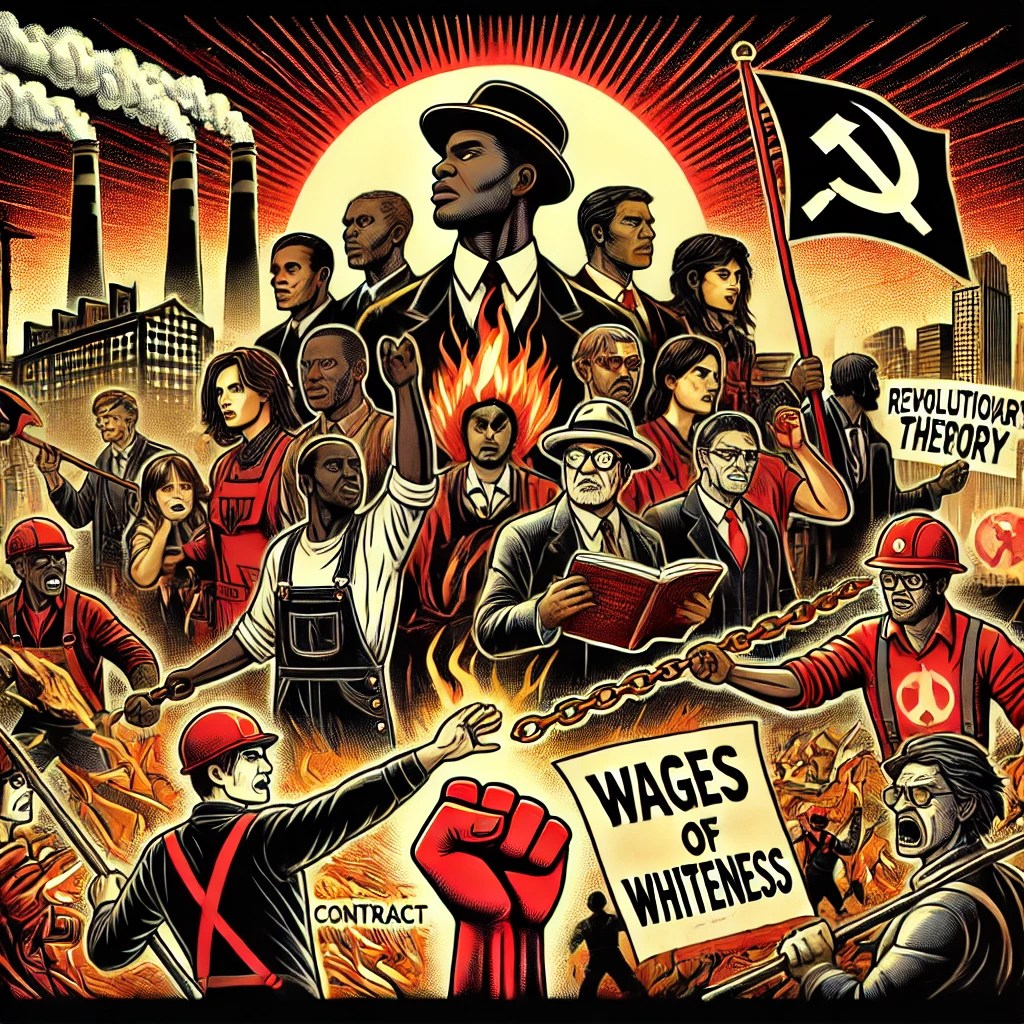
I. The Urgency of Clarifying Race and Class in 2025
Welcome to America, 2025: a nation in decline, clinging to its illusions like a drowning man grasping at air. The economy is collapsing, the empire is fracturing, and the ruling class is responding the only way it knows how—by tightening the screws of repression and flooding the media with propaganda designed to keep the people confused, divided, and afraid.
Turn on the news and you’ll hear two dominant, but equally useless, narratives about race and class.
On one side, liberal politicians and corporate executives will tell you that America’s racial problems can be solved with a few more diversity hires, some rainbow capitalism, and maybe a Black woman CEO at Goldman Sachs. The problem, they say, isn’t capitalism itself—it’s just a matter of “inclusion” and “equity” within the capitalist system. This is how you end up with oil companies sponsoring Juneteenth events and defense contractors boasting about their LGBTQ-friendly workplace policies while bombing civilians in the Global South.
On the other side, class reductionists—mostly white, mostly male, mostly obsessed with proving they “don’t see color”—will insist that race is just a distraction from the “real” struggle. They’ll tell you that if we could all just forget about slavery, colonialism, and genocide for a moment, we’d see that everyone is just a worker and that the solution is a vague call for “class unity.” They’ll tell you that the white working class in America is just as exploited as a Bangladeshi sweatshop worker or a Congolese miner working under the barrel of a gun.
Both of these positions are wrong. And not just wrong—actively dangerous. Because they both erase how capitalism actually works.
Race is not some historical accident, some cultural phenomenon, or some psychological bias. It is a structure of class rule. It was created and weaponized to divide the working class, secure imperial domination, and ensure that the wealth of the world remained in the hands of a tiny elite.
This series, Race/Class 101, will dismantle these illusions and provide a materialist, historical, and revolutionary analysis of how race and class developed together, how they continue to function in the capitalist world system, and why any serious movement for socialism must take them both into account.
II. Why Race and Class Cannot Be Separated in U.S. and Global History
Let’s make one thing very clear: capitalism was never some neutral economic system that just so happened to have racial disparities. Capitalism was built on race.
It didn’t emerge from the polite debates of European philosophers. It wasn’t born from the “Protestant work ethic” or some miraculous burst of innovation. It was hammered into existence on the decks of slave ships, in the killing fields of the Caribbean plantations, in the bones of massacred Indigenous peoples, and through the systematic plunder of Africa, Asia, and Latin America.
The first capitalists weren’t self-made entrepreneurs. They were genocidal warlords, slave traders, and colonial administrators who discovered that the easiest way to extract wealth was through mass death. The transatlantic slave trade wasn’t a side effect of capitalism—it was capitalism in its most brutal, undiluted form.
And here’s the part that makes liberals squirm: race didn’t create this system. The system created race.
Before slavery, there were no “white” people and no “Black” people in the way we understand them today. There were just different nations, different tribes, different cultures. It was only when the ruling class needed a way to divide the exploited that they invented whiteness—a category of privilege to buy the loyalty of European workers, ensuring that they would side with the slave masters rather than the enslaved.
This is the true, material function of race: to structure and enforce class rule, to ensure that some laborers could be super-exploited while others were given just enough privilege to make them identify with the ruling class instead of their fellow workers.
This is why any movement that tries to ignore race while talking about class is doomed to fail.
III. The Failure of Liberal Identity Politics and Class Reductionism
We live in an age where “diversity” has become a billion-dollar industry. Until recently, every major corporation had a Chief Diversity Officer. Every university offers an endless supply of anti-racism training sessions. Every politician, no matter how racist their policies, has a Black or Latino staffer on hand to tweet about their commitment to equity.
This is the world of liberal identity politics—where the goal is not to dismantle racial capitalism but to make sure it’s run by a diverse group of CEOs, landlords, and prison wardens.
Of course, the class reductionists are no better. Their solution is to ignore race altogether, pretending that centuries of colonial exploitation can be erased with a single cry of “workers of the world, unite!”
But history tells a different story.
When white workers had the chance to unite with Black and Indigenous people to overthrow the plantation system, they sided with the slave masters instead. When labor unions had the chance to fight segregation, most chose to exclude Black workers and preserve white job security. When the socialist movement could have embraced national liberation, too many of its leaders saw it as a “distraction” from “real” class struggle.
This isn’t some unfortunate accident. It’s how the system was designed to function.
IV. The Roadmap of this Series: From Colonial Conquest to Technofascism
So, how did we get here?
How did capitalism go from plantation slavery to digital surveillance? How did the old slave patrols transform into the modern police force? How did the imperial conquests of the 19th century evolve into drone warfare, economic sanctions, and corporate data mining?
This series will break it down step by step.
1. How Capitalism Was Born in Slavery and Colonial Plunder
The attack on Africa and Indigenous genocide as the foundations of capitalist accumulation.
How race was constructed to justify forced labor and economic domination.
2. The Construction of Whiteness and the Settler-Colonial State
The legal codification of white supremacy to divide the working class.
How land ownership and job security were weaponized to maintain white working-class loyalty to capitalism.
3. Imperialism and the Racial Division of Global Labor
How European and U.S. imperialism structured the modern economy along racial lines.
The emergence of the white labor aristocracy as a stabilizing force for capitalism.
4. From the Civil Rights Struggle to Neoliberal Counterinsurgency
How the Black liberation struggle threatened capitalist rule.
The rise of COINTELPRO, mass incarceration, and the drug war as tools to contain revolution.
5. Technofascism and the Digital Plantation
How surveillance, AI, and algorithmic discrimination have created a new form of racialized economic control.
The role of Big Tech in enforcing and managing capitalist rule.
V. Setting the Terms of the Debate
This series isn’t about empty rhetoric or abstract theory. It’s about weaponized information—the kind of knowledge that arms people for revolutionary struggle.
The ruling class has spent centuries perfecting the art of propaganda. They know that as long as people remain confused about race and class, capitalism will survive.
That ends here.
This series will break through the lies, expose the contradictions, and lay the foundation for a revolutionary movement that understands the full picture of capitalism’s racial class structure.
No more illusions. No more false debates. Only the cold, hard truth—and the strategy to overthrow the system.
Stay tuned.
 Weaponized Information
Leave a comment